PROBLEMA n. 1 – Tre Cilindri molto scivolosi (100 Punti)
Quesito n. 1.
La figura qui sotto rappresenta il sistema di forze agenti sui tre cilindri identificati come n. 1, 2 e 3: ad essa si fa riferimento per i simboli.
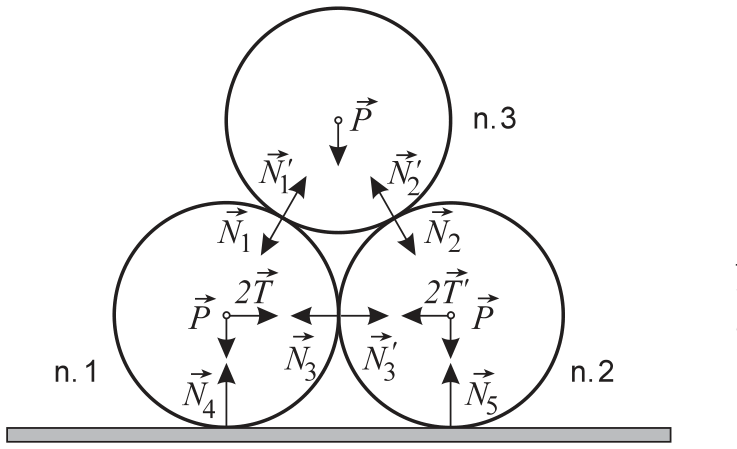 NOTA: per motivi di chiarezza le intensità delle forze in questa figura non sono riprodotte in scala.
Nelle figure seguenti sono mostrati i diagrammi di corpo libero dei cilindri n.3 e n.1 (quello per il cilindro n.2 è simmetrico del secondo). Le forze e e le loro reazioni, e (che, per il terzo principio della dinamica, sono rispettivamente uguali in modulo alle prime, con verso opposto) sono inclinate di sul piano orizzontale dato che il triangolo che ha per vertici i centri delle sezioni circolari dei cilindri in contatto tra loro è chiaramente equilatero; ne segue che le loro proiezioni, orizzontale e verticale, si ottengono moltiplicando i moduli rispettivamente per e .
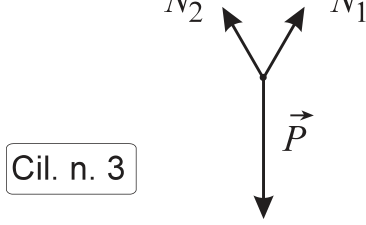 Detto il peso di ogni cilindro, le condizioni di equilibrio del cilindro n.3, tenendo conto che per simmetria , portano all’equazione seguente, relativa alla componente verticale delle forze
Quindi
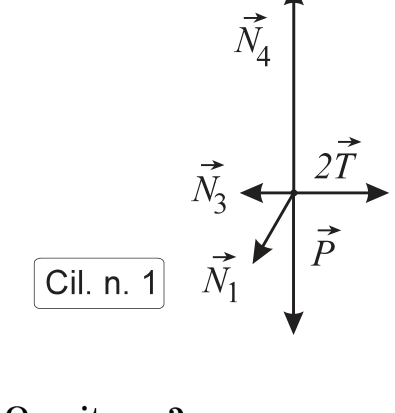 Per l’equilibrio del sistema basta studiare il cilindro n. 1 essendo il sistema di forze equivalente a quello del cilindro n. 2. La condizione di equilibrio per traslazioni orizzontali è sufficiente per determinare la tensione in ciascuna delle due corde.
Il valore minimo di si ha per per cui
Topic: Rigid Body Statics, Newtonian Mechanics Metodi: Free-Body Diagram, Vector Decomposition, Symmetry Argument Competenze: Diagrammatic Reasoning, Mathematical Modeling, Physical Reasoning Objects: Cylinder, String Fonte: Testo (PDF) — p.1 Soluzione: Soluzioni (PDF)
PROBLEM no. 1 – Three Very Slippery Cylinders (100 Points)
Question no. 1.
The figure below shows the system of forces acting on the three cylinders labeled as no. 1, 2 and 3: its symbols are referred to in the following.
NOTE: for clarity reasons, the magnitudes of the forces in this figure are not drawn to scale.
The following figures show the free-body diagrams for cylinder no. 3 and cylinder no. 1 (the diagram for cylinder no. 2 is symmetric to the second one). The forces and , and their reactions, and (which, by the third law of dynamics, are respectively equal in magnitude to the first ones and opposite in direction), are inclined at with respect to the horizontal plane because the triangle whose vertices are the centers of the circular cross-sections of the cylinders in contact with each other is clearly equilateral; it follows that their horizontal and vertical components are obtained by multiplying the magnitudes respectively by and .
Let be the weight of each cylinder. The equilibrium conditions for cylinder no. 3, taking into account that by symmetry , lead to the following equation, related to the vertical component of the forces
Therefore
For equilibrium of the system it is sufficient to study cylinder no. 1, since the force system is equivalent to that of cylinder no. 2. The condition for equilibrium in horizontal translations is sufficient to determine the tension in each of the two strings.
The minimum value of occurs for , so that
Solution: Soluzioni (PDF)
Quesito n. 2.
In assenza di attrito, poiché le rette d’azione di tutte le forze presenti tra i cilindri e tra il piano e i cilindri intersecano gli assi di ciascun cilindro, tutti i momenti assiali sono nulli; se dunque inizialmente i cilindri sono in quiete, non si avrà nessun moto rotatorio: i tre cilindri traslano senza rotolare.
Poiché si assume che il sistema accelerato non collassi, esso si muove rigidamente e dunque, per il secondo principio, l’accelerazione può essere subito determinata essendo .
Si considerano poi le equazioni di moto, separatamente per ciascun cilindro (per i simboli fare riferimento ai relativi diagrammi di corpo libero), come segue. Rispetto al caso statico studiato prima, il sistema di forze non è più simmetrico: adesso le reazioni vincolari non hanno lo stesso modulo, mentre, per il principio di azione e reazione, resta vero che , , .
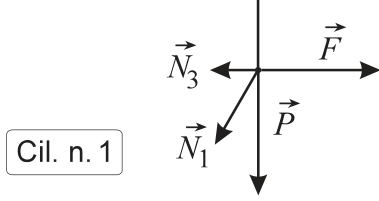 Per il cilindro n. 1
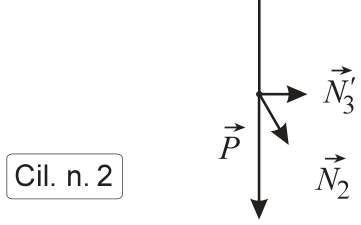 Per il cilindro n. 2
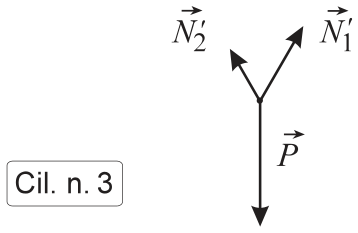 Per il cilindro n. 3
L’insieme delle 6 equazioni costituiscono un sistema nelle incognite ed . Quest’ultima, anche senza la considerazione fatta sopra, si sarebbe potuta trovare sommando membro a membro le tre equazioni relative alle componenti orizzontali del moto (le prime di ogni coppia), per cui si può sostituire
Il sistema di forze sul cilindro n. 3 consente di ricavare e . Risolvendo il sistema, infatti, si trova
Una prima condizione su si ottiene allora osservando che il sistema non collassa se risulta . Da qui si ricava .
La seconda condizione su si ottiene dalle equazioni del moto di uno degli altri due cilindri. In particolare, dall’equazione della componente orizzontale del moto del cilindro n. 2, si ricava
Anche in questo caso deve essere . Da qui si ricava .
In conclusione, il sistema non collassa se viene accelerato nel modo descritto da una forza tale che
PROBLEMA n. 2 – Tri-ciclo … termodinamico (35 Punti)
Il rendimento di una macchina termica è dato dal rapporto tra il lavoro netto scambiato nel ciclo e il calore assorbito. Il lavoro si calcola come segue.
Nell’isoterma quasi statica 1–2, essendo , il lavoro è dato da:
Nel raffreddamento isobaro quasi statico 2–3, tenendo conto del fatto che e , il lavoro è:
Infine, nell’isocora 2–3, il lavoro è nullo. Il lavoro netto del ciclo risulta quindi:
Si calcola ora il calore assorbito nel ciclo: il sistema assorbe calore nell’espansione isoterma 1–2 e nel riscaldamento isocoro 3–1.
Nell’espansione isoterma, poiché l’energia interna di un gas perfetto dipende solo dalla temperatura, , e dunque .
Nel riscaldamento isocoro, , e dunque .
Poiché il gas è monoatomico, e risulta
Dall’equazione di stato dei gas perfetti, tenendo conto che il volume non varia, si ha e dunque
In definitiva:
Infine il rendimento risulta:
Topic: Thermodynamics Metodi: Thermodynamic Cycle Analysis, First Law of Thermodynamics, Ideal Gas Law, Calculus-Integration Competenze: Mathematical Modeling, Physical Reasoning Objects: Gas, Heat Engine Fonte: Testo (PDF) — p.2 Soluzione: Soluzioni (PDF)
Question no. 2.
In the absence of friction, since the lines of action of all forces present between the cylinders and between the plane and the cylinders intersect the axes of each cylinder, all axial torques are zero; therefore, if initially the cylinders are at rest, no rotational motion will occur: the three cylinders translate without rolling.
Since it is assumed that the accelerated system does not collapse, it moves rigidly and thus, by Newton’s second law, the acceleration can be immediately determined as being .
The equations of motion are then considered separately for each cylinder (for the symbols, refer to the corresponding free-body diagrams), as follows. Compared to the static case studied previously, the force system is no longer symmetric: now the constraint reactions do not have the same magnitude, while, by Newton’s third law, it remains true that , , .
For cylinder no. 1
For cylinder no. 2
For cylinder no. 3
The set of six equations constitutes a system in the unknowns and . The latter could have been found even without the consideration above by summing term by term the three equations relative to the horizontal components of motion (the first in each pair), so that may be substituted.
The force system on cylinder no. 3 allows and to be determined. Indeed, solving the system yields
A first condition on is thus obtained by observing that the system does not collapse if . From this, it follows that .
The second condition on is obtained from the equations of motion of one of the other two cylinders. In particular, from the horizontal component equation of motion for cylinder no. 2, one obtains
In this case too, it must be . From here, one obtains .
In conclusion, the system does not collapse if it is accelerated in the manner described by a force such that
PROBLEM no. 2 – Tri-cycle … thermodynamic (35 Points)
The efficiency of a heat engine is given by the ratio between the net work exchanged in the cycle and the heat absorbed. The work is calculated as follows.
In the quasi-static isothermal process 1–2, since , the work is given by:
In the quasi-static isobaric cooling process 2–3, taking into account that and , the work is:
Finally, in the isochoric process 2–3, the work is zero. The net work of the cycle thus results in:
The heat absorbed in the cycle is now computed: the system absorbs heat during the isothermal expansion 1–2 and during the isochoric heating 3–1.
During the isothermal expansion, since the internal energy of an ideal gas depends only on temperature, , and thus .
During the isochoric heating, , and thus .
Since the gas is monatomic, , and one obtains
From the ideal gas equation of state, taking into account that volume does not change, one has , and thus
In conclusion:
Finally, the efficiency is:
Solution: Soluzioni (PDF)
PROBLEMA n. 3 – Prove di elasticità (100 Punti)
Topic: Elasticity & Materials Metodi: Physical Modeling, Stress-Strain Analysis Competenze: Physical Reasoning Objects: Atom Fonte: Testo (PDF) — p.4 Soluzione: Soluzioni (PDF)
PROBLEM no. 3 – Elasticity Tests (100 Points)
Solution: Soluzioni (PDF)
Quesito n. 1.
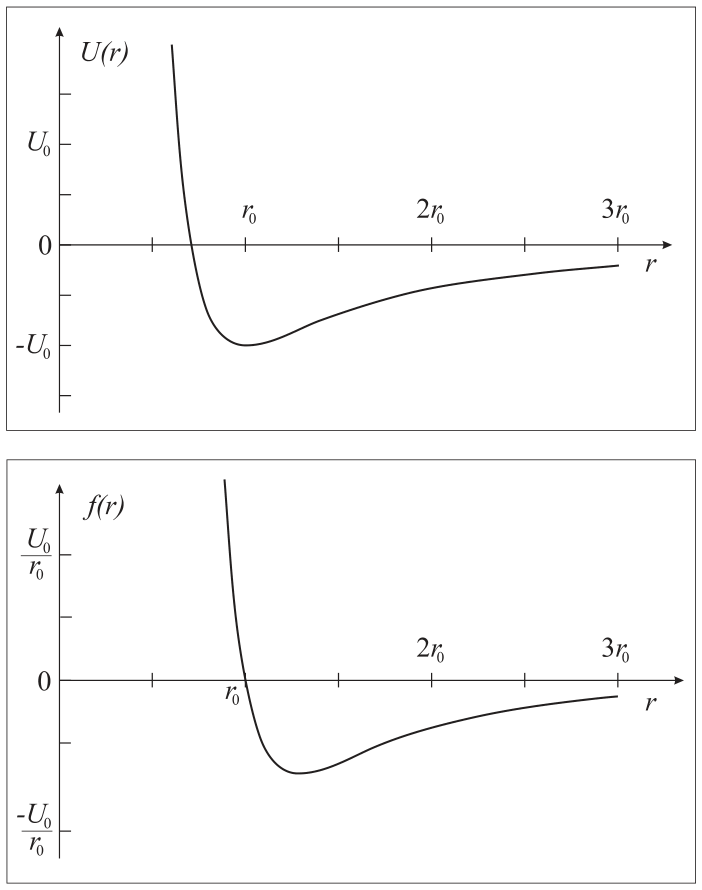
Si riportano qui a fianco i grafici richiesti. Quello dell’energia potenziale può essere tracciato – in modo qualitativo – calcolando direttamente la funzione per una decina di valori del rapporto , oppure disegnando separatamente i due rami iperbolici ( e ) e valutando “graficamente” la differenza, o ancora con uno studio semplificato di funzione (casi limite, asintoti, massimi e minimi). Dalla definizione di differenza di energia potenziale, come l’opposto del lavoro della forza al variare della distanza , che per spostamenti infinitesimi si scrive , si può dedurre la relazione inversa che serve in questo caso per determinare la forza interatomica:
Il grafico della forza si può quindi ottenere semplicemente considerando la derivata, cioè osservando nel primo grafico la pendenza e i punti di minimo e di flesso, o altrimenti si può utilizzare l’espressione esplicita della forza, in analogia con quanto fatto con quello dell’energia.
Topic: Elasticity & Materials, Newtonian Mechanics Metodi: Calculus-Integration, Energy Conservation Method, Physical Modeling Competenze: Mathematical Modeling, Diagrammatic Reasoning, Physical Reasoning Objects: Atom Fonte: Testo (PDF) — p.4 Soluzione: Soluzioni (PDF)
Question no. 1.
The requested graphs are reported here alongside. The graph of the potential energy can be sketched – in a qualitative way – by directly computing the function for about ten values of the ratio , or by drawing separately the two hyperbolic branches ( and ) and evaluating “graphically” their difference, or alternatively by a simplified function analysis (limit cases, asymptotes, maxima and minima). From the definition of potential energy difference, as the opposite of the work done by the force when varying the distance , which for infinitesimal displacements is written as , the inverse relation needed in this case to determine the interatomic force can be deduced:
The force graph can therefore be obtained simply by considering the derivative, that is, observing in the first graph the slope and the points of minimum and inflection, or alternatively by using the explicit expression of the force, in analogy with what was done for the potential energy graph.
Solution: Soluzioni (PDF)
Quesito n. 2.
Da quanto sopra si evince che per l’energia potenziale ha un minimo, e la forza è nulla. Questa è pertanto la distanza di equilibrio (stabile). Nell’espressione precedente della forza il primo termine è repulsivo e il secondo è attrattivo; siccome il primo termine è maggiore del secondo in valore assoluto quando , l’interazione è repulsiva per e attrattiva per . In condizioni di equilibrio l’energia potenziale interatomica è . In un modello più realistico gli esponenti sarebbero più alti, ma il modello è stato qui scelto in modo da essere facilmente trattabile.
Topic: Elasticity & Materials, Newtonian Mechanics Metodi: Energy Conservation Method, Physical Modeling Competenze: Physical Reasoning, Mathematical Modeling Objects: Atom Fonte: Testo (PDF) — p.4 Soluzione: Soluzioni (PDF)
Question no. 2.
From the above it follows that for the potential energy has a minimum, and the force is zero. This is therefore the equilibrium distance (stable).
In the previous expression for the force, the first term is repulsive and the second is attractive; since the first term has a greater absolute value than the second when , the interaction is repulsive for and attractive for . Under equilibrium conditions, the interatomic potential energy is .
In a more realistic model, the exponents would be higher, but the model has been chosen here to be easily manageable.
Solution: Soluzioni (PDF)
Quesito n. 3.
A seguito dell’applicazione di una forza esterna, il cristallo si deforma spostandosi dalla condizione di equilibrio, ed ogni distanza interatomica nella direzione della forza passa da a (nelle direzioni ortogonali alla forza la distanza interatomica rimane perché non ci sono interazioni coi secondi vicini). In tal modo si esercita una forza che bilancia complessivamente quella esterna.
Per studiare le piccole deformazioni si ponga con ; si trascurano poi i termini in rispetto a quelli in . La forza diviene
e sviluppando i binomi di Newton a denominatore e fermandosi al prim’ordine in , si ha
Nello stesso ordine di approssimazione si può scrivere che
Si poteva giungere a questa espressione anche in un solo passo essendo, con .
Si ottiene quindi
Ogni legame viene allungato di una quantità nella direzione di applicazione della forza esterna, quindi . Le forze interne si bilanciano, e rimangono le forze esterne al bordo del cristallo, che si sommano in proporzione al numero di legami per unità di superficie; essendo ed si ha
Sostituendo i valori numerici e ricordando che , si ha . L’ordine di grandezza ottenuto è ragionevole (per l’acciaio è ).
Topic: Elasticity & Materials Metodi: Approximation & Series Expansion, Stress-Strain Analysis, Physical Modeling Competenze: Mathematical Modeling, Physical Reasoning Objects: Atom Fonte: Testo (PDF) — p.5 Soluzione: Soluzioni (PDF)
Question no. 3.
Following the application of an external force, the crystal deforms moving away from equilibrium, and each interatomic distance in the direction of the force changes from to (in directions orthogonal to the force, the interatomic distance remains because there are no interactions with second neighbors). In this way, a force is exerted that balances the external one overall.
To study small deformations, let with ; then terms in are neglected compared to those in . The force becomes
and expanding the binomials in the denominator to first order in , one obtains
In the same order of approximation, one can write that
One could have reached this expression in a single step, since with .
One thus obtains
Each bond is stretched by an amount in the direction of application of the external force, so that . The internal forces balance each other, and only the external forces at the edge of the crystal remain, which add up in proportion to the number of bonds per unit area; since and , one has
Substituting numerical values and remembering that , one obtains . The order of magnitude obtained is reasonable (for steel it is ).
Solution: Soluzioni (PDF)
Quesito n. 4.
Per trovare le condizioni di rottura, si può osservare che per valori molto grandi di la forza tende a zero, per cui occorre trovare quando l’intensità della forza interatomica attrattiva ha un massimo in funzione di : al di là non può più compensare la forza esterna e il cristallo si spezza. Questa condizione si ha quando
La deformazione, o allungamento relativo, in queste condizioni è
Naturalmente questo valore non è realistico perché un solido reale contiene sempre impurezze che ne determinano la rottura prima.
Topic: Elasticity & Materials Metodi: Calculus-Integration, Physical Modeling, Approximation & Series Expansion Competenze: Mathematical Modeling, Physical Reasoning Objects: Atom Fonte: Testo (PDF) — p.5 Soluzione: Soluzioni (PDF)
Question no. 4.
To find the conditions for fracture, one can observe that for very large values of the force tends to zero, so it is necessary to determine when the magnitude of the attractive interatomic force reaches a maximum as a function of : beyond this point it can no longer compensate the external force and the crystal breaks. This condition occurs when
The deformation, or relative elongation, under these conditions is
Of course, this value is not realistic because a real solid always contains impurities that cause its fracture earlier.
Solution: Soluzioni (PDF)
Quesito n. 5.
A questo punto per ottenere lo sforzo di rottura basta sostituire nella formula di e poi ricordare che lo sforzo è .
Si ottiene quindi
e in ultima analisi
Anche questo valore non è realistico per la stessa ragione precedente (per l’acciaio è 50 volte meno, ma l’acciaio non è cristallino).
Topic: Elasticity & Materials Metodi: Stress-Strain Analysis, Physical Modeling Competenze: Mathematical Modeling, Physical Reasoning Objects: Atom, Capacitor Fonte: Testo (PDF) — p.6 Soluzione: Soluzioni (PDF)
Question no. 5.
At this point, to obtain the breaking stress it is sufficient to substitute into the formula for , and then remember that the stress is .
One thus obtains
and ultimately
This value is also unrealistic for the same reason as before (for steel it is 50 times smaller, but steel is not crystalline).
Solution: Soluzioni (PDF)
PROBLEMA n. 4 – Condensatori sempre più piccoli (65 Punti)
Quesito n. 1.
In un condensatore sferico, detta la carica distribuita uniformemente sul conduttore interno di raggio , il campo tra le armature si determina applicando il teorema di Gauss(*)
e la d.d.p. tra le armature, direttamente dalla definizione, essendo il raggio del conduttore sferico esterno.
Si ricava quindi la capacità
Ponendo adesso e con si ottiene
che coincide appunto con l’espressione della capacità di un condensatore piano nel vuoto.
Topic: Electrostatics Metodi: Gauss’s Law, Electric Potential Method, Approximation & Series Expansion Competenze: Mathematical Modeling, Physical Reasoning Objects: Capacitor Fonte: Testo (PDF) — p.6 Soluzione: Soluzioni (PDF)
PROBLEM no. 4 – Smaller and smaller capacitors (65 Points)
Question no. 1.
In a spherical capacitor, denoting by the charge uniformly distributed on the inner conductor of radius , the electric field between the plates is determined by applying Gauss’s theorem(*)
and the potential difference between the plates, directly from the definition, being the radius of the outer spherical conductor.
The capacitance is therefore obtained as
Now setting and with , one obtains
which precisely coincides with the expression for the capacitance of a parallel-plate capacitor in vacuum.
Solution: Soluzioni (PDF)
Quesito n. 2.
La capacità del condensatore e la tensione di lavoro sono date da
Posto da cui
per cui, eliminando , si ottiene
(*) Il simbolo indica che l’integrale di superficie viene calcolato su una superficie chiusa, in questo caso una sfera di raggio .
Topic: Electrostatics Metodi: Electric Potential Method, Physical Modeling Competenze: Mathematical Modeling, Physical Reasoning Objects: Capacitor Fonte: Testo (PDF) — p.6 Soluzione: Soluzioni (PDF)
Question no. 2.
The capacitance of the capacitor and the operating voltage are given by
Given , from which
therefore, eliminating , one obtains
(*) The symbol indicates that the surface integral is computed over a closed surface, in this case a sphere of radius .
Solution: Soluzioni (PDF)
Quesito n. 3.
Dall’espressione precedente si deduce che per ottenere il volume minimo, a parità di capacità e tensione massima di lavoro, occorre massimizzare il prodotto . Dall’analisi della tabella che segue si ricava che tra i materiali citati quello che consente di realizzare condensatori più piccoli è la mica.
| Materiale | [kV/mm] | [10 V/m] | |
|---|---|---|---|
| 1. Carta paraffinata | 2.5 | 50 | 6.25 |
| 2. Ceramica | 60 | 15 | 13.5 |
| 3. Mica | 8 | 90 | 64.8 |
| 4. Polistirolo | 2.6 | 50 | 6.50 |
| 5. Porcellana | 6 | 25 | 3.75 |
| 6. Resina epossidica | 4 | 35 | 4.90 |
| 7. Teflon | 2.2 | 20 | 0.88 |
Topic: Electrostatics Metodi: Physical Modeling, Experimental Data Analysis Competenze: Physical Reasoning, Mathematical Modeling Objects: Capacitor Fonte: Testo (PDF) — p.7 Soluzione: Soluzioni (PDF)
Question no. 3.
From the previous expression it follows that, for a given capacity and maximum operating voltage, to achieve the minimum volume one must maximize the product . From the analysis of the following table it is found that, among the materials mentioned, mica allows for the realization of smaller capacitors.
| Material | [kV/mm] | [10 V/m] | |
|---|---|---|---|
| 1. Paraffined paper | 2.5 | 50 | 6.25 |
| 2. Ceramic | 60 | 15 | 13.5 |
| 3. Mica | 8 | 90 | 64.8 |
| 4. Polystyrene | 2.6 | 50 | 6.50 |
| 5. Porcelain | 6 | 25 | 3.75 |
| 6. Epoxy resin | 4 | 35 | 4.90 |
| 7. Teflon | 2.2 | 20 | 0.88 |
Soluzione: Soluzioni (PDF)
Quesito n. 4.
Invertendo la relazione precedente si trova
Appare ragionevole che il condensatore sia ceramico, dato che utilizzando la mica avrebbe potuto essere ancora più piccolo.
Materiale prodotto dal gruppo
Segreteria Olimpiadi Italiane della Fisica presso Liceo Scientifico “U. Morin” VENEZIA MESTRE fax: 041.584.1272 e-mail: olifis@libero.it
Topic: Electrostatics Metodi: Physical Modeling, Experimental Data Analysis Competenze: Physical Reasoning, Mathematical Modeling Objects: Capacitor Fonte: Testo (PDF) — p.7 Soluzione: Soluzioni (PDF)
Question no. 4.
Inverting the previous relation, one finds
It seems reasonable that the capacitor is ceramic, since using mica it could have been even smaller.
Material produced by the group
Secretariat of the Italian Physics Olympiad
at Liceo Scientifico “U. Morin”
VENEZIA MESTRE
fax: 041.584.1272
e-mail: olifis@libero.it
Solution: Soluzioni (PDF)