PROBLEMA n. 1 – Viaggio in galleria (90 Punti)
Quesito n. 1.
Nel caso elettrostatico, dal Teorema di Gauss, si ottiene che il campo interno alla distribuzione uniforme di carica negativa vale
In analogia avremo
dove è il raggio della Terra e l’accelerazione di gravità standard (a livello del mare).
Topic: Gravitation, Electrostatics Metodi: Gauss’s Law, Physical Modeling, Symmetry Argument Competenze: Physical Reasoning, Mathematical Modeling Objects: Planet Fonte: Testo (PDF) — p.1 Soluzione: Soluzioni (PDF)
PROBLEM no. 1 – Tunnel Journey (90 Points)
Question no. 1.
In the electrostatic case, from Gauss’s Theorem, it follows that the internal field within the uniformly distributed negative charge is given by
In analogy, we will have
where is the radius of the Earth and the standard gravitational acceleration (at sea level).
Solution: Soluzioni (PDF)
Quesito n. 2.
Detta la proiezione del vettore lungo la galleria, l’equazione di moto è quella di un moto armonico:
essendo il periodo di un’oscillazione completa. La durata del viaggio () è metà del periodo:
Topic: Newtonian Mechanics, Oscillations & Waves Metodi: Simple Harmonic Motion Analysis, Kinematic Equations, Physical Modeling Competenze: Mathematical Modeling, Physical Reasoning Objects: Planet Fonte: Testo (PDF) — p.1 Soluzione: Soluzioni (PDF)
Question no. 2.
Let be the projection of the vector along the tunnel, the equation of motion is that of a harmonic oscillation:
where is the period of a complete oscillation. The duration of the journey () is half of the period:
Solution: Soluzioni (PDF)
Quesito n. 3.
La velocità massima si trova con la conservazione dell’energia o con la legge oraria:
avendo posto e .
Essendo poi ed si trova
Oppure
Topic: Conservation of Energy, Oscillations & Waves, Newtonian Mechanics Metodi: Energy Conservation Method, Simple Harmonic Motion Analysis, Conservation Laws Competenze: Mathematical Modeling, Physical Reasoning Objects: Planet Fonte: Testo (PDF) — p.1 Soluzione: Soluzioni (PDF)
Question no. 3.
The maximum velocity is found using energy conservation or the time-dependent equation:
having set and .
Since and , we find
Alternatively,
Solution: Soluzioni (PDF)
Quesito n. 4.
La rotazione terrestre nel riferimento (non inerziale) della Terra determina una forza centrifuga opposta alla componente del campo parallela alla galleria: . Questa dunque non altera l’equazione ma ne modifica solo un coefficiente.
Numericamente
essendo la durata del giorno.
Si può quindi approssimare la soluzione ponendo
La variazione (positiva) è quindi
Si osservi che nel riferimento non inerziale si dovrebbe considerare anche la forza di Coriolis (); questa però risulta sempre perpendicolare alla direzione del moto e in questo caso è annullata dalla reazione vincolare.
Topic: Newtonian Mechanics, Rotational Dynamics Metodi: Free-Body Diagram, Vector Decomposition, Approximation & Series Expansion Competenze: Mathematical Modeling, Physical Reasoning Objects: Planet Fonte: Testo (PDF) — p.2 Soluzione: Soluzioni (PDF)
Question no. 4.
The Earth’s rotation in the reference frame (non-inertial) of the Earth generates a centrifugal force opposite to the component of the field parallel to the tunnel: . This does not alter the equation but only modifies one of its coefficients.
Numerically
where is the duration of a day.
One can therefore approximate the solution by setting
The (positive) variation is therefore
Note that in the non-inertial reference frame one should also consider the Coriolis force (); however, this is always perpendicular to the direction of motion and in this case it is canceled by the constraint reaction.
Topic: Newtonian Mechanics, Rotational Dynamics Metodi: Free-Body Diagram, Vector Decomposition, Approximation & Series Expansion Competenze: Mathematical Modeling, Physical Reasoning Objects: Planet Fonte: Testo (PDF) — p.2 Soluzione: Soluzioni (PDF)
Quesito n. 5.
Sia la frazione di energia persa in un viaggio (semi-oscillazione completa). La condizione è che
Ma dall’espressione vista al punto 3. si ricava
Per si ha
La distanza dalla stazione di arrivo si ottiene infine come
Anche qui, in alternativa, si poteva considerare come energia potenziale quella legata al moto armonico (come nel caso di una molla) data da
Si vede subito che questa differisce da quella gravitazionale – calcolata sopra – solo per un termine costante che quindi risulta ininfluente:
dove è la distanza della galleria dal centro della Terra.
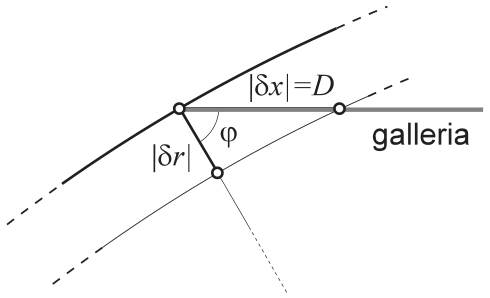 La condizione si esprime ora come
Per e si ritrova
Topic: Conservation of Energy, Oscillations & Waves Metodi: Energy Conservation Method, Simple Harmonic Motion Analysis, Conservation Laws Competenze: Mathematical Modeling, Physical Reasoning Objects: Planet Fonte: Testo (PDF) — p.2 Soluzione: Soluzioni (PDF)
Question no. 5.
Let be the fraction of energy lost in a journey (complete semi-oscillation). The condition is that
But from the expression seen in point 3., it follows that
For we have
The distance from the arrival station is finally obtained as
Here too, alternatively, one could consider as potential energy that associated with harmonic motion (as in the case of a spring) given by
It is immediately seen that this differs from the gravitational potential energy—calculated above—only by a constant term, which therefore proves irrelevant:
where is the distance of the tunnel from the center of the Earth.
The condition is now expressed as
For and we recover
Solution: Soluzioni (PDF)
Quesito n. 6.
Se l’oscillazione si dimezza in ampiezza, l’energia totale diventa 1/4 di quella iniziale, mentre il periodo di oscillazione non cambia. Si può quindi scrivere nuovamente
Se la variazione di energia è lenta si può confondere il rapporto incrementale con la derivata (vedi suggerimento in termini di potenza media e istantanea) e scrivere
La condizione da imporre è
L’ampiezza si sarà dimezzata dopo
Topic: Oscillations & Waves, Conservation of Energy Metodi: Energy Conservation Method, Differential Equations, Simple Harmonic Motion Analysis Competenze: Mathematical Modeling, Physical Reasoning Objects: Planet Fonte: Testo (PDF) — p.3 Soluzione: Soluzioni (PDF)
Question no. 6.
If the oscillation amplitude is halved, the total energy becomes one-fourth of the initial value, while the oscillation period remains unchanged. One can therefore write again
If the energy variation is slow, one can identify the incremental ratio with the derivative (see hint in terms of average and instantaneous power) and write
The condition to impose is
The amplitude will have halved after
Topic: Oscillations & Waves, Conservation of Energy Metodi: Energy Conservation Method, Differential Equations, Simple Harmonic Motion Analysis Competenze: Mathematical Modeling, Physical Reasoning Objects: Planet Fonte: Testo (PDF) — p.3 Soluzione: Soluzioni (PDF)
Quesito n. 7.
Nel modello della Terra a due strati, con nucleo pesante, il campo gravitazione nel nucleo cresce linearmente con ed è ovviamente maggiore che nel caso visto prima. Questo è vero anche nel mantello; infatti la densità del mantello è necessariamente minore di quella della Terra omogenea e di conseguenza, fissata una superficie sferica di raggio nella regione del mantello, la massa esterna è certamente minore rispetto al caso della Terra omogenea. Di conseguenza la massa della parte interna alla superficie è sempre maggiore ed è quindi maggiore anche il campo gravitazionale; dunque il viaggio durera` meno.
Il moto però non è più armonico dato che, solo per una distribuzione omogenea, vale la dipendenza lineare tra campo e distanza dal centro.
Topic: Gravitation, Newtonian Mechanics Metodi: Gauss’s Law, Physical Modeling, Symmetry Argument Competenze: Physical Reasoning Objects: Planet Fonte: Testo (PDF) — p.3 Soluzione: Soluzioni (PDF)
Question no. 7.
In the two-layer Earth model, with a heavy core, the gravitational field inside the core increases linearly with and is obviously greater than in the previous case. This is also true in the mantle; indeed, the density of the mantle must necessarily be less than that of a homogeneous Earth, and therefore, for a fixed spherical surface of radius in the mantle region, the external mass is certainly smaller than in the case of a homogeneous Earth. Consequently, the mass inside the surface is always greater and thus the gravitational field is also greater; therefore, the journey will take less time.
However, the motion is no longer harmonic because only for a uniform distribution does the linear dependence between field and distance from the center hold.
Solution: Soluzioni (PDF)
PROBLEMA n. 2 – Ciclo termodinamico (90 Punti)
Quesito n. 1.
Per la trasformazione isobara:
valido qualunque sia lo stato B.
Topic: Thermodynamics Metodi: Ideal Gas Law, First Law of Thermodynamics Competenze: Mathematical Modeling, Physical Reasoning Objects: Gas Fonte: Testo (PDF) — p.3 Soluzione: Soluzioni (PDF)
PROBLEM no. 2 – Thermodynamic Cycle (90 Points)
Question no. 1.
For the isobaric transformation:
valid for any state B.
Solution: Soluzioni (PDF)
Quesito n. 2.
La temperatura nello stato B deve essere maggiore o uguale a , ovvero, nel piano , B deve stare sopra l’isoterma per C. Infatti nell’espansione adiabatica il lavoro è positivo a spese dell’energia interna e dunque la temperatura può solo diminuire o restare uguale (per lavoro nullo, come caso estremo). Ne segue che
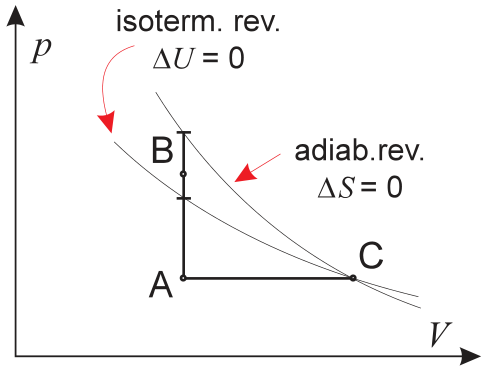 Al tempo stesso, poiché le adiabatiche reversibili sono curve isoentropiche, il punto B deve stare sotto l’adiabatica reversibile per C dato che l’entropia può solo aumentare o al massimo restare costante (se la trasformazione del gas fosse un’adiabatica reversibile). Il massimo, o meglio, l’estremo superiore per la temperatura può essere calcolato su una trasformazione adiabatica reversibile ove , dove nel caso di gas biatomico. Quindi
Il ragionamento svolto sopra può essere sviluppato a partire dalle stesse premesse discutendo i diversi contributi di calore e lavoro per determinare il valore minimo di e calcolando la variazione di entropia per il valore massimo. Nel seguito si indicheranno con e i calori molari, rispettivamente a pressione e volume costante.
Per un ciclo termodinamico
Per il primo principio si ha dunque
Trattandosi di un’espansione il lavoro deve essere non negativo per cui
Per l’espansione adiabatica irreversibile deve essere , ovvero
In definitiva, per la temperatura dello stato B valgono le condizioni
Topic: Thermodynamics Metodi: First Law of Thermodynamics, Thermodynamic Cycle Analysis, Ideal Gas Law Competenze: Mathematical Modeling, Physical Reasoning Objects: Gas Fonte: Testo (PDF) — p.4 Soluzione: Soluzioni (PDF)
Question no. 2.
The temperature in state B must be greater than or equal to , that is, in the plane point B must lie above the isotherm for C. Indeed, in an adiabatic expansion, work is positive at the expense of internal energy and thus temperature can only decrease or remain equal (in the extreme case of zero work). It follows that
At the same time, since reversible adiabatic processes are isoentropic curves, point B must lie below the reversible adiabatic curve for C because entropy can only increase or at most remain constant (if the gas transformation were a reversible adiabatic process). The maximum, or rather the supremum, for temperature can be computed along a reversible adiabatic transformation where , with in the case of a diatomic gas. Therefore
The reasoning above can be developed starting from the same premises by discussing the different contributions of heat and work to determine the minimum value of and computing the entropy change for the maximum value. In what follows, and will denote molar heat capacities at constant pressure and volume, respectively.
For a thermodynamic cycle
Thus, from the first law,
Since it is an expansion, work must be non-negative, so
For the irreversible adiabatic expansion, it must be , that is,
In conclusion, for the temperature in state B the following conditions hold:
Solution: Soluzioni (PDF)
Quesito n. 3.
Il ciclo svolto dal gas è stato definito termico se il gas compie lavoro sull’esterno: e quindi anche ; in altre parole il gas assorbe più calore di quanto ne cede; al contrario se il lavoro è fatto sul gas dall’esterno ( e ) allora esegue un ciclo frigorifero.
Il valore particolare di per cui il ciclo cambia da frigorifero a termico si ottiene quindi imponendo che ovvero
Alternativamente:
detta tale temperatura, si ha che per il ciclo è frigorifero, mentre per il ciclo è termico.
Come caso superiore estremo si ha quello di un’adiabatica reversibile che rende reversibile l’intero ciclo: notare che solo in questo caso il lavoro è calcolabile attraverso l’area del piano delimitata dalla curva che rappresenta il ciclo e solo in questo caso il verso orario di percorrenza del ciclo conferma che si tratta di un ciclo termico.
Topic: Thermodynamics Metodi: Thermodynamic Cycle Analysis, First Law of Thermodynamics, Ideal Gas Law Competenze: Mathematical Modeling Objects: Gas Fonte: Testo (PDF) — p.5 Soluzione: Soluzioni (PDF)
Question no. 3.
The cycle performed by the gas is defined as thermal if the gas does work on the outside: and therefore also ; in other words, the gas absorbs more heat than it releases. Conversely, if work is done on the gas from outside ( and ), then it performs a refrigeration cycle.
The particular value of for which the cycle changes from refrigeration to thermal is obtained by imposing that , i.e.,
Alternatively:
Let be this temperature; then for the cycle is refrigeration, while for the cycle is thermal.
As an extreme upper case, there is a reversible adiabatic process that makes the entire cycle reversible: note that only in this case is the work calculable through the area of the plane bounded by the curve representing the cycle, and only in this case does the clockwise direction of traversal confirm that it is a thermal cycle.
Solution: Soluzioni (PDF)
Quesito n. 4.
Il rendimento di un ciclo termico è
dove è il calore complessivamente scambiato, mentre e sono quelli effettivamente assorbito e ceduto (, ). Il rendimento è quindi una funzione della temperatura :
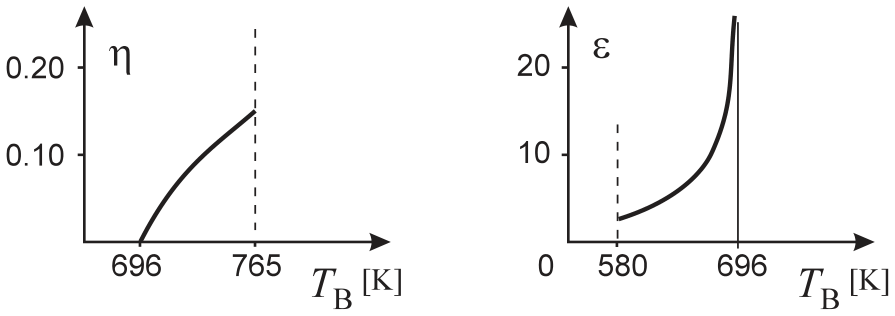
L’espressione del rendimento, valida per , è una funzione monotona crescente di . Numericamente risulta: ed
L’efficienza frigorifera
Si ricava: ed .
I grafici dei due parametri sono riportati qui sotto.
Topic: Thermodynamics Metodi: Thermodynamic Cycle Analysis, First Law of Thermodynamics, Ideal Gas Law Competenze: Mathematical Modeling, Physical Reasoning Objects: Gas Fonte: Testo (PDF) — p.5 Soluzione: Soluzioni (PDF)
Question no. 4.
The efficiency of a thermodynamic cycle is
where is the total heat exchanged, while and are those actually absorbed and released (, ). The efficiency is therefore a function of the temperature :
The expression for efficiency, valid for , is a monotonic increasing function of . Numerically it results: and
The refrigeration efficiency
It is found: and .
The graphs of the two parameters are reported below.
Solution: Soluzioni (PDF)
PROBLEMA n. 3 – Esplorando il fondo (50 Punti)
Quesito n. 1.
Si consideri un arbitrario punto A del fondo della vasca, a distanza dal piede della perpendicolare condotta dal punto di osservazione O, e il raggio di luce che partendo da questo punto arriva nello stesso punto O. A causa della rifrazione subita dalla luce nel passaggio dall’acqua all’aria, esso sembra essere emesso da un punto A’, come mostrato in figura.
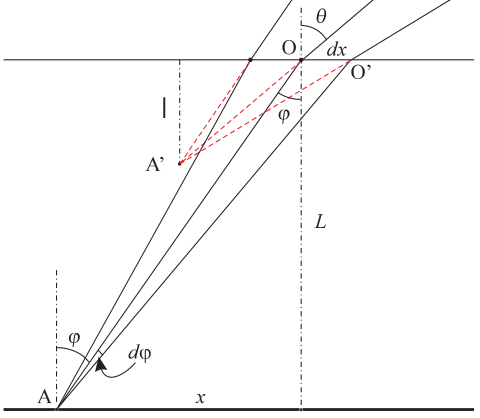 In termini dell’angolo mostrato in figura, si ha .
Il raggio che parte da A, con un angolo rispetto alla verticale, passa per O; invece un raggio adiacente che parte con angolo giunge alla superficie di separazione in un punto distante da O di una quantità data da
e, considerando che per l’espressione tra parentesi quadra è la derivata della funzione , si ha
Nota: Si poteva giungere allo stesso risultato differenziando l’espressione iniziale:
Analogamente, indicando con la profondità del punto A’, si ha che
Differenziando la Legge di Snell, , si ottiene
Sostituendo nella (1) l’espressione per appena ottenuta, si ricava
ed uguagliando le espressioni (2) e (3) si ottiene infine
Sempre da si ricava che
D’altra parte, applicando la Legge di Snell, si può anche scrivere
In ultima analisi
che sostituita nella (4) fornisce
Soluzione alternativa
Come prima, oltre al raggio uscente da A e passante per O, si consideri un secondo raggio che forma con il primo un angolo piccolo e che attraversa la superficie dell’acqua in un punto O’.
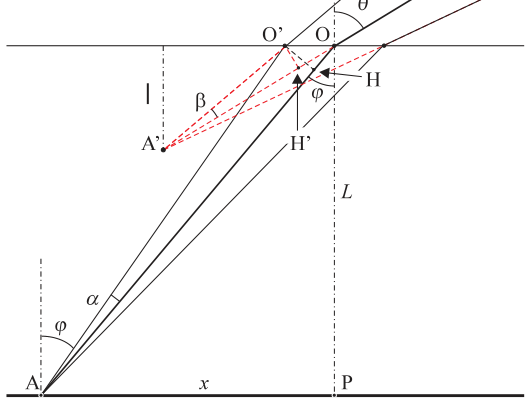 La profondità di A’ si può esprimere in funzione della profondità effettiva , della distanza e dell’indice di rifrazione considerando che il segmento OO’ è un lato comune dei due triangoli OHO’ e OH’O’.
Da semplici considerazioni geometriche si ricava che e . Dalla geometria del sistema si ricavano successivamente
Analogamente
Uguagliando la (1’) e la (2’) si ottiene
Ricordando che la divergenza del fascio è molto piccola si può approssimare , e ; pertanto l’espressione precedente diventa
La legge di Snell applicata nei punti O e O’ fornisce rispettivamente
Con l’approssimazione introdotta e tenendo presente la prima espressione, dalla seconda si ottiene
Sostituendo quest’ultima nella (3’) si ottiene
che coincide con la (4). La legge di Snell, espressa in termini dei coseni degli angoli si può scrivere
Dunque
Infine, ricordando che , dall’espressione precedente si ha
e la (4’) – in funzione di , ed – si scrive come
Topic: Geometric Optics Metodi: Snell’s Law, Ray Tracing, Calculus-Integration Competenze: Mathematical Modeling, Diagrammatic Reasoning Objects: Container Fonte: Testo (PDF) — p.6 Soluzione: Soluzioni (PDF)
PROBLEM no. 2 – Exploring the Bottom (50 Points)
Question no. 3.
Consider an arbitrary point A on the bottom of the basin, at a distance from the foot of the perpendicular drawn from the observation point O, and the light ray originating from this point that arrives at the same point O. Due to the refraction experienced by light in passing from water to air, it appears to be emitted from a point A’, as shown in the figure.
In terms of the angle shown in the figure, one has .
The ray originating from A, at an angle with respect to the vertical, passes through O; instead, a neighboring ray originating at angle reaches the interface surface at a point distant from O by an amount , given by
and, considering that as the expression within square brackets is the derivative of the function , one obtains
Note: The same result could have been obtained by differentiating the initial expression:
Similarly, denoting by the depth of point A’, one has that
Differentiating Snell’s Law, , one obtains
Substituting the expression for just obtained into (1), one finds
and equating expressions (2) and (3), one finally obtains
From one also derives that
On the other hand, applying Snell’s Law, one can also write
Finally,
which, when substituted into (4), yields
Alternative solution
As before, besides the ray emerging from A and passing through O, consider a second ray forming a small angle with the first one, and crossing the water surface at point O’.
The depth of A’ can be expressed as a function of the actual depth , the distance , and the refractive index , by noting that segment OO’ is a common side of triangles OHO’ and OH’O’.
From simple geometric considerations, one finds that and . From the geometry of the system, one successively obtains
Similarly,
Equating (1’) and (2’), one obtains
Recalling that the beam divergence is very small, one may approximate , , and ; thus, the previous expression becomes
Snell’s Law applied at points O and O’ respectively yields
With the approximation introduced and keeping in mind the first expression, from the second one it follows that
Substituting this last result into (3’) yields
which coincides with (4). Snell’s Law, expressed in terms of the cosines of the angles, can be written as
Therefore,
Finally, recalling that , from the previous expression one has
and (4’) — expressed as a function of , , and — becomes
Topic: Geometric Optics Metodi: Snell’s Law, Ray Tracing, Calculus-Integration Competenze: Mathematical Modeling, Diagrammatic Reasoning Objects: Container Fonte: Testo (PDF) — p.6 Soluzione: Soluzioni (PDF)
Quesito n. 2.
Come si può anche comprendere dalla figura, la posizione geometrica dell’immagine A’ diminuisce al crescere di , quindi si ha quando e quando . Per , , e , per cui dalla (4) si ha . Per anche ovvero , per cui dalla (5) si ha .
Topic: Geometric Optics Metodi: Snell’s Law, Ray Tracing Competenze: Mathematical Modeling, Physical Reasoning Objects: Container Fonte: Testo (PDF) — p.8 Soluzione: Soluzioni (PDF)
Question no. 2.
As can also be understood from the figure, the geometric position of the image A’ decreases as increases, therefore occurs when and when . For , , and , so from (4) it follows that . For , also i.e. , so from (5) it follows that .
Solution: Soluzioni (PDF)
Quesito n. 3.
Il massimo valore di si ha quando il valore sotto la radice quadrata nella (5) si annulla (non può essere negativo per reale) quindi
e l’area della superficie complessiva del fondale che può essere osservata è
Topic: Geometric Optics Metodi: Snell’s Law, Ray Tracing Competenze: Mathematical Modeling Objects: Container Fonte: Testo (PDF) — p.8 Soluzione: Soluzioni (PDF)
Question no. 3.
The maximum value of occurs when the expression under the square root in (5) vanishes (it cannot be negative for real ), therefore
and the area of the total bottom surface that can be observed is
Solution: Soluzioni (PDF)
PROBLEMA n. 4 – Correnti in un anello (70 Punti)
Topic: Circuits, Magnetism Metodi: Physical Modeling Competenze: Physical Reasoning Objects: Wire Fonte: Testo (PDF) — p.9 Soluzione: Soluzioni (PDF)
PROBLEM no. 4 – Currents in a Ring (70 Points)
Solution: Soluzioni (PDF)
Quesito n. 1.
La resistenza equivalente tra i punti A e B è data da
essendo l’area della sezione del filo; essendo si ha
A corrente costante () la massima d.d.p. si ha quando è massima la resistenza equivalente cioè per , ovvero quando B è diametralmente opposto ad A. Si ha
Topic: Circuits Metodi: Kirchhoff’s Laws, Equivalent Circuit Reduction Competenze: Mathematical Modeling, Diagrammatic Reasoning Objects: Wire Fonte: Testo (PDF) — p.9 Soluzione: Soluzioni (PDF)
Question no. 1.
The equivalent resistance between points A and B is given by
where is the cross-sectional area of the wire; since we have
For constant current (), the maximum potential difference occurs when the equivalent resistance is maximized, i.e., for , or when B is diametrically opposite to A. We have
Solution: Soluzioni (PDF)
Quesito n. 2.
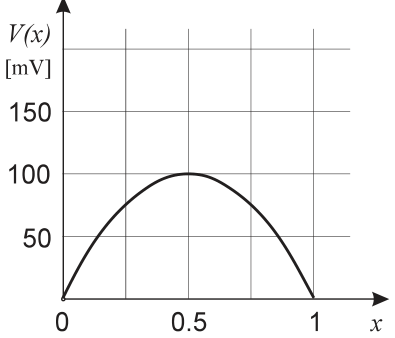
La d.d.p. è proporzionale alla resistenza equivalente:
Notare che la d.d.p. può essere valutata in due modi equivalenti
Il grafico richiesto di è riportato a fianco.
Topic: Circuits Metodi: Kirchhoff’s Laws, Equivalent Circuit Reduction Competenze: Mathematical Modeling, Diagrammatic Reasoning Objects: Wire Fonte: Testo (PDF) — p.9 Soluzione: Soluzioni (PDF)
Question no. 2.
The potential difference is proportional to the equivalent resistance:
Note that the potential difference can be evaluated in two equivalent ways
The required graph of is shown alongside.
Solution: Soluzioni (PDF)
Quesito n. 3.
Posto che ed , la potenza dissipata nel primo arco è
Dunque
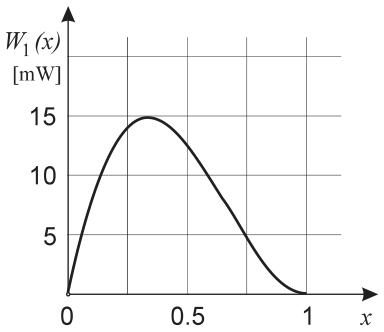
Notare che non è simmetrica rispetto a . Il massimo di si trova derivando
Anche qui, a fianco è riportato il grafico della funzione .
Topic: Circuits Metodi: Kirchhoff’s Laws, Calculus-Integration Competenze: Mathematical Modeling Objects: Wire Fonte: Testo (PDF) — p.9 Soluzione: Soluzioni (PDF)
Question no. 3.
Given that and , the power dissipated in the first arc is
Therefore,
Note that is not symmetric with respect to . The maximum of is found by differentiation
Also here, adjacent is the graph of the function .
Solution: Soluzioni (PDF)
Quesito n. 4.
Il campo magnetico al centro dell’anello è nullo in ogni caso. Infatti, ricordando l’espressione di Laplace per il calcolo del campo magnetico,
il contributo dei due fili rettilinei è nullo essendo questi allineati col centro dell’anello (e quindi ) e per i due archi percorsi da correnti in verso opposto, detto il raggio dell’anello [], si ha
Topic: Magnetism, Circuits Metodi: Biot-Savart Law, Symmetry Argument Competenze: Mathematical Modeling, Physical Reasoning Objects: Wire Fonte: Testo (PDF) — p.9 Soluzione: Soluzioni (PDF)
Question no. 4.
The magnetic field at the center of the ring is zero in every case. Indeed, recalling Laplace’s expression for calculating the magnetic field,
the contribution from the two straight wires is zero because they are aligned with the center of the ring (and therefore ), and for the two arcs carrying currents in opposite directions, denoting by the radius of the ring [], one has
Soluzione: Soluzioni (PDF)
Quesito n. 5.
Le risposte 1, 2 e 3 non cambiano; cambia invece il campo magnetico al centro dell’anello.
Adesso esso è dovuto al filo perpendicolare ed è quindi nel piano dell’anello; il suo modulo è comunque indipendente dalla posizione di B (quindi da ) e può essere ricavato dall’espressione di Laplace data sopra, o più semplicemente con considerazioni di simmetria, osservando che due tratti infinitesimi di filo disposti simmetricamente rispetto ad un piano ortogonale al filo stesso, danno uguali contributi al campo calcolato in un punto qualunque del piano.
Dunque il modulo del campo è metà di quello di un filo rettilineo indefinito e vale
Materiale prodotto dal gruppo
Segreteria Olimpiadi Italiane della Fisica presso Liceo Scientifico “U. Morin” VENEZIA MESTRE fax: 041.584.1272 e-mail: olifis@libero.it
Topic: Magnetism Metodi: Biot-Savart Law, Symmetry Argument Competenze: Mathematical Modeling, Physical Reasoning Objects: Wire Fonte: Testo (PDF) — p.10 Soluzione: Soluzioni (PDF)
Question no. 5.
Answers 1, 2 and 3 do not change; what changes is the magnetic field at the center of the ring.
Now it is due to the perpendicular wire and therefore lies in the plane of the ring; its magnitude remains independent of the position of B (thus from ) and can be obtained either from the Laplace expression given above, or more simply by symmetry considerations, observing that two infinitesimal segments of wire arranged symmetrically with respect to a plane orthogonal to the wire itself give equal contributions to the field calculated at any point on the plane.
Thus, the magnitude of the field is half that of an infinite straight wire and equals
Material produced by the group
Secretariat of the Italian Physics Olympiad
at Liceo Scientifico “U. Morin”
VENEZIA MESTRE
fax: 041.584.1272
e-mail: olifis@libero.it
Solution: Soluzioni (PDF)