PROBLEMA n. 1 – Sistema trasportatore a rulli 85 Punti Quesito n. 1. Si consideri il punto di contatto tra un generico rullo e la lastra. Affinché essa non slitti la sua velocità deve essere uguale a quella tangenziale nel punto di contatto; quindi Poiché è la stessa in ogni punto della lastra, è uguale per tutti i rulli.
Topic: Rotational Dynamics, Newtonian Mechanics Metodi: Physical Modeling, Kinematic Equations, Free-Body Diagram Competenze: Physical Reasoning, Mathematical Modeling Objects: Cylinder Fonte: Testo (PDF) — p.1 Soluzione: Soluzioni (PDF)
The Commission has already taken a number of measures. 1 Rolls-cylinder conveyor system 85 points Question No. 1. Consider the point of contact between a generic roller and the plate. In order not to speed up it must be equal to the tangential at the point of contact; then Since is the same at each point on the plate, is the same for all rolls.
Topic: Rotational Dynamics, Newtonian Mechanics Metodi: Physical Modeling, Kinematic Equations, Free-Body Diagram Competenze: Physical Reasoning, Mathematical Modeling Objects: Cylinder Fonte: Testo (PDF) — p.1 Soluzione: Soluzioni (PDF)
Quesito n. 2. Poiché non c’è slittamento, tra un urto e l’altro l’energia si conserva; inoltre, sempre tra un urto e l’altro, la variazione di energia potenziale gravitazionale è pari a . Nel calcolare l’energia cinetica si deve tenere conto della velocità traslazionale della lastra e di quella rotazionale dei rulli, ognuno dei quali ha momento d’inerzia . Usando e si ha
Topic: Conservation of Energy, Rotational Dynamics, Newtonian Mechanics Metodi: Energy Conservation Method, Conservation Laws, Torque & Angular Momentum Analysis Competenze: Physical Reasoning, Mathematical Modeling Objects: Cylinder Fonte: Testo (PDF) — p.1 Soluzione: Soluzioni (PDF)
Question No. 2. Since there is no disconnect, energy is stored between one impact and another; moreover, always between one impact and another, The gravitational potential energy change is . In calculating kinetic energy, one must The speed of the translations of the plate and the rotation of the rolls, each of which has momentum, shall be taken into account. d’inerzia . Using and you have
Topic: Conservation of Energy, Rotational Dynamics, Newtonian Mechanics Metodi: Energy Conservation Method, Conservation Laws, Torque & Angular Momentum Analysis Competenze: Physical Reasoning, Mathematical Modeling Objects: Cylinder Fonte: Testo (PDF) — p.1 Soluzione: Soluzioni (PDF)
Quesito n. 3. Si indichi con e con rispettivamente la variazione della quantità di moto della lastra causata dal rullo urtato e da ognuno dei rulli a contatto con la lastra. Si indichi inoltre con e rispettivamente la variazione del momento angolare del rullo fermo e di ognuno dei rulli in rotazione a contatto con la lastra. Il momento angolare di un corpo rigido si può esprimere come dove rappresenta il momento d’inerzia e la velocità angolare. In un urto, tra la lastra ed i rulli si sviluppano delle forze impulsive parallele alla direzione del moto (forze d’attrito). L’impulso delle forze che i rulli esercitano sulla lastra fa cambiare la quantità di moto della lastra Si noti che e hanno segno opposto. La variazione della quantità di moto della lastra prodotta dai singoli rulli è legata alla variazione del momento angolare di ogni rullo. Infatti la variazione di q.d.m. della lastra è data da dove è la forza applicata da un rullo alla lastra. Nel caso di forza impulsiva l’integrale è esteso ad un intervallo temporale trascurabile, ma la variazione di q.d.m. risulta comunque finita. Il momento dell’impulso delle forze che la lastra esercita su ogni singolo rullo in un punto della superficie, che per il terzo principio della dinamica hanno la stessa intensità, la stessa direzione e verso opposto, fa cambiare il momento angolare dei rulli: precisamente fa diminuire il momento angolare di rulli ed aumentare il momento angolare del rullo che viene messo in moto. Ne segue che la variazione di momento angolare del rullo risulta Si ha dunque e Sostituendo le ultime due espressioni nella prima si ottiene Ricordando che e che e sviluppando i calcoli si ricava infine
Topic: Conservation of Momentum, Rotational Dynamics, Newtonian Mechanics Metodi: Impulse-Momentum Theorem, Torque & Angular Momentum Analysis, Free-Body Diagram Competenze: Physical Reasoning, Mathematical Modeling, Diagrammatic Reasoning Objects: Block, Cylinder Fonte: Testo (PDF) — p.1 Soluzione: Soluzioni (PDF)
Question No. 3. Indicate the change in the amount of rolling of the plate caused by the rolling stock with and respectively urtato e da ognuno dei rulli a contatto con la lastra. It is also denoted by and respectively the change in the angular moment of the stationary roller and of each roll in rotation in contact with the the plate. The angular moment of a rigid body can be expressed as where represents the moment of inertia and the angular velocity. In a collision, impulse forces parallel to the direction of the motor develop between the plate and the rolls (forces) The Commission has not yet taken a decision. The pulse of the forces exerted by the rollers on the plate changes the amount of motion of the plate Note that and are marked opposite. The change in the amount of rolling stock produced by the individual rolls is related to the change in momentum. angle of each roll. In fact, the change in q.d.m. the plate is given by where is the force applied by a roller to the plate. In the case of an impulse force the integral is extended to an interval The time scale is negligible, but the change in Q.D.M. It’s over anyway. The moment of the force pulse exerted by the plate on each single roll at a point on the surface, The third principle of dynamics is that they have the same intensity, the same direction and the opposite direction. The angular momentum of the rolls: it precisely decreases the angular momentum of rolls and increases the the angular moment of the roll being started. The result is that the change in angular momentum of the roller The following is the list of the The Commission has therefore e By replacing the last two expressions in the first one, you get If we remember that and that and develop the calculations we get
Topic: Conservation of Momentum, Rotational Dynamics, Newtonian Mechanics Metodi: Impulse-Momentum Theorem, Torque & Angular Momentum Analysis, Free-Body Diagram Competenze: Physical Reasoning, Mathematical Modeling, Diagrammatic Reasoning Objects: Block, Cylinder Fonte: Testo (PDF) — p.1 Soluzione: Soluzioni (PDF)
Quesito n. 4. Combinando i risultati dei due punti precedenti si ricava e con la relazione data nel testo , si ottiene Raggiungere una velocità limite significa e dalla espressione precedente si ricava da cui Sostituendo questo risultato nella relazione tra e ricavata nel quesito precedente, si ottiene
Topic: Newtonian Mechanics, Conservation of Energy, Rotational Dynamics Metodi: Conservation Laws, Energy Conservation Method, Approximation & Series Expansion Competenze: Mathematical Modeling, Physical Reasoning Objects: Block, Cylinder, Inclined Plane Fonte: Testo (PDF) — p.2 Soluzione: Soluzioni (PDF)
Question No. 4. Combining the results of the two previous points He ‘s getting rich . and the report given in , The maximum speed is and the previous expression is from which By replacing this result in the ratio between and in the previous question,
Topic: Newtonian Mechanics, Conservation of Energy, Rotational Dynamics Metodi: Conservation Laws, Energy Conservation Method, Approximation & Series Expansion Competenze: Mathematical Modeling, Physical Reasoning Objects: Block, Cylinder, Inclined Plane Fonte: Testo (PDF) — p.2 Soluzione: Soluzioni (PDF)
Quesito n. 5. Si ha
Topic: Newtonian Mechanics, Conservation of Energy Metodi: Conservation Laws, Energy Conservation Method Competenze: Mathematical Modeling, Physical Reasoning Objects: Block, Cylinder Fonte: Testo (PDF) — p.2 Soluzione: Soluzioni (PDF)
Question No. 5. Si ha
Topic: Newtonian Mechanics, Conservation of Energy Metodi: Conservation Laws, Energy Conservation Method Competenze: Mathematical Modeling, Physical Reasoning Objects: Block, Cylinder Fonte: Testo (PDF) — p.2 Soluzione: Soluzioni (PDF)
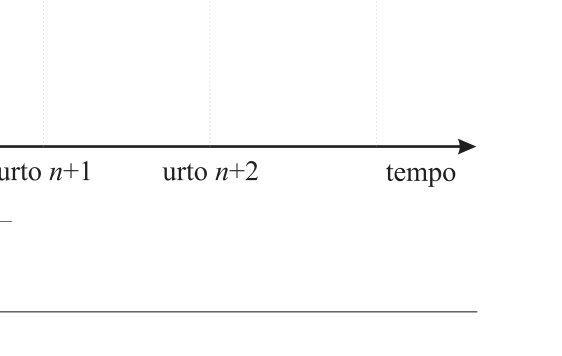
Quesito n. 6. Vedi grafico a fianco. ——————————— PROBLEMA n. 2 – Nuclei speculari 85 Punti
p.2 — Grafico velocita lastra in funzione del tempo
Topic: Nuclear & Particle Physics Metodi: Physical Modeling Competenze: Physical Reasoning, Diagrammatic Reasoning Objects: — Fonte: Testo (PDF) — p.2 Soluzione: Soluzioni (PDF)
Question No. 6. See the chart next to it. ——————————— The Commission has already taken a number of measures. 2 Speculative nuclei 85 points
**p.2 ** Time-speed sheet chart
Topic: Nuclear & Particle Physics Metodi: Physical Modeling Competenze: Physical Reasoning, Diagrammatic Reasoning Objects: — Fonte: Testo (PDF) — p.2 Soluzione: Soluzioni (PDF)
Quesito n. 1. Abbiamo: da cui Quindi:
Topic: Nuclear & Particle Physics Metodi: Physical Modeling, Dimensional Analysis Competenze: Mathematical Modeling, Physical Reasoning Objects: Nucleus, Sphere Fonte: Testo (PDF) — p.3 Soluzione: Soluzioni (PDF)
Question No. 1. We have: from which So , what ?
Topic: Nuclear & Particle Physics Metodi: Physical Modeling, Dimensional Analysis Competenze: Mathematical Modeling, Physical Reasoning Objects: Nucleus, Sphere Fonte: Testo (PDF) — p.3 Soluzione: Soluzioni (PDF)
Quesito n. 2. Per calcolare l’energia potenziale elettrostatica di una sfera uniformemente carica si immagini di “assemblare” la sfera per aggiunta di successivi gusci sferici infinitesimi. Si supponga allora di avere una sfera uniformemente carica (con densità volumica di carica ), di raggio . Il potenziale di questa sfera (ponendo ) è: Si immagini ora di aggiungere a questa sfera, trasportandolo dall’infinito, un guscio carico infinitesimo, di raggio e spessore . La carica del guscio risulta: L’aumento di energia potenziale elettrostatica sarà: Integrando questa espressione si otterrà l’energia potenziale richiesta: ——————— In alternativa si può calcolare questa energia sia integrando la densità di energia del campo elettrostatico, sia usando l’espressione più generale dell’energia di configurazione di un sistema di cariche con distribuzione continua. Nel primo caso occorre preliminarmente trovare (con il teorema di Gauss) le espressioni del campo internamente ed esternamente alla sfera di raggio , nel secondo caso quella del potenziale e.s. nei soli punti interni. In sintesi: • Attraverso la densità di energia : con • Come energia di configurazione con e ——————— Tenendo conto del fatto che si ha infine quindi
Topic: Electrostatics, Nuclear & Particle Physics Metodi: Gauss’s Law, Coulomb’s Law, Calculus-Integration Competenze: Mathematical Modeling, Physical Reasoning, Diagrammatic Reasoning Objects: Sphere, Nucleus Fonte: Testo (PDF) — p.3 Soluzione: Soluzioni (PDF)
Question No. 2. To calculate the electrostatic potential energy of a uniformly charged sphere, imagine that assembly The sphere to add infinite successive spherical shells. So let’s assume we have a sphere evenly carica (con densità volumica di carica ), di raggio . The potential of this sphere (putting ) is: Now imagine adding to this sphere, carrying it from the infinite, a shell loaded infinitely, of radius. e spessore . The load of the shell is: The increase in potential electrostatic energy shall be: The following is the total energy required by integrating this expression: ——————— Alternatively, this energy can be calculated by integrating the energy density of the electrostatic field, The most general expression of the configuration energy of a distributed load system is Keep going. In the first case, we must first find (with Gauss’s theorem) the expressions of the field Internally and externally to the radius sphere , in the second case that of potential e.s. in points only The internal In short: • Through the energy density : with • As a configuration energy with e ——————— Given that has finally been So, what do you mean?
Topic: Electrostatics, Nuclear & Particle Physics Metodi: Gauss’s Law, Coulomb’s Law, Calculus-Integration Competenze: Mathematical Modeling, Physical Reasoning, Diagrammatic Reasoning Objects: Sphere, Nucleus Fonte: Testo (PDF) — p.3 Soluzione: Soluzioni (PDF)
Quesito n. 3. Nel caso di nuclei speculari, è lo stesso per i due membri della coppia, e il termine vale per uno dei due e per l’altro. Ne segue immediatamente che: dove l’espressione dell’energia e.s. trovata sopra viene modificata in Considerando adesso due nuclei speculari, con , ed essendo si ha e quindi
Topic: Nuclear & Particle Physics, Electrostatics Metodi: Conservation Laws, Coulomb’s Law, Symmetry Argument Competenze: Mathematical Modeling, Physical Reasoning Objects: Nucleus Fonte: Testo (PDF) — p.4 Soluzione: Soluzioni (PDF)
Question No. 3. In the case of specular nuclei, is the same for the two members of the pair, and the term is for one The two and for each other. It follows immediately that: where the expression of energy e.s. The above is amended to: Now, considering two specular nuclei, with , and being you have and then
Topic: Nuclear & Particle Physics, Electrostatics Metodi: Conservation Laws, Coulomb’s Law, Symmetry Argument Competenze: Mathematical Modeling, Physical Reasoning Objects: Nucleus Fonte: Testo (PDF) — p.4 Soluzione: Soluzioni (PDF)
Quesito n. 4. Nella tabella di dati fornita nel testo si aggiungono tre colonne in cui sono riportati rispettivamente i valori dell’espressione , i valori di e il valore di ricavato da quelli:
| Nucleo 1 | Nucleo 2 | (MeV) | |||
|---|---|---|---|---|---|
| 35 | (298.2) | (291.5) | 10.39 | 6.7 | 0.649 |
| 45 | (385.0) | (377.1) | 12.37 | 7.9 | 0.640 |
| 55 | (476.8) | (467.3) | 14.20 | 9.5 | 0.667 |
| 65 | (556.0) | (545.9) | 15.92 | 10.1 | 0.637 |
| 75 | (633.6) | (622.3) | 17.55 | 11.3 | 0.637 |
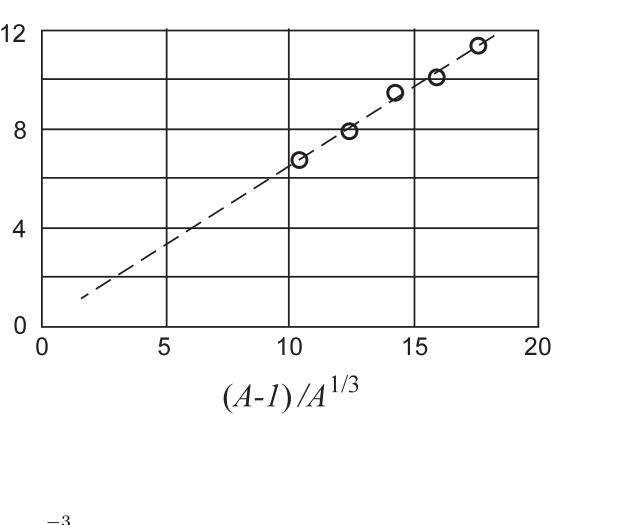
Calcolando la media dei valori riportati nell’ultima colonna, si ottiene una stima del valore di , pari a 0.648 MeV. Una stima più accurata può essere ottenuta con il metodo dei minimi quadrati cercando la migliore relazione lineare tra le variabili ed , come mostrato nel grafico. Si dovranno calcolare le somme Il valore della costante di proporzionalità è dato da Con questo valore, dalla (*) si può infine ottenere una stima di : Il valore comunemente accettato, ricavato con molti metodi diversi, è 1.25 fm: l’errore è del 7.2 %.
p.4 — Grafico Delta E_l contro (A-1) su A^(1/3)
Topic: Nuclear & Particle Physics, Electrostatics Metodi: Experimental Data Analysis, Graph Linearization, Coulomb’s Law Competenze: Experimental Data Analysis, Graph Linearization, Mathematical Modeling Objects: Nucleus Fonte: Testo (PDF) — p.4 Soluzione: Soluzioni (PDF)
Question No. 4. In the table of data provided in the text, three columns are added showing the values respectively: of the expression , the values of and the value of derived from:
| Nucleo 1 | Nucleo 2 | (MeV) | |||
|---|---|---|---|---|---|
| 35 | (298.2) | (291.5) | 10.39 | 6.7 | 0.649 |
| 45 | (385.0) | (377.1) | 12.37 | 7.9 | 0.640 |
| 55 | (476.8) | (467.3) | 14.20 | 9.5 | 0.667 |
| 65 | (556.0) | (545.9) | 15.92 | 10.1 | 0.637 |
| 75 | (633.6) | (622.3) | 17.55 | 11.3 | 0.637 |
Calculating the mean of the values in the last column gives an estimate of the value , equal to 0.648 MeV. A more accurate estimate can be obtained by the method of least squares by looking for the best ratio linear between the variables and , as shown in the graph. The sums will have to be calculated The value of the proportionality constant is given by With this value, the (*) can finally be obtained an estimate of : Commonly accepted value, obtained by The error rate is 7.2%.
p.4 — Grafico Delta E_l contro (A-1) su A^(1/3)
Topic: Nuclear & Particle Physics, Electrostatics Metodi: Experimental Data Analysis, Graph Linearization, Coulomb’s Law Competenze: Experimental Data Analysis, Graph Linearization, Mathematical Modeling Objects: Nucleus Fonte: Testo (PDF) — p.4 Soluzione: Soluzioni (PDF)
Quesito n. 5. La densità di massa risulta: La densità di carica del nucleo: Questi valori vanno intesi solo come stime approssimative. ——————————— PROBLEMA n. 3 – Ancora il campo elettrostatico radiale di modulo uniforme! 85 Punti Nota: parlando di campo e potenziale è sempre sottinteso l’attributo “elettrostatico”.
Topic: Nuclear & Particle Physics, Electrostatics Metodi: Physical Modeling, Dimensional Analysis Competenze: Mathematical Modeling, Estimation & Approximation Objects: Nucleus Fonte: Testo (PDF) — p.4 Soluzione: Soluzioni (PDF)
Question No. 5. The mass density is: The charge density of the core: These values should only be understood as approximate estimates. ——————————— The Commission has already taken a number of measures. 3 The uniformly modulated radial electrostatic field! 85 points Note: when speaking of field and potential, the attribute electrostatic is always understood.
Topic: Nuclear & Particle Physics, Electrostatics Metodi: Physical Modeling, Dimensional Analysis Competenze: Mathematical Modeling, Estimation & Approximation Objects: Nucleus Fonte: Testo (PDF) — p.4 Soluzione: Soluzioni (PDF)
Quesito n. 1. Le cariche superficiali si determinano immediatamente con l’uso del teorema di Coulomb (applicazione del teorema di Gauss) considerando che il campo (o meglio la sua componente radiale) è discontinuo nell’attraversamento delle due superfici. In alternativa si può usare direttamente il teorema di Gauss: detta la carica contenuta nella sfera di raggio generico , essa è pari a . La carica sulla superficie interna si trova facendo il limite di per , mentre quella sulla superficie esterna per differenza tra la carica totale (nulla) e quella positiva fino a ; quindi
Topic: Electrostatics Metodi: Gauss’s Law, Coulomb’s Law, Electric Potential Method Competenze: Mathematical Modeling, Diagrammatic Reasoning, Physical Reasoning Objects: Sphere Fonte: Testo (PDF) — p.5 Soluzione: Soluzioni (PDF)
Question No. 1. The surface loads are determined immediately by the use of Coulomb’s theorem (application of the Gauss’s theorem) considering that the field (or rather its radial component) is discontinuous in the crossing of the two surfaces. In alternativa si può usare direttamente il teorema di Gauss: detta la carica contenuta nella sfera di The generic radius is . The load on the inner surface is found by making the limit of for , while that on the surface external for difference between total (zero) and positive charge up to ; then
Topic: Electrostatics Metodi: Gauss’s Law, Coulomb’s Law, Electric Potential Method Competenze: Mathematical Modeling, Diagrammatic Reasoning, Physical Reasoning Objects: Sphere Fonte: Testo (PDF) — p.5 Soluzione: Soluzioni (PDF)
Quesito n. 2. Per quanto sopra, dette , , le cariche superficiali e spaziale, deve essere La carica spaziale (o volumetrica) occupa il volume per cui la densità media è
Topic: Electrostatics Metodi: Gauss’s Law, Coulomb’s Law, Electric Potential Method Competenze: Mathematical Modeling, Diagrammatic Reasoning Objects: Sphere Fonte: Testo (PDF) — p.5 Soluzione: Soluzioni (PDF)
Question No. 2. For the purposes of the above, the above , , surface and spatial loads shall be The spatial (or volumetric) load occupies the volume for which the density is The average is
Topic: Electrostatics Metodi: Gauss’s Law, Coulomb’s Law, Electric Potential Method Competenze: Mathematical Modeling, Diagrammatic Reasoning Objects: Sphere Fonte: Testo (PDF) — p.5 Soluzione: Soluzioni (PDF)
Quesito n. 3. Poiché la carica non è distribuita uniformemente (ma dipende solo dalla distanza , ovvero ), occorre applicare il teorema di Gauss ad uno strato di spessore infinitesimo (trascurando termini di ordine superiore al primo): e infine
Topic: Electrostatics Metodi: Gauss’s Law, Calculus-Integration, Electric Potential Method Competenze: Mathematical Modeling, Physical Reasoning Objects: Sphere Fonte: Testo (PDF) — p.5 Soluzione: Soluzioni (PDF)
Question No. 3. Since the load is not evenly distributed (but depends only on the distance , or ), it is necessary to The first is the application of Gauss’s theorem to a layer of infinitesimal thickness (neglecting terms of order higher than the first: And finally,
Topic: Electrostatics Metodi: Gauss’s Law, Calculus-Integration, Electric Potential Method Competenze: Mathematical Modeling, Physical Reasoning Objects: Sphere Fonte: Testo (PDF) — p.5 Soluzione: Soluzioni (PDF)
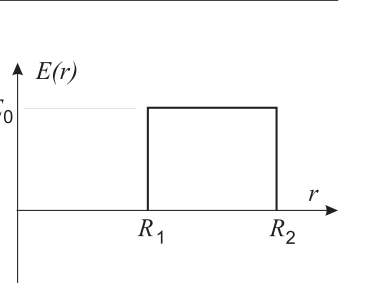
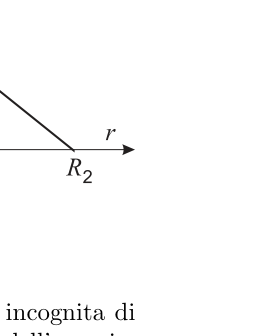
Quesito n. 4. Il calcolo del potenziale è immediato, essendo per a causa del campo esterno nullo. Per definizione espressione valida per . Nei punti interni alla prima sfera il potenziale è uniforme, dato che il campo è nullo, ed è pari a I grafici richiesti sono riportati a fianco.
p.6 — Grafico campo radiale E(r) in funzione di r
Topic: Electrostatics Metodi: Electric Potential Method, Calculus-Integration, Gauss’s Law Competenze: Mathematical Modeling, Physical Reasoning, Diagrammatic Reasoning Objects: Sphere Fonte: Testo (PDF) — p.6 Soluzione: Soluzioni (PDF)
Question No. 4. The calculation of the potential is immediate, being for a The result of the external field is zero. By definition the expression valid for . In the points inside the first sphere the The potential is uniform, since the field is zero, and is equal to The required graphs are listed side by side.
The radial field graph E(r) as a function of r
Topic: Electrostatics Metodi: Electric Potential Method, Calculus-Integration, Gauss’s Law Competenze: Mathematical Modeling, Physical Reasoning, Diagrammatic Reasoning Objects: Sphere Fonte: Testo (PDF) — p.6 Soluzione: Soluzioni (PDF)
Quesito n. 5. Trattandosi di una campo di forze centrale si conserva il momento angolare, perpendicolare al piano individuato dalla posizione e velocità iniziali. Pertanto la traiettoria deve stare tutta sul medesimo piano. In alternativa si può riconoscere che la forza è sempre nello stesso piano e dunque non può mai esserci una componente perpendicolare di accelerazione, tale da portare la particella fuori dello stesso piano.
p.6 — Grafico campo E(r) traiettoria forza centrale
Topic: Electrostatics, Newtonian Mechanics Metodi: Conservation Laws, Torque & Angular Momentum Analysis, Vector Decomposition Competenze: Physical Reasoning, Mathematical Modeling Objects: Point Charge Fonte: Testo (PDF) — p.6 Soluzione: Soluzioni (PDF)
Question No. 5. The Commission has already adopted a number of proposals for a directive on the protection of workers’ rights. angular, perpendicular to the plane determined by the position and speed The initial Therefore, the entire trajectory must be on the same plane. Alternatively, you can recognize that the force is always on the same plane. And so there can never be a perpendicular component of acceleration that would take the particle out of the same plane.
The following table shows the results of the calculations:
Topic: Electrostatics, Newtonian Mechanics Metodi: Conservation Laws, Torque & Angular Momentum Analysis, Vector Decomposition Competenze: Physical Reasoning, Mathematical Modeling Objects: Point Charge Fonte: Testo (PDF) — p.6 Soluzione: Soluzioni (PDF)
Quesito n. 6. Alla distanza minima (si omette il pedice per semplicità) la particella si muove con velocità incognita di modulo . Occorre quindi impostare un sistema di due equazioni: una è fornita dalla conservazione dell’energia, l’altra dalla conservazione del momento angolare avendo moltiplicato la prima equazione per ed avendo sostituito per definizione di . Dalla seconda equazione che, sostituito nella prima per eliminare l’incognita dà Nella variabile l’equazione da risolvere è Si osserva che , e che la derivata è sempre positiva nell’intervallo considerato: dunque nello stesso intervallo la funzione è continua e crescente per cui ha certamente uno ed un solo zero che può essere determinato ad esempio col metodo dicotomico: Soluzione numerica dell’equazione in
| valore nel punto medio | nuovo intervallo | nuova posizione |
|---|---|---|
| 1.500 – 2.000 | ||
| 1.500 – 1.750 | ||
| 1.625 – 1.750 | ||
| 1.687 – 1.750 | ||
| 1.687 – 1.719 |
La soluzione (a meno dell’1 %) vale per cui . ——————————— PROBLEMA n. 4 – Due altoparlanti 45 Punti
Topic: Electrostatics, Newtonian Mechanics Metodi: Conservation Laws, Energy Conservation Method, Torque & Angular Momentum Analysis Competenze: Mathematical Modeling, Physical Reasoning, Estimation & Approximation Objects: Point Charge Fonte: Testo (PDF) — p.6 Soluzione: Soluzioni (PDF)
Question No. 6. At minimum distance (the pedicure is omitted for simplicity) the particle moves at an unknown speed of modulo . A system of two equations must therefore be set up: one is provided by the conservation of energy, The other is the conservation of angular momentum. having multiplied the first equation by and having replaced by definition of . From the second equation that, replaced in the first to eliminate the unknown dà In the variable the equation to be solved is It is noted that , and that the derivative is always positive in the range The function is therefore continuous and increasing over the same interval, so it certainly has one and one only zero which can be determined, for example, by the dichotomous method: The numerical solution of the equation in
♪ value in the middle ♪ new range ♪ new position ♪ |---|---|---| | | 1.500 – 2.000 | | | | 1.500 – 1.750 | | | | 1.625 – 1.750 | | | | 1.687 – 1.750 | | | | 1.687 – 1.719 | |
The solution (less than 1%) is for which . ——————————— The Commission has already taken a number of measures. 4 Two speakers 45 points
Topic: Electrostatics, Newtonian Mechanics Metodi: Conservation Laws, Energy Conservation Method, Torque & Angular Momentum Analysis Competenze: Mathematical Modeling, Physical Reasoning, Estimation & Approximation Objects: Point Charge Fonte: Testo (PDF) — p.6 Soluzione: Soluzioni (PDF)
Quesito n. 1. Consideriamo il vertice B. Affinché in esso si abbia il massimo d’intensità del prim’ordine, le onde provenienti dai due altoparlanti devono arrivare in fase. Poiché le sorgenti sono in fase, l’unico sfasamento è quello introdotto dalla differenza di cammino : in B ci sarà un massimo se . I massimi del prim’ordine si hanno quando la differenza di cammino è pari a una lunghezza d’onda: Il valore trovato corrisponde ad un La#3. Si ha interferenza distruttiva, come è noto, quando la differenza di cammino percorso dalle onde sonore è un multiplo dispari di mezze lunghezze d’onda. I punti del piano del quadrato in cui si hanno i minimi d’interferenza descrivono il luogo . I punti del piano in cui si ha interferenza distruttiva, dunque, appartengono alle iperboli di un fascio che ha i fuochi nelle sorgenti ed e l’asse di simmetria coincidente con l’asse del segmento . I punti da trovare sono quelli d’intersezione tra le iperboli suddette e i lati del quadrato. Il problema è simmetrico e, per risolverlo, si fissa un sistema di riferimento cartesiano con gli assi paralleli ai lati del quadrato e origine nel punto medio del segmento . I punti d’interferenza distruttiva sull’asse delle ordinate aventi ordinata positiva sono quelli che soddisfano la condizione , con purché . In questo caso soltanto e dunque m e m. Considerando che questi sono i vertici delle iperboli d’interferenza distruttiva e che le sorgenti sono nei fuochi, si determinano rapidamente le equazioni dei luoghi cercati. I minimi d’interferenza sono 4 sul segmento , due sul lato BC del quadrato, gli altri due sui lati ed . Indicando con l’ordinata dei vertici e con quella dei fuochi, i luoghi hanno l’equazione generale seguente In particolare, lungo il segmento BC mentre lungo i segmenti ed La figura accanto descrive la situazione. ——————— In alternativa i minimi sui segmenti BC, ed si possono trovare anche senza ricorrere alle iperboli, semplicemente scrivendo la condizione d’interferenza distruttiva, analogamente a quanto s’è fatto per trovare i massimi. Si ottiene, rispettivamente sui lati orizzontali e sul lato verticale,
Topic: Oscillations & Waves, Wave Optics Metodi: Superposition Principle, Interference & Diffraction Analysis, Wave Equation Competenze: Mathematical Modeling, Physical Reasoning, Diagrammatic Reasoning Objects: — Fonte: Testo (PDF) — p.7 Soluzione: Soluzioni (PDF)
Question No. 1. Let’s consider the B-summit. In order to achieve the maximum intensity of the first order, the waves coming from the Two speakers must be in phase. Since the sources are in phase, the only phase-out is the one introduced from the path difference : in B there will be a maximum if . The first-order maximum has been When the difference in path is equal to a wavelength: The value found corresponds to a La#3. You have destructive interference, as you know, when the difference in pathway traveled by the sound waves is A odd multiple of half wavelengths. The points on the square plane where the The minimum interference shall describe the place . The points of the plan where interference is involved distruttiva, dunque, appartengono alle iperboli di un fascio che ha i fuochi nelle sorgenti ed e l’asse di symmetry matching the segment axis. The points to be found are those at the intersection of the hyperbolites The above and the sides of the square. The problem is symmetrical and a reference system is used to solve it. Cartesian with parallel axes on the sides of the square and originating in the middle of the segment. The destructive interference points on the axis of positive ordered orders are those that satisfy the following criteria: the condition , with provided that . In this case only and therefore m e m. Considering that these are the peaks of interference hyperbolic The results of the research are very good. I The minimum interference is 4 on the segment, two on the BC side of the square, the other two on the and sides. Indicating with the order of the peaks and with that of the fires, the places have the following general equation In particular, along the BC segment whereas along the and segments The figure next to it describes the situation. ——————— Alternatively, the BC, and segments can be found without the use of hyperbolic, The first is that the data is not available to the public. Maximum. The horizontal and vertical sides are obtained, respectively.
Topic: Oscillations & Waves, Wave Optics Metodi: Superposition Principle, Interference & Diffraction Analysis, Wave Equation Competenze: Mathematical Modeling, Physical Reasoning, Diagrammatic Reasoning Objects: — Fonte: Testo (PDF) — p.7 Soluzione: Soluzioni (PDF)
Quesito n. 2. Per una sorgente puntiforme di onde tridimensionali, l’intensità è direttamente proporzionale alla potenza della sorgente e inversamente proporzionale al quadrato della distanza. Poiché la potenza degli altoparlanti è la stessa e l’intensità è, anche, direttamente proporzionale al quadrato dell’ampiezza, si ha Lo sfasamento dipende dalla differenza di cammino di due raggi emessi dalle sorgenti. Si ha
Topic: Oscillations & Waves Metodi: Superposition Principle, Wave Equation, Physical Modeling Competenze: Mathematical Modeling, Physical Reasoning Objects: — Fonte: Testo (PDF) — p.7 Soluzione: Soluzioni (PDF)
Question No. 2. For a point source of three-dimensional waves, the intensity is directly proportional to the power of the The distance is proportional to the square of the distance. Because the power of the speakers is the same. And the intensity is also directly proportional to the square of the width, so we have The phase difference depends on the path difference of two rays emitted by the sources. Si ha
Topic: Oscillations & Waves Metodi: Superposition Principle, Wave Equation, Physical Modeling Competenze: Mathematical Modeling, Physical Reasoning Objects: — Fonte: Testo (PDF) — p.7 Soluzione: Soluzioni (PDF)
Quesito n. 3. Sovrapponendo due onde sinusoidali con la stessa frequenza e sfasate di , si ottiene un’onda sinusoidale con la stessa frequenza, la cui ampiezza è legata alle ampiezze delle due onde componenti dalla relazione . Questa espressione si ricava facilmente utilizzando la rappresentazione vettoriale delle funzioni d’onda mediante i fasori. Secondo questa rappresentazione, l’ampiezza dell’onda risultante si determina sommando due vettori di modulo e che formano un angolo . Si può arrivare allo stesso risultato sommando due funzioni d’onda di ampiezza diversa e sfasate di : e . Così facendo si ottiene l’onda di ampiezza e fase iniziale che si vuol determinare. Sviluppando con la formula di addizione Imponendo l’uguaglianza, prima per e poi per , Quadrando e sommando Semplificando Ritornando al problema, si sa che accendendo o spegnendo l’altoparlante in non si nota alcuna variazione nell’intensità del suono in B, in altre parole le ampiezze della prima sorgente ed della sovrapposizione delle onde, sono uguali. Inoltre si ha che a causa della diversa distanza. Si ottiene, quindi, Ora, ricordando che , si ricava Materiale prodotto dal gruppo OLIMPIADI PROGETTO PROGETTO OLIMPIADI Segreteria Olimpiadi Italiane della Fisica fax: 041.584.1272 e-mail: olifis@libero.it I problemi n.1 e n.2 sono stati elaborati su proposta di due studenti già membri delle squadre italiane alle Olimpiadi Internazionali, rispettivamente Giuliano Chiriacò (Medaglia d’argento alle IPhO di Merida, Messico, 2009) e Andrea Caleo (Medaglia d’argento alle IPhO di Hanoi, Vietnam, 2008); per questa collaborazione va loro un vivo ringraziamento da parte del Gruppo Olimpiadi.
Topic: Oscillations & Waves Metodi: Superposition Principle, Wave Equation, Simple Harmonic Motion Analysis Competenze: Mathematical Modeling, Physical Reasoning Objects: — Fonte: Testo (PDF) — p.8 Soluzione: Soluzioni (PDF)
Question No. 3. Overlapping two sinusoidal waves with the same frequency and phase as , a sinusoidal wave with the same frequency, the amplitude of which is related to the amplitudes of the two waves in the ratio. This expression is easily obtained by using the vector representation of the The function of the wave by means of the beam. According to this representation, the resulting wave amplitude is determined by the adding two vectors of the and forming an angle . The same result can be obtained by adding two different, non-phase wave functions of : e . This is the wave amplitude and the initial phase which is He wants to determine. Developing with the addition formula By imposing equality, first for and then for , Quadrating and summing Simplifying Back to the problem, we know that when the speaker is switched on or off in no change is noticed. In the sound intensity in B, in other words the amplitudes of the first source and of the overlay The waves are the same. In addition, it has due to the different distance. So you get, Ora, ricordando che , si ricava Material produced by the group Olympic Games Project Olympic Project Italian Olympic Secretariat for Physics The Commission shall adopt delegated acts in accordance with Article 21 of this Regulation. The Commission has also adopted a number of measures to combat fraud. Problems 1 and 2 were drawn up on the proposal of two students already members of the Italian teams at the International Olympic Games, respectively Giuliano Chiriaco (Silver medal at the IPhO in Merida, Mexico, The European Commission has also launched a programme to promote the development of the European Union’s research and technological development strategy. I want to thank them very much from the Olympic Group.
Topic: Oscillations & Waves Metodi: Superposition Principle, Wave Equation, Simple Harmonic Motion Analysis Competenze: Mathematical Modeling, Physical Reasoning Objects: — Fonte: Testo (PDF) — p.8 Soluzione: Soluzioni (PDF)