Problema 1 Assorbimento di radiazione da parte di un gas Un recipiente cilindrico, con l’asse verticale, contiene un gas molecolare all’equilibrio termodinamico. La base superiore del cilindro si può spostare liberamente ed è fatta di una lastra di vetro; supponiamo che non vi sia perdita di gas e che l’attrito fra la lastra di vetro e il cilindro sia appena sufficiente per smorzare le oscillazioni ma non comporti perdite di energia apprezzabili nel bilancio energetico complessivo. All’inizio la temperatura del gas è uguale a quella dell’ambiente circostante. Il gas può essere considerato perfetto con buona approssimazione. Supponiamo anche che le pareti del cilindro (comprese le basi) abbiano una conduttività e capacità termiche molto basse, e quindi che gli scambi di calore fra il gas e l’ambiente siano molto lenti; nella soluzione di questo problema essi possono essere trascurati. Attraverso la lastra di vetro inviamo nel cilindro la luce emessa da un laser a potenza costante; l’aria e il vetro sono trasparenti per questa radiazione, ma essa è totalmente assorbita dal gas all’interno del recipiente. Assorbendo questa radiazione le molecole si portano in stati eccitati, da cui esse rapidamente riemettono radiazione infrarossa ritornando in cascata verso lo stato fondamentale; tuttavia questa radiazione è ulteriormente assorbita da altre molecole ed è riflessa dalle pareti del recipiente, compresa la lastra di vetro. In ultima analisi, quindi, l’energia assorbita proveniente dal laser viene trasferita in un tempo molto breve in moto termico (caos molecolare), e in seguito rimane nel gas per un tempo piuttosto lungo. Osserviamo che la lastra di vetro si alza; dopo un certo tempo di irraggiamento spegniamo il laser e misuriamo questo innalzamento. 1. Utilizzando i dati forniti in fondo e – se necessario – quelli sul foglio con le costanti fisiche, si calcoli la temperatura e la pressione del gas dopo l’irraggiamento. [2 punti] 2. Si calcoli il lavoro meccanico fatto dal gas in seguito all’assorbimento di radiazione. [1 punto] 3. Si calcoli l’energia raggiante assorbita nel corso dell’irraggiamento. [2 punti] 4. Si calcoli la potenza emessa dal laser che è assorbita dal gas, e il numero corrispondente di fotoni assorbiti (e quindi di processi elementari di assorbimento) per unità di tempo. [1.5 punti] 5. Si calcoli il rendimento del processo di conversione di energia ottica in energia potenziale meccanica della lastra di vetro. [1 punto] In seguito il cilindro è ruotato lentamente di , portando il suo asse in direzione orizzontale. Gli scambi di calore fra gas e recipiente possono ancora essere trascurati. 6. Si dica se la pressione e/o la temperatura del gas cambiano in seguito a questa rotazione e – in caso positivo – qual è il suo/loro nuovo valore. [2.5 punti] Dati Pressione ambiente: Temperatura ambiente: Diametro interno del cilindro: Massa della lastra di vetro: Quantità di gas all’interno del recipiente: Calore specifico molare a volume costante del gas: Lunghezza d’onda di emissione del laser: Tempo di irraggiamento: Spostamento della lastra mobile in seguito all’irraggiamento: NAME____________________________ TEAM_____________________________ CODE______________________________ Foglio-risposte In questo problema vi si chiede di dare i vostri risultati sotto forma sia di espressioni analitiche che di risultati numerici con unità: si scriva prima la formula e poi il risultato numerico (p. es. ). 1. Temperatura del gas dopo l’irraggiamento . Pressione del gas dopo l’irraggiamento . 2. Lavoro meccanico compiuto … 3. Energia ottica complessivamente assorbita dal gas 4. Potenza ottica proveniente dal laser assorbita dal gas Frequenza di assorbimento dei fotoni (numero di fotoni assorbiti per unità di tempo) . 5. Rendimento nella conversione di energiia ottica in variazione dell’energia potenziale meccanica della lastra di vetro .. 6. C’è un cambiamento di pressione in seguito alla rotazione del cilindro? SI NO Se sì, qual è il suo nuovo valore? . C’è un cambiamento di temperatura in seguito alla rotazione del cilindro? SI NO Se sì, qual è il suo nuovo valore? .
Topic: Thermodynamics, Modern-Quantum Physics, Newtonian Mechanics Metodi: Ideal Gas Law, First Law of Thermodynamics, Photon Energy Relation, Energy Conservation Method, Free-Body Diagram Competenze: Mathematical Modeling, Physical Reasoning, Unit Conversion Objects: Gas, Cylinder, Piston, Photon Fonte: Testo (PDF) — p.2
The problem is Radiation absorption by a gas A cylindrical container with a vertical axis contains a molecular gas in equilibrium The thermodynamic effect. The upper cylinder base can be moved freely and is made of a sheet of The glass is not gas-filled and the friction between the glass plate and the cylinder is The resulting fluctuations are not sufficient to dampen the oscillations but do not result in appreciable energy losses in the The overall energy budget. The gas temperature is initially the same as the ambient temperature. around. Gas can be considered perfect with good approximation. Let’s also assume The cylinder walls (including the bases) have a very high conductivity and thermal capacity. The Commission has already adopted a proposal for a directive on the approximation of the laws of the Member States relating to the use of energy in the production of energy. This is a problem that can be overlooked. Through the sheet of glass, we send the light emitted by a powerful laser into the cylinder. The air and glass are transparent to this radiation, but it is totally absorbed by the gas inside the container. By absorbing this radiation, the molecules are transported to excited states. From which they quickly emit infrared radiation, returning to the state in a waterfall. This radiation is also absorbed by other molecules and reflected by the from the walls of the container, including the sheet of glass. The energy absorbed is therefore ultimately The laser is transferred in a very short time in thermal motion (molecular chaos), and And then it stays in the gas for quite a while. We observe the glass plate rising; after a certain radiation time we turn off the Let’s take a laser and measure this elevation. 1. Using the data provided at the bottom and if necessary those on the sheet with the physical constants, The temperature and pressure of the gas after irradiation shall be calculated. The following points shall be added: 2. The mechanical work done by the gas as a result of radiation absorption is calculated. The following points shall be added: 3. The radiant energy absorbed during irradiation is calculated. The following points shall be added: 4. The laser output power is calculated and the corresponding number of absorbed photons (and therefore of elementary absorption processes) per unit of time. The Commission shall adopt implementing acts in accordance with Article 21 of this Regulation. 5. Calculate the efficiency of the process of conversion of optical energy into potential energy The mechanics of the glass plate. The following points shall be added: The cylinder is then rotated slowly by , leading its axis in a horizontal direction. The The heat exchange between gas and container can still be neglected. 6. Tell if the gas pressure and/or temperature change as a result of this rotation and If so, what is its new value? The following points shall be added: The data Pressione ambiente: Temperatura ambiente: The cylinder diameter shall be: Mass of the glass plate: Amount of gas in the container: Specific molar heat at constant gas volume: The laser emission wavelength: Tempo di irraggiamento: Movement of the movable plate following irradiation: The following is the list of the countries of the European Union: The Commission shall adopt implementing acts in accordance with Article 21 of this Regulation. The following is the list of the countries of the European Union: Paper-reactions In this problem you are asked to give your results in the form of both analytical and Number results with units: first write the formula and then the numerical result (p. es. ). 1. The temperature of the gas after irradiation . Gas pressure after irradiation . 2. Mechanical work performed … 3. Optical energy absorbed by the gas as a whole 4. Optical power from the laser absorbed by the gas Frequency of absorption of The number of photons Other, of a width of not more than 600 mm per unit of tempo) . 5. Performance in the conversion of optical energy to potential energy Mechanical working of glass plate .. 6. Is there a change in pressure as a result of the cylinder rotation? SI NO If so, what is its new value? . Is there a temperature change as a result of the cylinder rotation? SI NO If so, what is its new value? .
Topic: Thermodynamics, Modern-Quantum Physics, Newtonian Mechanics Metodi: Ideal Gas Law, First Law of Thermodynamics, Photon Energy Relation, Energy Conservation Method, Free-Body Diagram Competenze: Mathematical Modeling, Physical Reasoning, Unit Conversion Objects: Gas, Cylinder, Piston, Photon Fonte: Testo (PDF) — p.2
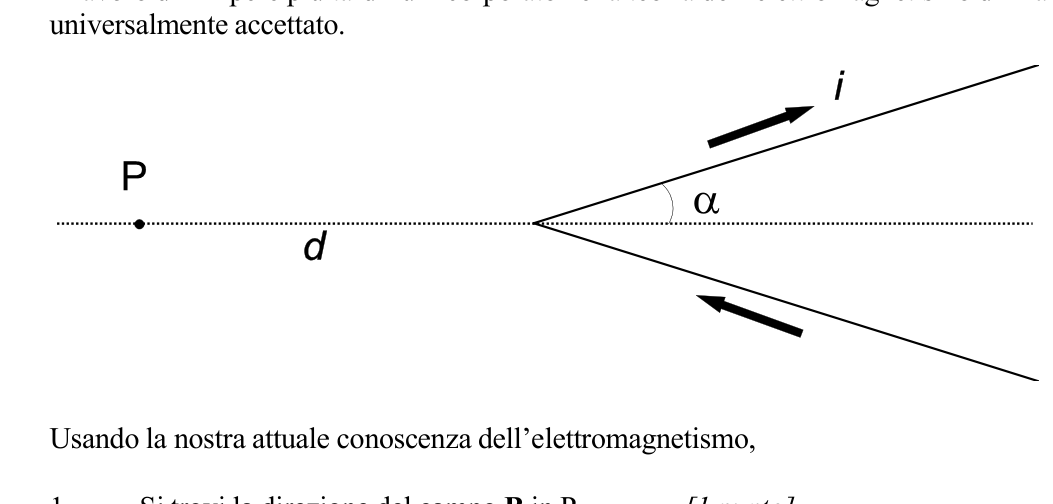
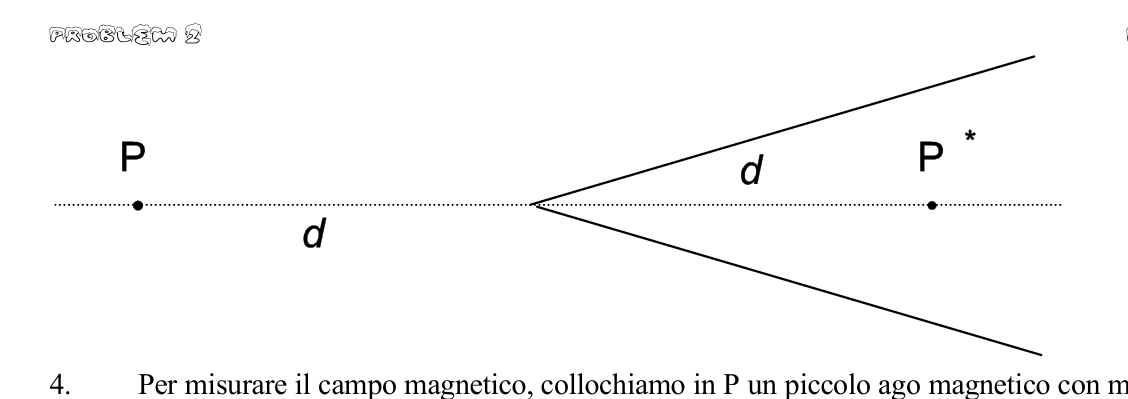
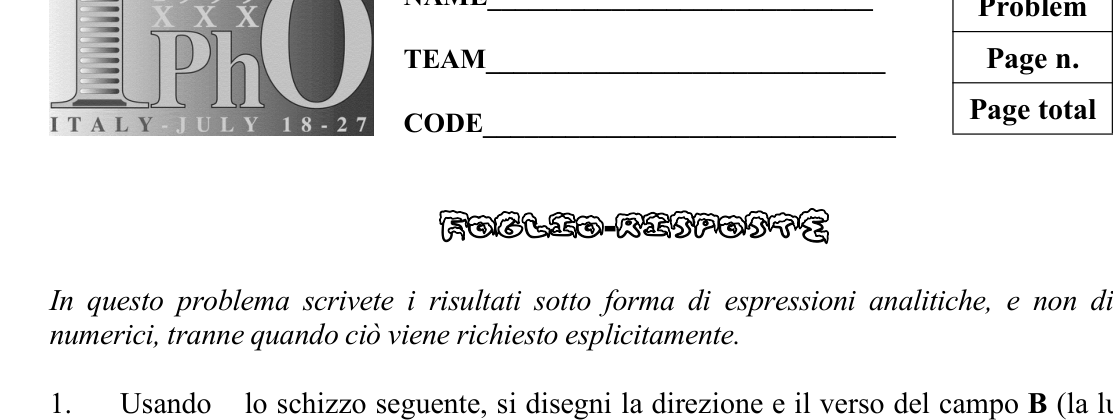
Problema 2 Campo magnetico prodotto da un filo a V Uno dei primi successi dell’interpretazione di Ampère dei fenomeni magnetici fu il calcolo del campo magnetico generato da correnti nei fili. Quest’interpretazione in certi casi era in disaccordo con precedenti ipotesi formulate originariamente da Biot e Savart. Un caso particolarmente interessante è quello di un filo sottile e molto lungo in cui circola una corrente costante , fatto di due tratti rettilinei piegati a formare una “V”, con semiapertura angolare (vedi figura). Secondo i calcoli di Ampère l’ampiezza del campo magnetico in un punto sull’asse della “V”, al di fuori di essa e a una distanza dal suo vertice, è proporzionale a . Il lavoro di Ampère più tardi fu incorporato nella teoria dell’elettromagnetismo di Maxwell, ed ora è universalmente accettato. Usando la nostra attuale conoscenza dell’elettromagnetismo, 1. Si trovi la direzione del campo in . [1 punto] 2. Sapendo che il campo è proporzionale a si trovi il fattore di proporzionalità in . [1.5 punti] 3. Si calcoli il campo in un punto simmetrico di rispetto al vertice, cioè lungo l’asse e alla stessa distanza , ma all’interno della “V” (vedi figura). [2 punti] 1 In questo problema è sempre misurato in radianti. 4. Per misurare il campo magnetico, collochiamo in un piccolo ago magnetico con momento d’inerzia e momento di dipolo magnetico ; esso oscilla attorno a un punto fisso in un piano che contiene la direzione di . Si calcoli il periodo delle piccole oscillazioni di quest’ago in funzione di . [2.5 punti] Nelle stesse condizioni Biot e Savart avevano invece fatto l’ipotesi che il campo magnetico in fosse (usando la notazione moderna) , dove è la permeabilità magnetica del vuoto. In effetti essi cercarono di decidere fra le due interpretazioni (quella di Ampère e quella di Biot e Savart) con un esperimento, misurando il periodo di oscillazione dell’ago magnetico al variare dell’apertura della “V”. Tuttavia, per alcuni valori di le differenze sono troppo piccole per essere facilmente misurabili. 5. Se, per discriminare sperimentalmente fra le due previsioni per il periodo di oscillazione dell’ago magnetico in , abbiamo bisogno di una differenza almeno del 10%, cioè ( è la previsione di Ampère e quella di Biot e Savart), si dica in quale intervallo, approssimativamente, dobbiamo scegliere la semiapertura della “V” per poter discriminare fra le due interpretazioni. [3 punti] Suggerimento A seconda della strada che seguite nella soluzione, la seguente equazione trigonometrica potrebbe esservi utile: NAME____________________________ TEAM_____________________________ CODE______________________________ Foglio-risposte In questo problema scrivete i risultati sotto forma di espressioni analitiche, e non di risultati numerici, tranne quando ciò viene richiesto esplicitamente. 1. Usando lo schizzo seguente, si disegni la direzione e il verso del campo (la lunghezza del vettore non ha importanza). Lo schizzo è in vista prospettica spaziale. 2. Fattore di proporzionalità . 3. Intensità (valore assoluto) del campo magnetico nel punto descritto nel testo Si disegni nello schizzo precedente la direzione di . 4. Periodo delle piccole oscillazioni dell’ago magnetico 5. Si scriva in quale intervallo di valori di (indicando qui i valori numerici degli estremi dell’intervallo) il rapporto fra i periodi di oscillazione, secondo le previsioni di Ampère e di Biot e Savart, è maggiore di 1.10: .
p.5 — Filo a V con punto P, distanza d, angolo alfa
p.6 — Filo a V con punti P e P asterisco
p.7 — Vista prospettica spaziale del filo a V
Topic: Magnetism, Oscillations & Waves, Electromagnetism Metodi: Biot-Savart Law, Ampère’s Law, Simple Harmonic Motion Analysis, Torque & Angular Momentum Analysis Competenze: Mathematical Modeling, Physical Reasoning, Diagrammatic Reasoning Objects: Wire, Magnet Fonte: Testo (PDF) — p.5
Problem two Magnetic field produced by a V-wire One of the first successes of Ampere’s interpretation of magnetic phenomena was the calculation of the magnetic field generated by currents in wires. This interpretation was in some cases at odds with the The Commission has therefore considered that the Commission should be able to assess the compatibility of the measures with the internal market. A particularly interesting case is that of a thin, very long wire in which a a constant current , made up of two straight lines folded to form a “V”, with an angular half-aperture (vedi figura). According to Ampère’s calculations the magnitude of the magnetic field at a point on the ‘V’ axis, outside it and at a distance from its vertex, is proportional to . Ampère’s work was later incorporated into Maxwell’s theory of electromagnetism, and is now The Commission has already adopted a number of proposals. Using our current knowledge of electromagnetism, 1. The direction of the field is in . The following points shall be added: 2. Knowing that the field is proportional to , the proportionality factor is found in . The Commission shall adopt implementing acts in accordance with Article 21 of this Regulation. 3. The field is calculated at a point symmetrical to with respect to the vertex, i.e. along the axis and at the same distance , but within the ‘V’ (see figure). The following points shall be added: 1 In this problem is always measured in radians. 4. To measure the magnetic field, we place in a small magnetic needle with momentum d’inerzia e momento di dipolo magnetico ; esso oscilla attorno a un punto fisso in un Plan containing the direction of . The period of the small oscillations of This is the function of . The following points shall be added: In the same conditions, Biot and Savart had instead hypothesized that the magnetic field in fosse (usando la notazione moderna) , dove è la permeabilità magnetica del vuoto. In fact, they tried to decide between the two interpretations (Ampère’s and Biot’s and Savart) with an experiment, measuring the period of oscillation of the magnetic field at varying The opening of the “V”. However, for some values of the differences are too small to be easily measurable. 5. If, to experimentally distinguish between the two forecasts for the oscillation period If we have a magnetic needle in , we need a difference of at least 10%, that is ( is Ampère’s prediction and is Biot and Savart’s), let’s say in which case interval, approximately, we have to choose the half-opening of the “V” so we can The Commission will be able to draw up a draft directive on the protection of workers’ rights. The following points shall be added: Suggestion Depending on the path you take in the solution, the following trigonometric equation could be be useful: The following is the list of the countries of the European Union: The Commission shall adopt implementing acts in accordance with Article 21 of this Regulation. The following is the list of the countries of the European Union: Paper-reactions In this problem, write the results in the form of analytical expressions, not results. The Commission shall adopt the following measures: 1. Using the following diagram, the direction and direction of the field (length) are drawn The carrier is not important). The sketch is from a spatial perspective. 2. Fattore di proporzionalità . 3. Intensity (absolute value) of the magnetic field in described in , the direction of is drawn in the previous diagram. 4. Period of small magnetic field oscillations 5. Write in which range of values of (indicating here the numerical values of the extremes) The ratio between the periods of oscillation, according to Ampère’s forecasts, is the and of Biot and Savart, it’s greater than 1.10: .
p.5 — Filo a V con punto P, distanza d, angolo alfa
**p.6 ** V-string with points P and P asterisk
p.7 — Vista prospettica spaziale del filo a V
Topic: Magnetism, Oscillations & Waves, Electromagnetism Metodi: Biot-Savart Law, Ampère’s Law, Simple Harmonic Motion Analysis, Torque & Angular Momentum Analysis Competenze: Mathematical Modeling, Physical Reasoning, Diagrammatic Reasoning Objects: Wire, Magnet Fonte: Testo (PDF) — p.5
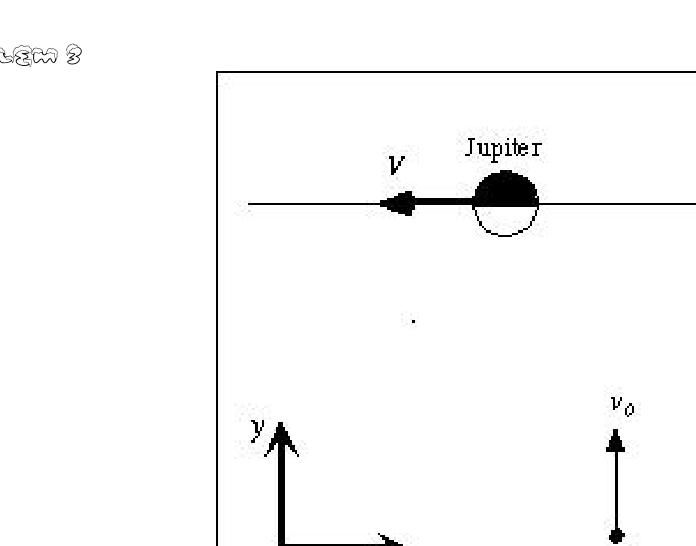
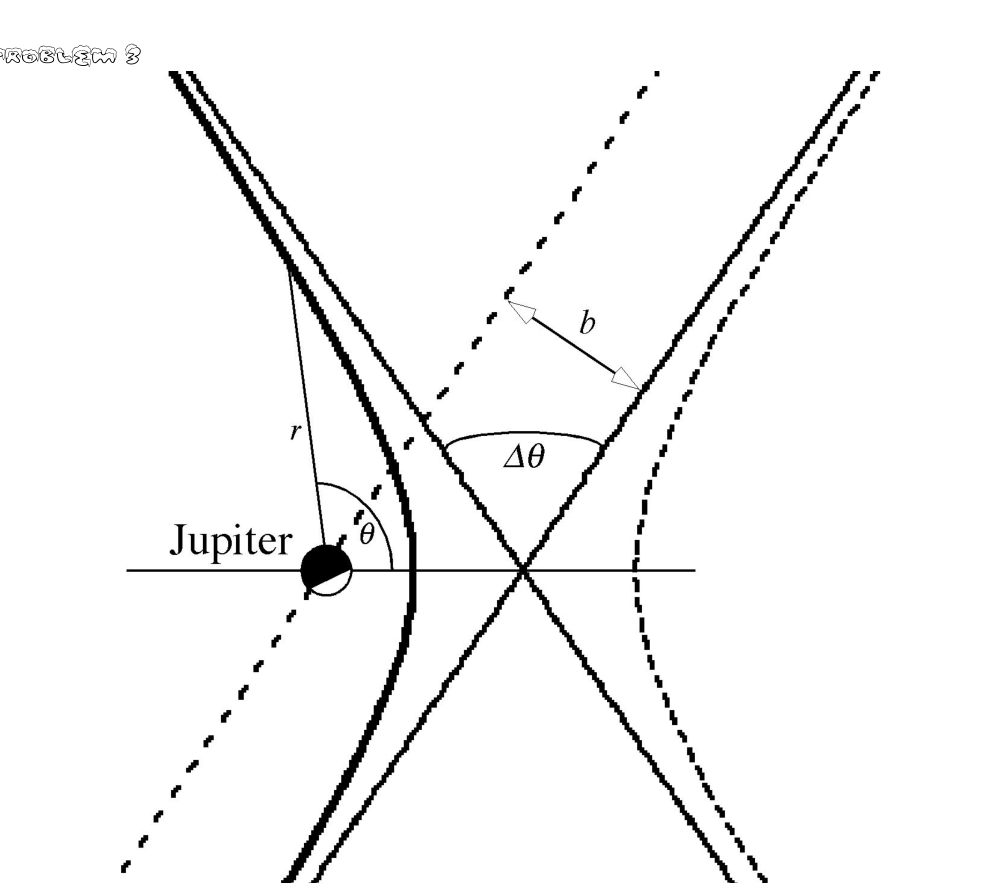
Problema 3 Una sonda spaziale verso Giove In questo problema consideriamo un metodo usato spesso per accelerare sonde spaziali nella direzione voluta. La sonda passa vicino a un pianeta e può aumentare notevolmente la propria velocità e/o variare considerevolmente la sua direzione di volo, scambiando una piccolissima quantità di energia col moto orbitale del pianeta. Studiamo qui quest’effetto per una sonda spaziale che passa vicino a Giove. Il pianeta Giove orbita intorno al Sole lungo una traiettoria ellittica, che possiamo approssimare con una circonferenza di raggio medio ; anzitutto, per procedere con l’analisi della situazione fisica, 1. Si trovi la velocità del pianeta nella sua orbita intorno al Sole. [1.5 punti] 2. Quando la sonda è fra il Sole e Giove (sul segmento Sole-Giove), si trovi la distanza da Giove dove l’attrazione gravitazionale del Sole è uguale a quella di Giove. [1 punto] Una sonda spaziale di massa passa vicino a Giove. Per semplicità si faccia l’ipotesi che la traiettoria della sonda spaziale sia interamente nel piano dell’orbita di Giove; in tal modo non consideriamo un caso importante, quello in cui la sonda spaziale è espulsa dal piano orbitale. Consideriamo soltanto ciò che avviene nella regione in cui l’attrazione di Giove è del tutto preponderante rispetto a tutte le altre interazioni gravitazionali. Nel sistema di riferimento del Sole la velocità iniziale è m/s (nel verso positivo dell’asse ) mentre la velocità di Giove è nel verso negativo dell’asse (vedi figura 1); per “velocità iniziale” intendiamo la velocità della sonda quando è nello spazio interplanetario, ancora distante da Giove ma già nella regione in cui l’attrazione solare è trascurabile rispetto a quella di Giove. Supponiamo che l’incontro avvenga in un tempo abbastanza breve per poter trascurare la variazione di direzione di Giove nella sua orbita intorno al Sole. Consideriamo il caso in cui la sonda passa dietro Giove, cioè l’ascissa è maggiore per la sonda che per Giove quando l’ordinata è la stessa. Figure 1 Vista nel sistema di riferimento del Sole. O indica l’orbita di Giove, S la sonda spaziale. 3. Si trovi la direzione del moto della sonda (cioè l’angolo fra la sua direzione e l’asse ) e la sua velocità nel sistema di riferimento di Giove, quando essa è ancora distante da Giove. [2 punti] 4. Si trovi l’energia totale della sonda spaziale nel sistema di riferimento di Giove, ponendo, come di regola, uguale a zero il valore della sua energia potenziale a distanza molto grande; nel nostro caso quand’essa si muove a velocità praticamente costante in presenza di interazioni gravitazionali molto piccole. [1 punto] La traiettoria della sonda spaziale nel sistema di riferimento di Giove è un ramo di iperbole la cui equazione in coordinate polari, in tale riferimento, è dove è la distanza fra uno degli asintoti e Giove (il cosidetto parametro d’impatto), è l’energia meccanica totale della sonda nel sistema di riferimento di Giove, è la costante di Cavendish, è la massa di Giove, e sono le coordinate polari (la distanza radiale e l’angolo polare). La figura 2 mostra i due rami dell’iperbole, uno dei quali è descritto dall’equazione (1); sono anche mostrati gli asintoti e le coordinate polari. Si noti che l’equazione (1) ha l’origine nel “fuoco attrattivo” dell’iperbole. La traiettoria della sonda spaziale è quella attrattiva (il ramo evidenziato). Figura 2. Traiettoria della sonda nel riferimento di Giove e asintoti dell’iperbole. Jupiter = Giove, Space probe = sonda spaziale. 5. Usando l’equazione (1) che descrive la traiettoria della sonda spaziale, si trovi la deviazione angolare totale nel sistema di riferimento di Giove (come indicato in figura 2) e la si esprima in funzione della velocità iniziale della sonda e del parametro d’impatto . [2 punti] 6. Facendo l’ipotesi che la minima distanza a cui la sonda possa passare da Giove sia pari a tre raggi di Giove dal centro del pianeta, si trovi il valore minimo possibile del parametro d’impatto e il valore massimo possibile della deviazione angolare . [1 punto] 7. Si trovi una formula per la velocità finale nel sistema di riferimento del Sole, in funzione soltanto della velocità di Giove , della velocità iniziale della sonda e dell’angolo di deviazione . [1 punto] 8. Usando i risultati precedenti, si trovi il valore numerico della velocità finale nel sistema di riferimento solare quando la deviazione angolare ha il valore massimo possibile. [0.5 punti] Suggerimento A seconda della strada che scegliete per la soluzione, le seguenti relazioni trigonometriche potrebbero esservi utili: NAME________________________________ TEAM________________________________ CODE________________________________ Foglio-risposte In questo problema dovete scrivere i vostri risultati sia come espressioni analitiche che come risultati numerici con unità (ad esempio ), tranne che dove è richiesto esplicitamente di far diversamente.
- Velocità di Giove lungo la sua orbita
- Distanza da Giove in cui le due attrazioni gravitazionali si eguagliano. .
- Velocità iniziale della sonda spaziale nel sistema di riferimento di Giove … e angolo che la sua direzione forma con l’asse come definito in figura 1,
- Energia totale della sonda spaziale nel sistema di riferimento di Giove …
- Si scriva una formula che dia la deviazione angolare della sonda nel sistema di riferimento di Giove in funzione del parametro d’impatto , della velocità iniziale e di altre quantità note o già calcolate
- Se la distanza della sonda dal centro di Giove non può essere minore di tre volte il raggio di Giove, si dia il valore minimo di e il valore massimo di
- Si scriva una formula che dia la velocità finale della sonda nel sistema di riferimento del Sole in funzione di , e
- Valore numerico della velocità finale nel sistema di riferimento solare quando la deviazione angolare ha il valore massimo calcolato al punto 6. Costanti fisiche e dati generali Oltre ai dati numerici forniti col testo dei singoli problemi, può essere utile la conoscenza di alcuni dati generali e costanti universali, che potete trovare fra quanto segue. Questi dati sono pressoché i più accurati attualmente disponibili, e quindi hanno un alto numero di cifre significative; tuttavia ci si attende che voi scriviate i vostri risultati con un numero di cifre appropriato per ciascun problema. Velocità della luce nel vuoto: Permeabilità magnetica del vuoto: Costante dielettrica del vuoto: Costante di Cavendish: Costante dei gas: Costante di Boltzmann: Costante di Stefan: Carica elementare: Massa dell’elettrone: Costante di Planck: Base della scala Celsius: Massa del Sole: Massa della Terra: Raggio medio della Terra: Semiasse maggiore dell’orbita terrestre: Giorno sidereo: Anno: Valore standard del campo gravitazionale terrestre al livello del mare: Valore standard della pressione atmosferica al livello del mare: Indice di rifrazione dell’aria per luce visibile, a pressione standard e a : Costante solare: Massa di Giove:
p.9 — Figura 1: orbita ellittica nel sistema del Sole
p.10 — Figura 2: traiettoria iperbolica vicino a Giove
Topic: Gravitation, Newtonian Mechanics, Conservation of Energy Metodi: Newton’s Law of Gravitation, Kepler’s Laws, Conservation of Energy, Conservation of Momentum, Vector Decomposition Competenze: Mathematical Modeling, Physical Reasoning, Estimation & Approximation Objects: Satellite, Planet, Star Fonte: Testo (PDF) — p.8
Problem 3 A space probe to Jupiter In this problem we consider a method often used to accelerate space probes in the The direction you want. The probe passes close to a planet and can greatly increase its own speed and/or vary considerably in flight direction, exchanging a very small amount of energy with the planet’s orbital motion. Let’s study this effect for a probe. spacecraft that passes near Jupiter. The planet Jupiter orbits the Sun along an elliptical trajectory, which we can approximate with an average radius of ; first, to proceed with the situation analysis the physics, 1. The planet’s speed is in its orbit around the Sun. The Commission shall adopt implementing acts in accordance with Article 21 of this Regulation. 2. When the probe is between the Sun and Jupiter (in the Sun-Jupiter segment), the distance from the Sun to Jupiter is Jupiter where the gravitational pull of the Sun is equal to that of Jupiter. The following points shall be added: A mass spacecraft passes near Jupiter. For simplicity’s sake, let’s make the assumption that the orbit of the spacecraft is entirely in the plane of Jupiter’s orbit; thus We’re not considering a major case, the one where the spacecraft is ejected from the orbital plane. Consider only what is happening in the region where Jupiter’s attraction is the This is more important than all other gravitational interactions. In the solar reference system the initial speed is m/s (in the direction of the Sun’s orbit). positive of the axis) while the velocity of Jupiter is on the negative side of the axis (see Figure 1); By “starting speed” we mean the speed of the probe when it’s in interplanetary space. It is still far from Jupiter but already in the region where the solar attraction is negligible compared to the The one on Jupiter. Let us suppose that the meeting takes place in a short time To ignore the change in direction of Jupiter in its orbit around the Sun. Consider the In the case where the probe passes behind Jupiter, the is greater for the probe than for Jupiter when the order is the same. Figure 1 Viewed from the solar reference system. Or it’s the orbit of Jupiter, or the space probe. 3. Find the direction of motion of the probe (i.e. the angle between its direction and the axis ) and its speed in the Jupiter reference system, when it is still distant from
- It’s not. The following points shall be added:
The total energy of the spacecraft is found in the reference system of Jupiter, The value of the energy potential at a distance is zero. The speed of the vehicle is very large; in our case when it is moving at a practically constant speed in the There are very small gravitational interactions. The following points shall be added: The trajectory of the space probe in Jupiter’s reference system is a branch of hyperbole whose the polar coordinate equation in that reference is where is the distance between one of the asynchronous points and Jupiter (the so-called impact parameter), is The total mechanical energy of the probe in the Jupiter reference system, is the constant of Cavendish, is the mass of Jupiter, and are the polar coordinates (the radial distance and the The polar angle). Figure 2 shows the two branches of the hyperbole, one of which is described by equation (1); The asynchronous and polar coordinates are also shown. It should be noted that equation (1) has its origin in the Attractive fire of hyperbole. The trajectory of the space probe is the attractive one (the branch The Commission has not yet taken any further action. Figure two. The probe’s trajectory in the reference to Jupiter and asynchronous hyperbole. Jupiter is Jupiter, Space probe = space probe. 5. Using equation (1) describing the trajectory of the spacecraft, the Total angular deviation in the Jupiter reference system (as shown in Figure 1) 2) and expressed as the initial speed of the probe and the parameter The impact of the test is . The following points shall be added: 6. The minimum distance the probe can travel from Jupiter is assumed to be If you have three Jupiter rays from the center of the planet, you have the minimum possible value of the parameter dimpact and the maximum possible value of the angular deviation . The following points shall be added: 7. A formula for the final speed is found in the solar reference system, in a function only of the speed of Jupiter , the initial speed of the probe , and The angle of deflection . The following points shall be added: 8. Using the previous results, we find the numerical value of the end speed in the Solar reference system when the angular deviation is the maximum value I’m sure you can. The following points shall be added: Suggestion Depending on the path you choose for the solution, the following trigonometric relationships may be useful: The name of the person concerned The Commission shall adopt the following measures: The following is the list of the countries of the European Union: Paper-reactions In this problem you have to write your results as both analytical expressions and as numerical results with units (e.g. ), except where required I’m not going to say that I’m not going to do it.
- The speed of Jupiter along its orbit
- Distance from Jupiter where the two gravitational attractions are equal. .
- Initial speed of the space probe in the reference system of Giove … and angle that its direction forms with the axis as defined in Figure 1,
- Total energy of the spacecraft in the Jupiter reference system …
- Write a formula giving the angular deviation of the probe in the reference system of Jupiter according to the impact parameter , the initial velocity and other known quantities or already calculated
- If the distance of the probe from the centre of Jupiter cannot be less than three times the radius of Giove, si dia il valore minimo di e il valore massimo di
- Write a formula that gives the probe’s final speed in the solar reference system in funzione di , e
- The number of end speed values in the solar reference system when the deviation is angular has the maximum value calculated in point 6. Physical constants and general data In addition to the numerical data provided with the text of the individual problems, knowledge of some of the General and universal constant data, which you can find in the following. This data is almost the same as the The most accurate figures currently available, and therefore have a high number of significant figures; however, there are You’re expected to write your results down with the right number of digits for each. I’m not sure. The speed of light in vacuum: The magnetic permeability of the vacuum: Costante dielettrica del vuoto: Costante di Cavendish: Gas constant: The Boltzmann constant is Costante di Stefan: Carica elementare: Mass of the electron: Costante di Planck: Base of the Celsius scale: Mass of the Sun: The mass of the Earth: Average radius of the Earth: Half-length greater than the Earth’s orbit: Giorno sidereo: Anno: Standard value of the ground gravitational field at sea level: Standard mean sea level air pressure: The refractive index of the air by visible light, at standard pressure and at : The solar constant is The mass of Jupiter:
p.9 — Figura 1: orbita ellittica nel sistema del Sole
p.10 — Figura 2: traiettoria iperbolica vicino a Giove
Topic: Gravitation, Newtonian Mechanics, Conservation of Energy Metodi: Newton’s Law of Gravitation, Kepler’s Laws, Conservation of Energy, Conservation of Momentum, Vector Decomposition Competenze: Mathematical Modeling, Physical Reasoning, Estimation & Approximation Objects: Satellite, Planet, Star Fonte: Testo (PDF) — p.8