Theoretical competition. Tuesday, 15 July 2014 1/1
Problema n. 1 (9 punti)
Questo problema è formato da tre parti indipendenti.
Parte A (3 punti)
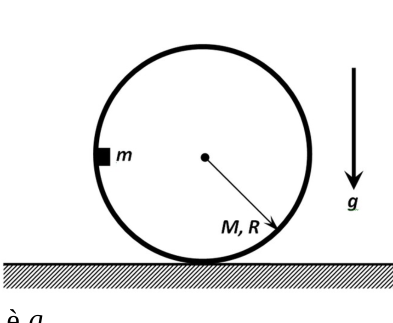
Un piccolo blocco di massa è delicatamente posto sulla superficie interna di un sottile cilindro cavo di massa e raggio . Inizialmente il cilindro è fermo su un piano orizzontale e il blocco è posto fermo ad un’altezza sopra il piano, come mostrato nella figura a sinistra. Trovare la forza di interazione tra il blocco e il cilindro nel momento in cui il blocco descrive il punto più basso della sua traiettoria. Si assuma che non ci sia attrito tra il blocco e la superficie interna del cilindro e che il cilindro si muova sul piano senza strisciare. L’accelerazione di gravità è .
Parte B (3 punti)
Una bolla di raggio , che contiene un gas perfetto biatomico, è formata da una pellicola di sapone di spessore ed è posta nel vuoto. La pellicola di sapone ha una tensione superficiale e una densità .
-
Trovare la formula per la capacità termica molare del gas nella bolla per un processo in cui il gas è riscaldato così lentamente che la bolla rimane in equilibrio meccanico e successivamente calcolarne il valore.
-
Si consideri ora che il raggio della bolla possa variare. Trovare la formula per la frequenza delle piccole oscillazioni del raggio e calcolarne il valore assumendo che la capacità termica della pellicola di sapone sia molto maggiore della capacità termica del gas nella bolla. Si assuma anche che l’equilibrio termico all’interno della bolla sia raggiunto molto più rapidamente della durata del periodo di oscillazione.
Suggerimento: Laplace ha dimostrato che c’è una differenza di pressione tra i due spazi separati da una superficie curva generica, la quale è causata dalla tensione superficiale che si forma sulla interfaccia che separa un liquido da un gas, ovvero .
Parte C (3 punti)
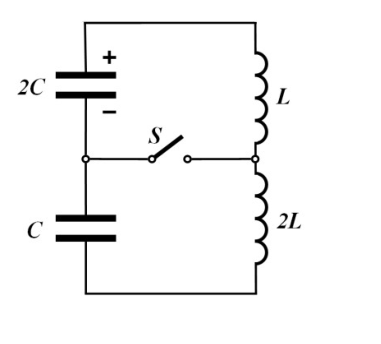
Nel circuito mostrato nella figura a destra, inizialmente l’interruttore è aperto, il condensatore di capacità ha una carica elettrica e quello di capacità è scarico, inoltre non passa corrente elettrica in nessuna delle due bobine di induttanza rispettivamente e . Il condensatore inizia ora a scaricarsi e nel momento in cui la corrente elettrica nelle bobine raggiunge il massimo valore, l’interruttore viene istantaneamente chiuso. Trovare la massima corrente che attraversa l’interruttore subito dopo.
p.1 — Blocco m dentro cilindro cavo M, R
p.1 — Circuito con condensatori 2C, C e induttori L, 2L
Topic: Newtonian Mechanics, Thermodynamics, Circuits Metodi: Conservation Laws, Energy Conservation Method, Free-Body Diagram, Ideal Gas Law, Simple Harmonic Motion Analysis, Kirchhoff’s Laws Competenze: Mathematical Modeling, Physical Reasoning, Diagrammatic Reasoning Objects: Block, Cylinder, Bubble, Gas, Capacitor Fonte: Testo (PDF) — p.1 Soluzione: Soluzioni (PDF)
Theoretical competition. The following is the list of the countries of the European Union:
The Commission shall adopt the following: 1 (9 points)
This problem is made up of three independent parties.
Part A (3 points)
A small mass block is gently placed on the inner surface of a thin cable cylinder of mass and radius . Initially the cylinder is fixed on a horizontal plane and the block is fixed at a height above the plane, as shown in the figure on the left. Find the force of interaction between the block and the cylinder at the time the block describes the lowest point of its trajectory. It is assumed that there is no friction between the block and the inner surface of the cylinder and that the cylinder moves flat without cracking. The acceleration by gravity is .
Part B (3 points)
A beam bubble, containing a perfect biatomic gas, is made of a soap film of thickness and is placed in the vacuum. The soap film has a surface tension and a density .
-
Find the formula for the molar thermal capacity of the gas in the bubble for a process where the gas is heated so slowly that the bubble remains in mechanical equilibrium and then calculate its value.
-
Consider now that the radius of the bubble may vary. Find the formula for the frequency of small radius oscillations and calculate its value assuming that the thermal capacity of the soap film is much greater than the thermal capacity of the gas in the bubble. It is also assumed that the thermal balance within the bubble is reached much faster than the duration of the oscillation period.
Tip: Laplace showed that there is a pressure difference between the two spaces separated by a generic curved surface, which is caused by the surface tension that forms on the interface separating a liquid from a gas, or .
Part C (3 points)
In the circuit shown in the figure to the right, the switch is initially open, the capacitor has an electrical charge and the capacitor is discharged, and no electric current is passed to either of the two induction coils and respectively. The capacitor will now start discharging and when the current in the coils reaches its maximum value, the switch will be shut down instantly. Find the maximum current that passes through the switch immediately afterwards.
The following table shows the number of units of the vehicle:
**p.1 ** Circuit with 2C, C capacitors and L, 2L inductors
Topic: Newtonian Mechanics, Thermodynamics, Circuits Metodi: Conservation Laws, Energy Conservation Method, Free-Body Diagram, Ideal Gas Law, Simple Harmonic Motion Analysis, Kirchhoff’s Laws Competenze: Mathematical Modeling, Physical Reasoning, Diagrammatic Reasoning Objects: Block, Cylinder, Bubble, Gas, Capacitor Fonte: Testo (PDF) — p.1 Soluzione: Soluzioni (PDF)