41esima Olimpiade Internazionale della Fisica – Prova Teorica, 19 Luglio 2010 1/3
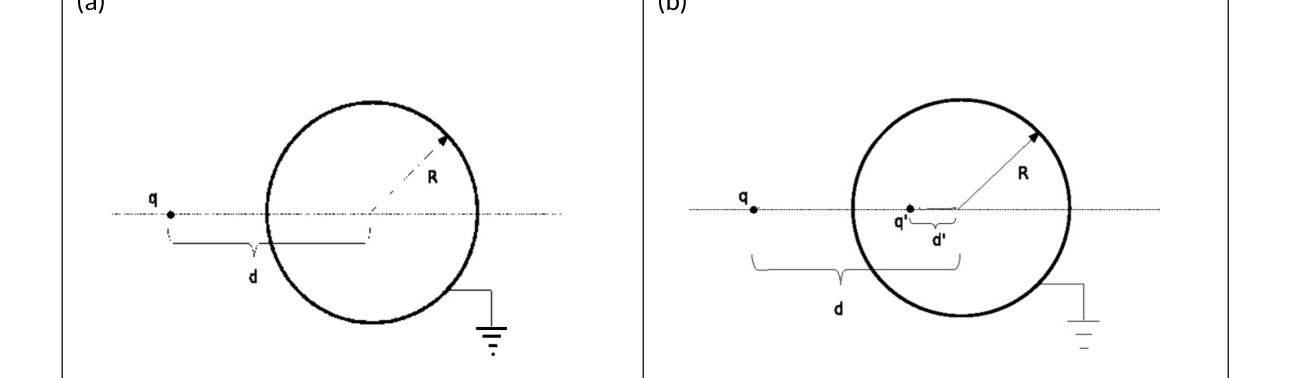
- Carica immagine in un oggetto metallico Introduzione – Metodo delle immagini Una particella puntiforme di carica elettrica è posizionata nelle vicinanze di una superficie sferica metallica collegata elettricamente a terra e di raggio [vedi Fig. 1(a)]. Di conseguenza, sulla sfera viene indotta una distribuzione superficiale di carica. Riuscire a calcolare il campo elettrico ed il potenziale elettrostatico prodotti dalla distribuzione della carica superficiale è un compito assai improbo. Tuttavia tale calcolo può essere considerevolmente semplificato utilizzando un metodo matematico chiamato metodo delle immagini. In questo metodo il campo elettrico ed il potenziale elettrostatico prodotti dalla carica distribuita sulla sfera sono equivalenti a quelli prodotti da una singola carica puntiforme posta dentro la sfera (non devi dimostrare ciò). Nota: Il campo elettrico ed il potenziale elettrostatico di questa carica immagine riproducono il campo elettrico ed il potenziale elettrostatico solamente all’esterno della sfera (compresa la sua superficie). (a) (b)
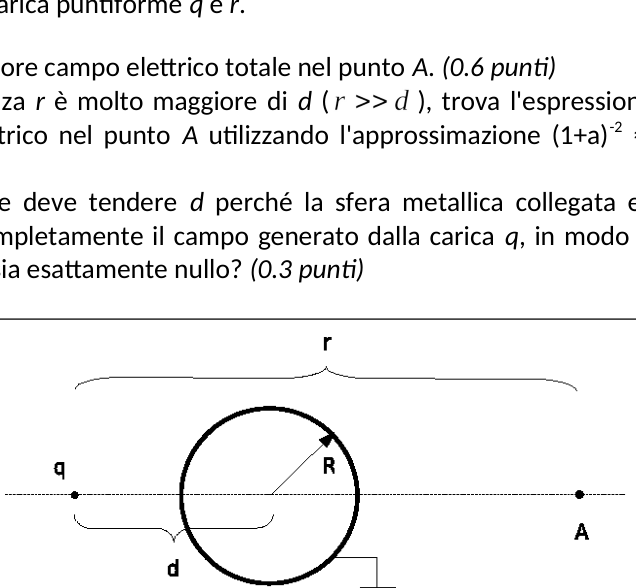
Fig 1. (a) Una carica puntiforme è posizionata nelle vicinanze di una sfera metallica collegata elettricamente a terra. (b) Il campo elettrico della carica indotta sulla sfera è equivalente al campo elettrico dovuto a una carica immagine . Parte 1 – La carica immagine Per la simmetria del sistema la carica si trova sulla linea congiungente la carica puntiforme e il centro della sfera [vedi Fig. 1(b)]. a) Qual è il valore del potenziale elettrostatico della sfera in figura? (0.3 punti) b) Esprimi e la distanza della carica dal centro della sfera, in funzione di , e . (1.9 punti) c) Trova l’espressione dell’intensità della forza che agisce sulla carica . Si tratta di una forza repulsiva? (0.5 punti) Parte 2 – Schermaggio di un campo elettrostatico Considera una particella puntiforme di carica q posizionata a distanza d dal centro di una sfera metallica di raggio R collegata elettricamente a terra. Siamo interessati a come la presenza della sfera metallica collegata elettricamente a terra modifica il campo elettrico in un punto A posizionato sul
41esima Olimpiade Internazionale della Fisica – Prova Teorica, 19 Luglio 2010 2/3 lato opposto della sfera (vedi Fig. 2). Il punto A è sulla retta che unisce la carica q al centro della sfera; la distanza di A dalla carica puntiforme q è r. a) Trova il vettore campo elettrico totale nel punto A. (0.6 punti) b) Se la distanza r è molto maggiore di d ( ), trova l’espressione approssimata per il campo elettrico nel punto A utilizzando l’approssimazione (1+a)-2 1-2a, dove . (0.6 punti) c) A che limite deve tendere d perché la sfera metallica collegata elettricamente a terra schermi completamente il campo generato dalla carica q, in modo che il campo elettrico totale in A sia esattamente nullo? (0.3 punti) Fig 2. Il campo elettrico in A è parzialmente schermato dalla sfera collegata elettricamente a terra. Parte 3 – Piccole oscillazioni nel campo elettrico generato dalla sfera metallica Una particella puntiforme di carica q e massa m è legata a un filo di lunghezza L che ha l’altra estremità fissata a un muro nelle vicinanze della sfera metallica collegata elettricamente a terra. Nelle tue considerazioni, ignora tutti gli effetti elettrostatici prodotti dal muro. La particella puntiforme si comporta come un pendolo matematico (vedi Fig. 3). Il punto al quale il filo è fissato al muro si trova a distanza dal centro della sfera. Trascura gli effetti della gravità. a) Trova il modulo della forza elettrica che agisce sulla carica puntiforme q per un certo angolo e indicane chiaramente la direzione in un disegno (0.8 punti) b) Per questa forza, esprimi la componente perpendicolare al filo in funzione di , L, R, q e . (0.8 punti) c) Trova la frequenza delle piccole oscillazioni del pendolo. (1.0 punti) Fig 3. Una carica puntiforme nelle vicinanze di una sfera metallica collegata a terra oscilla come un pendolo.
41esima Olimpiade Internazionale della Fisica – Prova Teorica, 19 Luglio 2010 3/3 Parte 4 – L’energia elettrostatica del sistema Data una distribuzione di cariche elettriche, è importante calcolare l’energia elettrostatica del sistema. Nel nostro problema (vedi Fig. 1a), c’è interazione elettrostatica tra la carica q esterna alla sfera e le cariche indotte sulla superficie della sfera ed è presente un’interazione elettrostatica anche tra le cariche indotte sulla sfera. In funzione della carica q, del raggio R della sfera e della distanza d determina le seguenti energie elettrostatiche: a) l’energia elettrostatica dovuta all’interazione tra la carica q e le cariche indotte sulla sfera; (1.0 punti) b) l’energia elettrostatica dovuta all’interazione tra le cariche indotte sulla sfera; (1.2 punti) c) l’energia elettrostatica totale del sistema dovuta all’interazione. (1.0 punti) Suggerimento: Ci sono almeno due modi diversi di risolvere il problema: (1) Puoi sfruttare il seguente integrale: . (2) Un altro modo è usare il fatto che per una famiglia di N cariche puntiformi posizionate nei punti , l’energia elettrostatica la semisomma su tutte le coppie di cariche diverse:
p.1 — Carica vicino a sfera metallica, pannelli (a) e (b)
p.2 — Carica vicino a sfera collegata a terra
Topic: Electrostatics, Oscillations & Waves, Conservation of Energy Metodi: Electric Potential Method, Coulomb’s Law, Approximation & Series Expansion, Simple Harmonic Motion Analysis, Energy Conservation Method Competenze: Mathematical Modeling, Physical Reasoning, Diagrammatic Reasoning Objects: Point Charge, Conducting Sphere, Pendulum Fonte: Testo (PDF) — p.1
41st International Physics Olympics Theoretical proof, 19 July 2010 1/3
- Loading images into a metal object Introduction Method of imaging A pointed particle of electric charge It is situated near a spherical surface. Electrically connected earth and radium metal (see Fig. 1(a)]. The Commission has therefore decided to a superficial distribution of charge is induced. The electric field and the The electrostatic potential produced by the surface charge distribution is a very difficult task. I’m not. However, this calculation can be considerably simplified by using a methodology mathematical method called the imaging method. In this method the electric field and the potential The electrostatic charge produced by the sphere is equivalent to that produced by a single point load You don’t have to prove that. Note: The electric field And the electrostatic potential of this charge image The electric field and the electrostatic potential only outside the sphere (including its surface). (a) (b)
Figure one. (a) A pointed load It is located near a metallic sphere connected to it. electrically on the ground. (b) The electric field of the charge induced on the sphere is equal to the field Electrical due to a charge image . Part 1 The image load For the symmetry of the system the charge The pointed charge is on the connecting line e il the centre of the sphere [see Fig. 1(b)]. a) What is the value of the electrostatic potential of the sphere in the figure? (Documents and documents) b) Expressions and distance of the load from the centre of the sphere, depending on the , e . The Commission’s proposal for a directive on the protection of workers’ rights c) Find the expression of the intensity of the force acting on the load . It’s a The repulsive force? (0.5 points) Part 2 Scanning of an electrostatic field Consider a pointed charge particle q located at a distance d from the centre of a sphere R-ray metal electrically connected to the ground. We’re interested in how the presence of the sphere Electrically connected metal ground modifies the electric field at a point A on the
41st International Physics Olympics Theoretical proof, 19 July 2010 2/3 The opposite side of the sphere (see Fig. 2). The point A is on the straight line joining the charge q to the center of the sphere; The distance of A from the point charge q is r. a) Find the total electric field vector at point A. (0.6 points) b) If the distance r is much greater than d ( ), finds the approximate expression for the electric field in point A using the approximation (1+a)-2 1-2a, where . (0.6 points) c) To what extent must it tend d because the metal ball electrically connected to the ground The electric field is completely displaced by the charge q, so that the electric field is Is total in A exactly zero? (Documents and documents) Figure two. The electric field in A is partially shielded by the sphere electrically connected to the ground. Part 3 Small oscillations in the electric field generated by the metal sphere A pointed particle with a charge q and mass m is bound to a length L string that has the other an end fixed to a wall near the metal sphere electrically connected to the ground. In your opinion, he ignores all the electrostatic effects produced by the wall. The particle The point shape behaves like a mathematical pendulum (see Fig. 3). The point at which the wire is fixed to the The wall is in the distance. From the center of the sphere. It’s tracking the effects of gravity. a) Find the electrical force modulation acting on the q-point charge at a certain angle and clearly indicate the direction in a drawing (0.8 points) b) For this force, express the component perpendicular to the wire as , L, R, q e . (i.e. the number of points) c) Find the frequency of the small oscillations of the pendulum. The following points are added: Figure three. A pointed charge near a metal ball connected to the ground oscillates as a The pendulum.
41st International Physics Olympics Theoretical proof, 19 July 2010 3/3 Part 4 The electrostatic energy of the system Given the distribution of electrical charges, it is important to calculate the electrostatic energy of the The system. In our problem (see Fig. 1a), there is an electrostatic interaction between the external charge q at the The sphere and the induced charges on the surface of the sphere and there is an electrostatic interaction also between the induced charges on the sphere. Depending on the charge q, radius R of the sphere and distance d It shall generate the following electrostatic energies: a) the electrostatic energy due to the interaction between the q charge and the induced charges on the sphere; The following points are added: b) Electrostatic energy due to the interaction between the charges induced on the sphere (1.2 points) c) the total electrostatic energy of the system due to the interaction. The following points are added: Tip: There are at least two different ways to solve the problem: (1) You can use the following integer: . (2) Another way is to use the fact that for a family of N point-form charges located in points , electrostatic energy is half that on all different charge pairs:
**p.1 ** Load near metal sphere, panels (a) and (b)
**p.2 ** Load near ground-connected sphere
Topic: Electrostatics, Oscillations & Waves, Conservation of Energy Metodi: Electric Potential Method, Coulomb’s Law, Approximation & Series Expansion, Simple Harmonic Motion Analysis, Energy Conservation Method Competenze: Mathematical Modeling, Physical Reasoning, Diagrammatic Reasoning Objects: Point Charge, Conducting Sphere, Pendulum Fonte: Testo (PDF) — p.1