2)(V−b )=RT
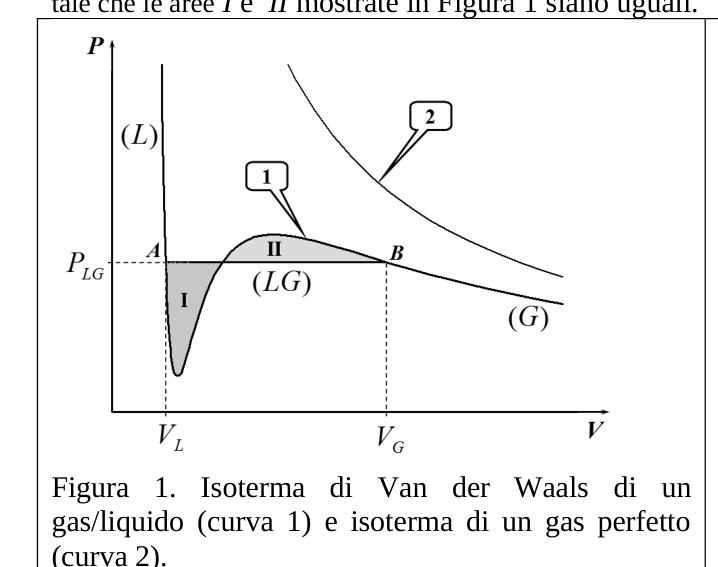
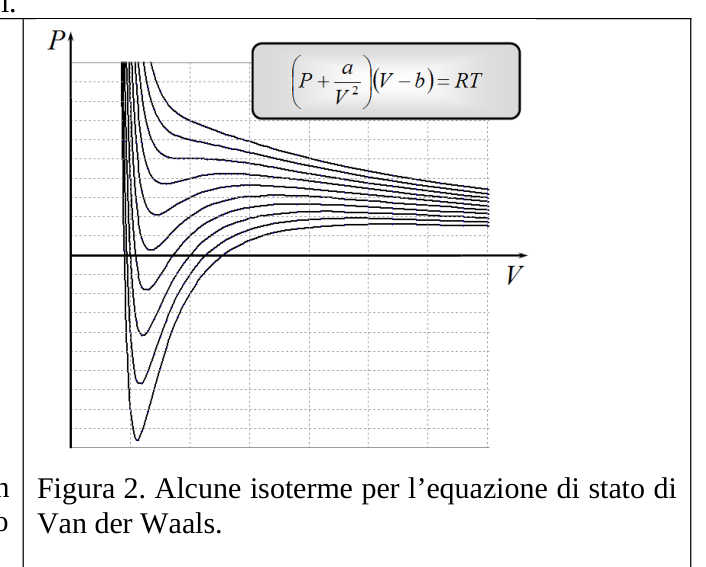
Theoretical competition. Tuesday, 15 July 2014 1/3 Problema n. 2. Equazione di stato di Van der Waals (11punti) Nel ben noto modello di gas perfetto, la cui equazione di stato obbedisce alla legge di Clapeyron- Mendeleev, sono trascurati i seguenti importanti effetti fisici. Primo, le molecole di un gas reale hanno una dimensione finita e, secondo, esse interagiscono una con l’altra. In questo problema si considera una mole d’acqua. Parte А. Equazione di stato di un gas non perfetto (2 punti) Tenendo conto delle dimensioni finite delle molecole, l’equazione di stato dei gas prende la forma: P )=RT, (1) dove P,V ,T sono rispettivamente la pressione del gas, il volume di una mole e la temperatura, R è la costante universale dei gas e b è una costante che rappresenta un qualche volume. A1 Individuare una possibile relazione tra b e il diametro d delle molecole. (0.3 punti) Tenendo conto dell’attrazione delle forze intermolecolari, Van der Waals propose la seguente equazione di stato che descrive entrambi gli stati della materia: liquido e gassoso. (P+ a V )=RT. (2) dove a è un’altra costante opportuna. Per temperature T, al di sotto di un valore critico T c, l’isoterma dell’equazione (2) viene rappresentata bene dalla curva 1, mostrata in Figura 1, che non è monotona e che è detta isoterma di Van der Waals. Nella stessa figura, la curva 2 mostra l’isoterma di un gas perfetto alla stessa temperatura T. Una isoterma reale differisce però dalla isoterma di van der Waals per un segmento orizzontale, АВ, tracciato ad una certa pressione costante PLG. Questo segmento è posizionato tra i volumi V L e V G, e corrisponde all’equilibrio tra la fase liquida (indicata con il pedice L) e quella gassosa (indicata con il pedice G). Per la seconda legge della termodinamica J. Maxwell ha dimostrato che la pressione PLG deve essere scelta in modo tale che le aree I e II mostrate in Figura 1 siano uguali. Figura 1. Isoterma di Van der Waals di un gas/liquido (curva 1) e isoterma di un gas perfetto (curva 2). Figura 2. Alcune isoterme per l’equazione di stato di Van der Waals. Al crescere della temperatura il segmento AB nell’isoterma si riduce fino a diventare un singolo punto in cui la temperatura e la pressione raggiungono rispettivamente i valori T c e PLG=Pc. I parametri Pc e T c sono detti critici e possono essere misurati sperimentalmente con un elevato grado di precisione. A2 Esprimere le costanti di Van der Waals, a e b, in funzione di T c e Pc. (1.3 punti) A3 Per l’acqua T c=647 K e 7Pa. Calcolare aw and bw per l’acqua. (0.2 punti) A4 Stimare il diametro della molecola d’acqua dw. (0.2 punti)
Theoretical competition. Tuesday, 15 July 2014 2/3 Parte B. Proprietà di gas e liquidi (6 punti) Questa parte del problema tratta delle proprietà dell’acqua allo stato gassoso e liquido alla temperatura . È noto che la pressione di vapore saturo a questa temperatura è 5 Pa, e la massa molare dell’acqua è kg mole. Stato gassoso Per la descrizione delle proprietà dell’acqua allo stato gassoso è ragionevole assumere che valga la disuguaglianza V . B1 Ricavare la formula per il volume V G ed esprimerla in funzione di R,T , p0 ed a. (0.8 punti) Il volume V G0 può essere approssimativamente valutato utilizzando la legge dei gas perfetti. B2 Valutare in percentuale la diminuzione relativa del volume del gas dovuta alle forze intermolecolari, G V G0 =V G V G0 . (0.3 punti) Se il volume del sistema scende sotto V G, il gas inizia a condensare. Se il gas è abbastanza puro, può rimanere in uno stato meccanicamente metastabile (detto vapore soprassaturo) fino a quando il suo volume raggiunge un certo valore V Gmin. La condizione di stabilità meccanica di gas soprassaturo a temperatura costante è data da: dP dV <0. В3 Trovare e valutare quante volte il volume del vapore acqueo può essere ridotto mentre rimane in uno stato metastabile. In altre parole, calcolare V G/V G min. (0.7 punti) Stato
liquido
Per descrivere il comportamento dell’acqua allo stato liquido, secondo l’equazione di Van der Waals, è ragionevole assumere la seguente disuguaglianza 2. B4 Esprimere il volume dell’acqua liquida V L in funzione di a,b, R e T. (1 punto) Assunto che bRT , trovare le seguenti proprietà caratteristiche dell’acqua. Non sorprenderti se qualcuno dei valori che ottieni non coincide con quelli noti! B5 Esprimere la densità dell’acqua liquida, L, usando qualcuno dei termini . Calcolare, quindi, il suo valore. (0.3 punti) B6 Esprimere il coefficiente di dilatazione termica 1 V L L usando qualcuno dei termini di a,b, R. Calcolare, quindi, il suo valore. (0.6 punti) B7 Esprimere il calore latente di vaporizzazione dell’acqua L usando qualcuno dei termini di . Calcolare, quindi, il suo valore. (1.1 punti) B8 Considerare uno strato mono molecolare di acqua e stimarne la tensione superficiale . (1.2 punti) Parte С. Sistema liquido-gas (3punti) Dalla regola di Maxwell e dall’equazione di Van der Waals, cioè tenendo conto dell’uguaglianza delle aree ed eseguendo un semplice integrale, si può dimostrare (utilizzando anche le approssimazioni fatte nella Parte B) che la tensione di vapore saturo PLG dipende dalla temperatura T come segue ln PLG=A+ B T . (3) A e B sono delle costanti opportune che si esprimono in termini di a e b come segue A=ln( a b , bR .
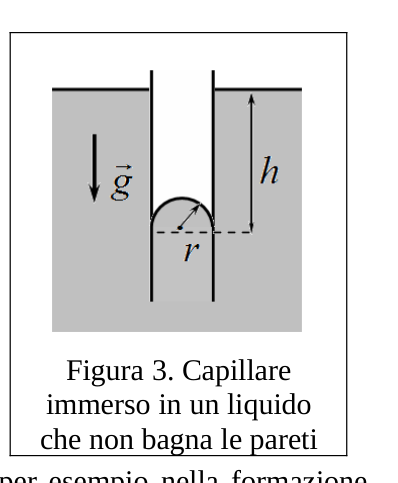
Theoretical competition. Tuesday, 15 July 2014 3/3 W. Thomson ha mostrato che la pressione di vapore saturo dipende dalla curvatura della superficie del liquido. Si consideri un liquido che non bagna le pareti di un capillare (angolo di contatto uguale a ). Quando il capillare è immerso nel liquido, il liquido nel capillare si abbassa fino ad un certo livello a causa della tensione superficiale (vedi Figura 3). С1 Trovare la (piccola) variazione di pressione del vapore saturo che si trova al di sopra della superficie curva del liquido. Esprimere il risultato in termini della densità del vapore, , della densità del liquido, , della tensione superficiale, , e del raggio di curvatura r della superficie. (1.3 punti) Gli stati metastabili, considerati nella Parte B3, sono largamente utilizzati in apparati sperimentali quali le camere a nebbia utilizzate per rilevare le particelle elementari. Essi inoltre si verificano anche in natura, per esempio nella formazione della rugiada mattutina. Il vapore soprassaturo condensa formando goccioline di liquido. Goccioline molto piccole evaporano rapidamente, ma quelle sufficientemente grandi possono crescere. C2 Si supponga che, una sera, la temperatura sia t e che il vapore acqueo nell’aria sia saturo. La mattina seguente, la temperatura ambiente è scesa di un piccolo . Assumendo che la pressione di vapore saturo non sia cambiata, stimare il minimo raggio delle goccioline che possono crescere. Utilizzare il valore tabulato della tensione superficiale dell’acqua, . (1.7 punti) Figura 3. Capillare immerso in un liquido che non bagna le pareti
p.1 — Isoterma di Van der Waals gas/liquido
p.1 — Alcune isoterme dell’equazione di Van der Waals
p.3 — Capillare immerso in liquido non bagnante
Topic: Thermodynamics, Kinetic Theory, Fluid Mechanics Metodi: Ideal Gas Law, Approximation & Series Expansion, Calculus-Integration, Physical Modeling, Thermodynamic Cycle Analysis Competenze: Mathematical Modeling, Physical Reasoning, Estimation & Approximation Objects: Gas, Droplet Fonte: Testo (PDF) — p.1 Soluzione: Soluzioni (PDF)
2)(V−b )=RT
Theoretical competition. The Commission’s decision on the application of this Regulation The Commission shall adopt the following: 2. The following table shows the statistical data of the statistical data of the statistical data of the statistical data of the statistical data of the statistical data of the statistical data of the statistical data of the statistical data of the statistical data of the statistical data of the statistical data of the statistical data of the statistical data of the statistical data of the statistical data of the statistical data of the statistical data of the statistical data of the statistical data of the statistical data of the statistical data of the statistical data of the statistical data of the statistical data of the statistical data of the statistical data of the statistical data of the statistical data of the statistical data of the statistical data of the data of the statistical data. In the well-known perfect gas model, whose equation of state obeys Clapeyron’s law Mendeleev, the following important physical effects are overlooked. First, the molecules of a real gas have a The two dimensions are finite and, second, they interact with each other. In this problem, we consider a mole
- I’m not going to. Part A. Equation of state of an imperfect gas (2 points) Taking into account the finite dimensions of the molecules, the gas state equation takes the form: P )=RT, (1) where P, V, T are respectively the gas pressure, volume of a mole and temperature, R is the The universal gas constant and b is a constant that represents some volume. A1 Identify a possible relationship between b and the diameter d of the molecules. (Documents and documents) Taking into account the attraction of intermolecular forces, Van der Waals proposed the following: state equation describing both states of matter: liquid and gaseous. (P+ a V )=RT. (2) where a is another appropriate constant. For temperatures T below a critical value T c, the isotherm of the equation (2) is This is well represented by curve 1, shown in Figure 1, which is not monotonous and is called Van der Isotherm. Waals. In the same figure, curve 2 shows the isotherm of a perfect gas at the same temperature T. One of them. However, the actual isotherm differs from van der Waals’s isotherm by a horizontal segment, AВ, traced to a certain constant pressure PLG. This segment is positioned between volumes V L and V G, and corresponds to the balance between the liquid phase (indicated with the L-point) and the gaseous phase (indicated with the G-point). For the Second law of thermodynamics J. Maxwell showed that the PLG pressure must be chosen so that the so that areas I and II shown in Figure 1 are the same. Figure 1 is shown. Van der Waals isotherm of a Gas/liquid (curve 1) and isotherm of a perfect gas (curve 2) Figure two. Some isotherms for the state equation of I’m going to tell you something. As the temperature increases, the AB segment in the isotherm shrinks to become a single point where the temperature and pressure reach T c and PLG=Pc respectively. The parameters Pc The results of the experiment are described as ‘critical’ and can be measured experimentally with a high degree of accuracy. A2 Express the Van der Waals constants a and b, as a function of T c and Pc. The Commission shall adopt implementing acts in accordance with Article 21 of this Regulation. A3 For water T c=647 K and 7Pa. Calculate aw and bw for water. (0.2 points) A4 Estimate the diameter of the water molecule dw. (0.2 points)
Theoretical competition. The Commission shall adopt implementing acts in accordance with Article 21 of the Financial Regulation. Part B. Property of gases and liquids (6 points) This part of the problem deals with the properties of water in the gaseous and liquid state in the temperatura . It is known that the saturated vapor pressure at this temperature is 5 Pa, and the molar mass of the water is kg I’m going to be a mole. Gas state For the description of the properties of water in the gaseous state it is reasonable to assume that it is worth the disuguaglianza V . B1 Find the formula for volume V G and express it as a function of R, T, p0 and a. (i.e. the number of points) The volume V G0 can be approximated using the perfect gas law. B2 Assess the relative decrease in gas volume due to intermolecular forces as a percentage, G V G0 =V G V G0 . (Documents and documents) If the volume of the system drops below V G, the gas begins to condense. If the gas is pure enough, it can remain in a mechanically metastable state (called overpressure steam) until its volume reaches a certain value of V Gmin. The condition of mechanical stability of the constant temperature supersaturated gas is given by: dP dV <0. В3 Find and evaluate how many times the volume of water vapor can be reduced while remaining in a It was metastable. In other words, calculate V G/V G min. (0.7 points) State of the Union
Liquid
To describe the behavior of water in the liquid state, according to the Van der Waals equation, It is reasonable to assume the following inequality 2. B4 Express the volume of liquid water V L in terms of a,b,R and T. (a) the number of days Assuming that bRT , find the following characteristic properties of water. Don’t be surprised if Some of the values you get don’t match the known ones! B5 Express the density of liquid water, L, using some of the terms . Calculate the So, its value. (Documents and documents) B6 Express the coefficient of thermal expansion 1 V L L using some of the terms of a,b,R. Calculate its value, then. (0.6 points) B7 Express the latent heat of water vaporization L using some of the terms . Calculate its value, then. The Commission shall adopt implementing acts in accordance with Article 21 of this Regulation. B8 Consider a mono-molecular layer of water and estimate its surface tension . The Commission shall adopt implementing acts in accordance with Article 21 of this Regulation. Part C. Liquid-gas system (3 points) From Maxwell’s rule and Van der Waals’ equation, that is, taking into account equality The results of the analysis of the data are presented in the following table: in Part B) that the PLG saturated vapour voltage depends on the temperature T as follows: In PLG = A+B T . (3) A and B are appropriate constants expressed in terms of a and b as follows A=ln( a b , bR .
Theoretical competition. The Commission shall adopt implementing acts in accordance with Article 21 of the Financial Regulation. W. Thomson showed that saturated vapor pressure depends on the curvature of the surface of the liquid. It is considered a liquid that does not wash the walls of a capillary (angle of contact equal to ). When the The capillary is submerged in the fluid, the fluid in the capillary is lowered to a The surface tension is due to a certain level (see Figure 3). С1 Find the (small) pressure change of the saturated vapor It is located above the curved surface of the liquid. Expressing The result in terms of the steam density, , of the density of the liquido, , della tensione superficiale, , e del raggio di curvatura r of the surface. The Commission shall adopt implementing acts in accordance with Article 21 of this Regulation. Metastable states, considered in Part B3, are broadly For the purposes of this Regulation, the following definitions shall apply: I’m going to pick up the elementary particles. They also occur in nature, for example in training. of the morning dew. The supersaturated vapor condenses to form droplets of liquid. Very little Small ones evaporate quickly, but large ones can grow. C2 Suppose that, one evening, the temperature is t and that the water vapour in the air is saturated. La The following morning, the ambient temperature dropped by a small . Assuming that the saturated vapour pressure has not changed, estimate the minimum droplet radius that can be I’m going to grow up. Use the table value of the surface tension of the water, . (1.7 (point) Figure 3 is shown. Capillary Soaked in a liquid ♪ That doesn’t wet the walls ♪
p.1 — Isoterma di Van der Waals gas/liquido
p.1 — Alcune isoterme dell’equazione di Van der Waals
**p.3 ** Capillary submerged in non-wet liquid
Topic: Thermodynamics, Kinetic Theory, Fluid Mechanics Metodi: Ideal Gas Law, Approximation & Series Expansion, Calculus-Integration, Physical Modeling, Thermodynamic Cycle Analysis Competenze: Mathematical Modeling, Physical Reasoning, Estimation & Approximation Objects: Gas, Droplet Fonte: Testo (PDF) — p.1 Soluzione: Soluzioni (PDF)