Introduzione
- La fisica della ciminiera
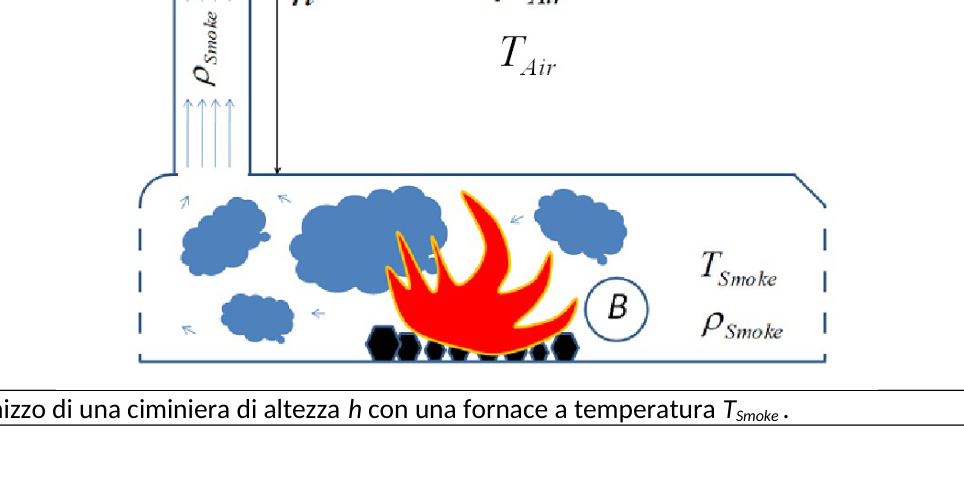
I prodotti gassosi della combustione vengono rilasciati nell’atmosfera (temperatura atmosferica ) attraverso una ciminiera cilindrica di sezione e altezza (vedi Fig. 1). Il combustibile solido viene bruciato nella fornace a temperatura . Si indica con il volume di gas prodotto nell’unità di tempo nella fornace.
Puoi assumere che:
-
la velocità del gas nella fornace è trascurabile
-
la densità del gas (fumo) è uguale alla densità dell’aria a parità di pressione e temperatura; il gas può essere trattato come un gas perfetto anche nella fornace
-
la pressione dell’aria varia con l’altezza secondo la legge di Stevino; la variazione della densità dell’aria con l’altezza è trascurabile
-
il flusso di gas nella ciminiera segue l’equazione di Bernoulli. Tale equazione stabilisce che in ogni punto del fluido gassoso valga la seguente legge di conservazione: dove è la densità del gas, è la sua velocità, la sua pressione e è la quota
-
la variazione della densità del gas è trascurabile lungo tutta la ciminiera
Fig 1. Schizzo di una ciminiera di altezza con una fornace a temperatura .
Parte 1
a) Qual è l’altezza minima della ciminiera necessaria a farla funzionare in maniera efficiente, cioè in modo che tutto il fumo prodotto nella fornace sia rilasciato in atmosfera? Esprimere il risultato in funzione di , , , , . Importante: in tutte le parti successive assumere che la ciminiera abbia proprio questa altezza minima. (3.5 punti)
b) Supponi che due ciminiere siano costruite per servire esattamente al medesimo scopo. Le loro sezioni trasversali sono identiche, ma le due ciminiere sono progettate per funzionare in due luoghi diversi del mondo: una in una regione fredda, progettata per funzionare a una temperatura atmosferica media di e l’altra in una regione calda, progettata per funzionare a una temperatura atmosferica media di . In entrambi i casi la temperatura della fornace è di . E’ stato calcolato che l’altezza della ciminiera progettata per funzionare nella regione fredda deve essere di 100 m. Quanto deve essere alta l’altra ciminiera? (0.5 punti)
c) Come dovrebbe variare la velocità del gas quando sale nella ciminiera? Tenendo conto che la sezione trasversale della ciminiera non cambia al variare della quota, traccia in un grafico l’andamento della velocità in funzione della quota. Indica nel grafico il punto dove il gas entra nella ciminiera. (0.6 punti)
d) Esprimi la pressione del gas in funzione della quota lungo la ciminiera. (0.5 punti)
Centrale solare
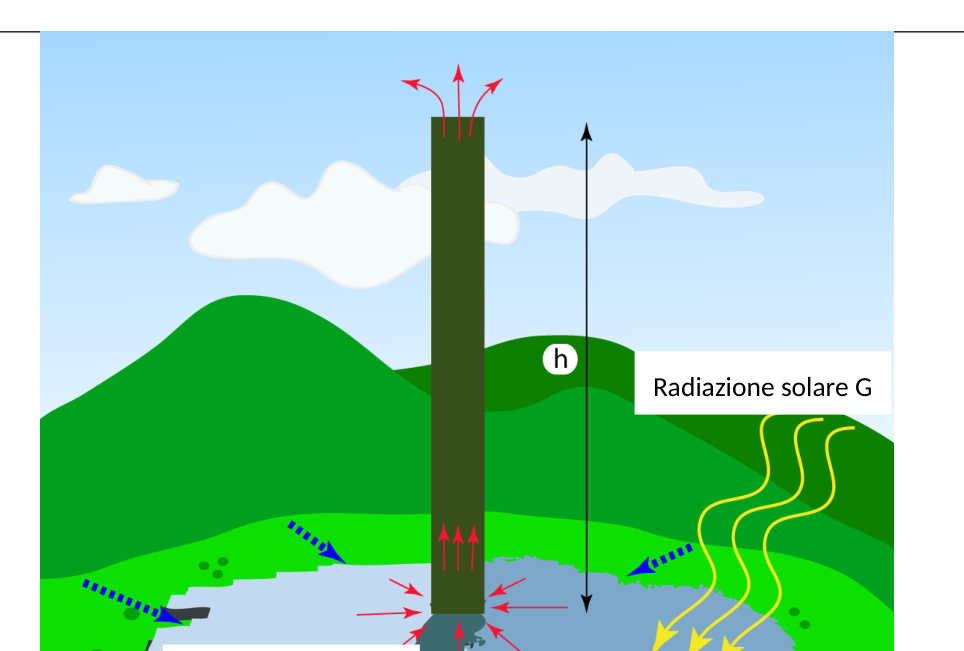
Il flusso di gas in una ciminiera può essere utilizzato per costruire un particolare tipo di centrale solare (ciminiera solare). L’idea è illustrata in Fig. 2. Il sole scalda l’aria sotto al collettore (di area ) che ha il bordo esterno aperto in modo da permettere liberamente il flusso di aria verso l’interno (vedi Fig. 2). Mentre l’aria riscaldata sale attraverso la ciminiera (seguendo le frecce sottili e continue della figura), nuova aria fredda entra nel collettore dall’ambiente circostante (seguendo le frecce spesse e tratteggiate) permettendo un flusso continuo di aria attraverso la centrale. Il flusso d’aria attraverso la ciminiera fa girare una turbina, producendo energia elettrica. L’energia della radiazione solare per unità di tempo per unità di superficie orizzontale del collettore è . Assumi che tutta l’energia solare ricevuta possa essere utilizzata per scaldare l’aria nel collettore e che il calore specifico dell’aria sia , trascurando la sua dipendenza dalla temperatura dell’aria. Definiamo l’efficienza della ciminiera solare come il rapporto tra l’energia cinetica del flusso di gas e l’energia solare assorbita per scaldare l’aria prima del suo ingresso nella ciminiera.
Fig 2. Disegno di una centrale solare.
Parte 2
a) Qual è l’efficienza della centrale solare? (2.0 punti)
b) Disegna un grafico che mostri come l’efficienza della ciminiera cambia in funzione della sua altezza. (0.4 punti)
Il prototipo di Manzanares
Il prototipo di ciminiera costruito in Manzanares (Spagna) ha un’altezza di 195 m e un raggio di 5 m. Il collettore è circolare con un diametro di 244 m. Il calore specifico dell’aria in condizioni di operatività normale per il prototipo di ciminiera solare è di 1012 J/(kg K), la densità dell’aria calda è di e la tipica temperatura atmosferica è K. A Manzanares in un giorno di sole, la potenza solare per unità di superficie orizzontale è tipicamente di .
Parte 3
a) Qual è l’efficienza del prototipo di centrale? Scrivi la stima numerica. (0.3 punti)
b) Quanta potenza potrebbe essere prodotta nel prototipo di centrale? (0.4 punti)
c) Quanta energia potrebbe produrre la centrale in una tipica giornata di sole? (0.3 punti)
Collettore di area
Radiazione solare
Parte 4
a) Di quanto aumenta la temperatura dell’aria nel passaggio dentro il collettore, dal momento in cui vi entra dall’esterno (aria fredda) a quello in cui passa nella ciminiera (aria calda)? Scrivine l’espressione algebrica e stimane il valore numerico per il prototipo di ciminiera. (1.0 punti)
b) Quanti chilogrammi al secondo di aria attraversa il sistema? (0.5 punti)
p.1 — Schizzo di una ciminiera con fornace
p.3 — Disegno di una centrale solare
Topic: Fluid Mechanics, Thermodynamics, Conservation of Energy Metodi: Bernoulli’s Equation, Ideal Gas Law, Continuity Equation, Energy Conservation Method Competenze: Mathematical Modeling, Physical Reasoning, Estimation & Approximation Objects: Gas, Tube Fonte: Testo (PDF) — p.1
Introduzione
- The Physics of the Fireplace
The gaseous combustion products are released into the atmosphere (atmospheric temperature ) through a cylindrical chimney of section and height (see Fig. 1). The solid fuel is burned in the furnace at . The volume of gas produced in the furnace unit of time is indicated by .
You can assume that:
-
the speed of the gas in the furnace is negligible
-
the density of the gas (smoke) is equal to the density of the air at the same pressure and temperature; the gas can be treated as a perfect gas even in the oven
-
air pressure varies with altitude according to Stevino’s law; the change in air density with altitude is negligible
-
the flow of gas in the chimney follows the Bernoulli equation. This equation states that at each point of the gas fluid the following law of conservation applies: where is the density of the gas, is its velocity, its pressure and is the quota
-
the change in gas density is negligible throughout the chimney
Figure one. A height chimney sketch with a furnace at temperature.
Parte 1
(a) What is the minimum height required for the chimney to operate efficiently, that is, so that all the smoke produced in the furnace is released into the atmosphere? The result shall be expressed as a function of , , , , . Important: in all subsequent parts assume that the chimney has exactly this minimum height. (iii. points)
(b) Suppose that two chimneys are built to serve exactly the same purpose. Their cross sections are identical, but the two chimneys are designed to operate in two different places around the world: one in a cold region, designed to operate at an average atmospheric temperature of and the other in a warm region, designed to operate at an average atmospheric temperature of . In both cases the oven temperature is . It has been calculated that the height of the chimney designed to operate in the cold region must be 100 m. How tall is the other chimney? (0.5 points)
(c) How should the speed of the gas change when it goes up into the chimney? Taking into account that the cross section of the chimney does not change as the altitude varies, it traces the speed of the chimney in a graph according to the altitude. It shows the point where the gas enters the chimney. (0.6 points)
(d) Express the gas pressure according to the elevation along the chimney. (0.5 points)
Centrale solare
The gas flow in a chimney can be used to build a particular type of solar power plant (solar chimney). The idea is illustrated in Fig. 2. The sun heats the air under the collector (area ) which has the outer edge open so as to allow free flow of air inward (see Fig. 2). As the heated air rises through the chimney (following the thin, continuous arrows of the figure), fresh cold air enters the collector from the surrounding environment (following the thick, stretched arrows) allowing a continuous flow of air through the power plant. The airflow through the chimney turns a turbine, producing electricity. The energy of solar radiation per unit of time per unit of horizontal surface area of the collector is . Assume that all the solar energy received can be used to heat the air in the collector and that the specific heat of the air is , neglecting its dependence on the temperature of the air. We define the efficiency of a solar chimney as the ratio of the kinetic energy of the gas flow to the solar energy absorbed to heat the air before it enters the chimney.
Figure two. I’m drawing a solar power plant.
Parte 2
(a) What is the efficiency of the solar power plant? (b) the number of points
(b) Draw a graph showing how the efficiency of the chimney changes according to its height. (0.4 points)
Il prototipo di Manzanares
The prototype chimney built in Manzanares (Spain) has a height of 195 m and a radius of 5 m. The collector shall be circular with a diameter of 244 m. The specific air temperature under normal operating conditions for the solar fireplace prototype is 1012 J/(kg K, the hot air density is and the typical atmospheric temperature is K. In Manzanares on a sunny day, the solar power per unit horizontal surface area is typically .
Parte 3
(a) What is the efficiency of the prototype power plant? Write down the numerical estimate. (Documents and documents)
(b) How much power could be produced in the prototype power plant? (0.4 points)
(c) How much energy could the power plant produce on a typical sunny day? (Documents and documents)
Collettore di area
Radiazione solare
Parte 4
(a) How much does the air temperature increase as it passes through the collector from the time it enters the collector from the outside (cold air) to the time it passes through the chimney (hot air)? Write the algebraic expression and estimate the numerical value for the fireplace prototype. The following points are added:
(b) How many kilograms per second of air passes through the system? (0.5 points)
**p.1 ** Sketch of a chimney with a furnace
p.3 — Disegno di una centrale solare
Topic: Fluid Mechanics, Thermodynamics, Conservation of Energy Metodi: Bernoulli’s Equation, Ideal Gas Law, Continuity Equation, Energy Conservation Method Competenze: Mathematical Modeling, Physical Reasoning, Estimation & Approximation Objects: Gas, Tube Fonte: Testo (PDF) — p.1