Nella figura è rappresentata una sorgente luminosa puntiforme e isotropa (cioè tale da emettere luce allo stesso modo in tutte le direzioni) e un apparato per la misura dell’intensità luminosa. Si vuole determinare l’andamento dell’intensità in funzione della distanza dalla sorgente. L’esperimento viene condotto in una stanza altrimenti oscura.
Quale delle seguenti espressioni è costante al variare della distanza ?
- A.
- B.
- C.
- D.
- E.
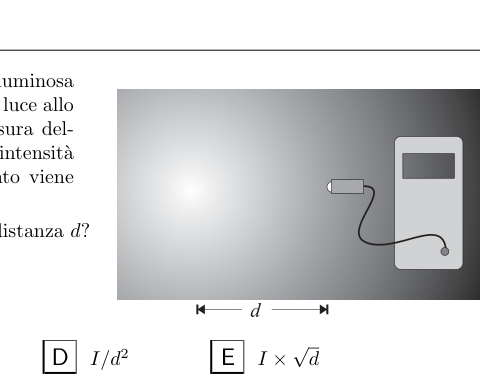 Point source and light intensity meter
Topic: Geometric Optics, Newtonian Mechanics Metodi: Physical Modeling, Dimensional Analysis Competenze: Physical Reasoning, Mathematical Modeling Objects: — Fonte: Testo (PDF) — p.3 Risposta: B · Soluzioni
A pointed and isotropic light source (i.e. one that emits light in the same way in all directions) and a light intensity measuring apparatus are shown in the figure. The intensity is determined by the distance from the source. The experiment is conducted in an otherwise dark room.
Which of the following is constant to the variation of the distance ?
- A.
- B.
- C.
- D.
- E.
Point source and light intensity meter
Topic: Geometric Optics, Newtonian Mechanics Metodi: Physical Modeling, Dimensional Analysis Competenze: Physical Reasoning, Mathematical Modeling Objects: — Fonte: Testo (PDF) — p.3 Risposta: B · Soluzioni
Nel libro “Dalla Terra alla Luna” di Jules Verne si immagina un potentissimo cannone in grado di sparare un proiettile fino alla Luna.
Quale dei seguenti grafici descrive meglio la relazione tra la massa del proiettile e la distanza dalla Terra, in questo ipotetico viaggio?
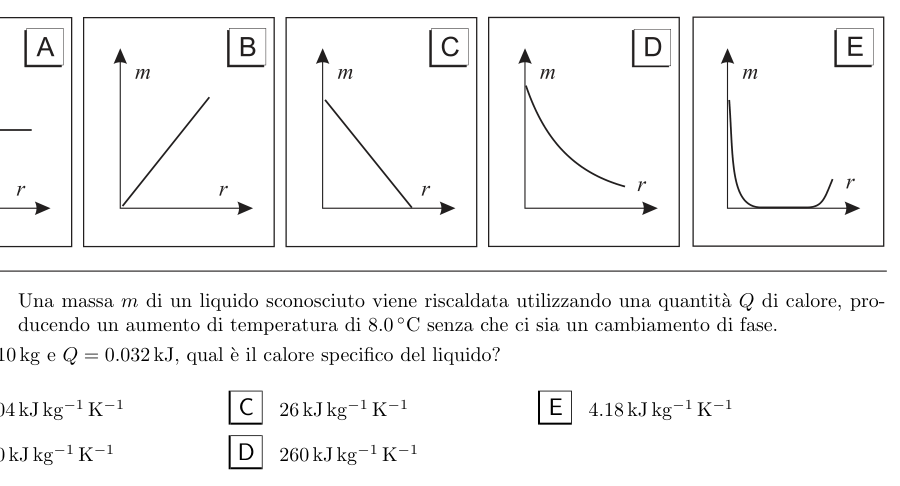 Five graphs of mass m vs distance r
Topic: Gravitation, Newtonian Mechanics Metodi: Physical Modeling, Newton’s Law of Gravitation Competenze: Physical Reasoning, Diagrammatic Reasoning Objects: Projectile, Planet Fonte: Testo (PDF) — p.3 Risposta: A · Soluzioni
In Jules Verne’s book “From the Earth to the Moon”, we imagine a very powerful cannon capable of firing a bullet to the Moon.
Quale dei seguenti grafici descrive meglio la relazione tra la massa del proiettile e la distanza dalla Terra, in questo ipotetico viaggio?
Five graphs of mass m vs distance r
Topic: Gravitation, Newtonian Mechanics Metodi: Physical Modeling, Newton’s Law of Gravitation Competenze: Physical Reasoning, Diagrammatic Reasoning Objects: Projectile, Planet Fonte: Testo (PDF) — p.3 Risposta: A · Soluzioni
Una massa di un liquido sconosciuto viene riscaldata utilizzando una quantità di calore, producendo un aumento di temperatura di senza che ci sia un cambiamento di fase.
Se e , qual è il calore specifico del liquido?
- A.
- B.
- C.
- D.
- E. Topic: Thermodynamics Metodi: First Law of Thermodynamics, Ideal Gas Law Competenze: Physical Reasoning, Unit Conversion Objects: — Fonte: Testo (PDF) — p.3 Risposta: B · Soluzioni
A mass of an unknown liquid is heated using a quantity of heat, producing a temperature increase of without any phase change.
If and , what is the specific heat of the liquid?
- A.
- B.
- C.
- D.
- E. Topic: Thermodynamics Metodi: First Law of Thermodynamics, Ideal Gas Law Competenze: Physical Reasoning, Unit Conversion Objects: — Fonte: Testo (PDF) — p.3 Risposta: B · Soluzioni
Quale delle seguenti combinazioni di unità di misura è equivalente al volt?
- A.
- B.
- C.
- D.
- E. Topic: Electromagnetism Metodi: Dimensional Analysis, Faraday’s Law of Induction Competenze: Unit Conversion, Physical Reasoning Objects: — Fonte: Testo (PDF) — p.4 Risposta: B · Soluzioni
Which of the following combinations of units of measurement is equivalent to the volt?
- A.
- B.
- C.
- D.
- E. Topic: Electromagnetism Metodi: Dimensional Analysis, Faraday’s Law of Induction Competenze: Unit Conversion, Physical Reasoning Objects: — Fonte: Testo (PDF) — p.4 Risposta: B · Soluzioni
La figura mostra una cassa alta che è posata a terra e deve essere caricata su una banchina alta .
Se la velocità di sollevamento è costante, il tempo impiegato è di e la cassa pesa , quale potenza è necessaria per sollevarla?
- A.
- B.
- C.
- D.
- E.
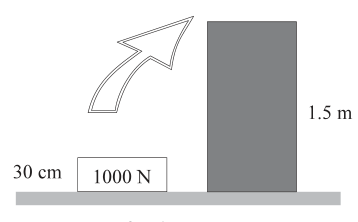 Crate being lifted onto dock
Topic: Newtonian Mechanics, Conservation of Energy Metodi: Energy Conservation Method, Kinematic Equations Competenze: Physical Reasoning, Mathematical Modeling Objects: Block Fonte: Testo (PDF) — p.4 Risposta: C · Soluzioni
The figure shows a high box which is laid on the ground and must be loaded onto a high bench .
If the lifting speed is constant, the time taken is and the case weighs , what power is required to lift it?
- A.
- B.
- C.
- D.
- E.
Crates being lifted onto dock
Topic: Newtonian Mechanics, Conservation of Energy Metodi: Energy Conservation Method, Kinematic Equations Competenze: Physical Reasoning, Mathematical Modeling Objects: Block Fonte: Testo (PDF) — p.4 Risposta: C · Soluzioni
Un fascio di luce monocromatica incide su due fenditure e la figura risultante è raccolta su uno schermo. La distanza sullo schermo tra due frange consecutive dove si verifica l’interferenza costruttiva…
1 – …aumenta quando lo schermo è allontanato dal piano delle fenditure. 2 – …aumenta quando viene utilizzato un fascio di luce di maggiore lunghezza d’onda. 3 – …aumenta quando diminuisce la distanza tra le fenditure.
Quali delle precedenti affermazioni sono corrette?
- A. Solo la 1.
- B. Solo la 2.
- C. Solo la 1 e la 2.
- D. Solo la 2 e la 3.
- E. Tutte e tre. Topic: Wave Optics Metodi: Interference & Diffraction Analysis, Superposition Principle Competenze: Physical Reasoning, Mathematical Modeling Objects: Slit, Screen Fonte: Testo (PDF) — p.4 Risposta: E · Soluzioni
A monochrome beam of light hits two slits and the resulting figure is collected on a screen. The distance on the screen between two consecutive fringes where the constructive interference occurs…
1 …increases when the screen is removed from the cleft plane. 2 …increases when a longer wavelength beam of light is used. 3 …increases as the distance between the cracks decreases.
Which of the above statements is correct?
- **A ** Only the 1.
- **B ** Only the 2.
- C. Only 1 and 2.
- D. Solo la 2 e la 3.
- E. Tutte e tre. Topic: Wave Optics Metodi: Interference & Diffraction Analysis, Superposition Principle Competenze: Physical Reasoning, Mathematical Modeling Objects: Slit, Screen Fonte: Testo (PDF) — p.4 Risposta: E · Soluzioni
La velocità di evaporazione di una certa quantità d’acqua dipende…
1 – …dall’umidità dell’aria al di sopra dell’acqua. 2 – …dall’area della superficie dell’acqua in contatto con l’aria. 3 – …dalla temperatura dell’acqua.
Quali delle affermazioni precedenti sono vere?
- A. Tutte e tre.
- B. Solo la 1 e la 2.
- C. Solo la 2 e la 3.
- D. Solo la 1.
- E. Solo la 3. Topic: Thermodynamics, Kinetic Theory Metodi: Kinetic Theory of Gases, Physical Modeling Competenze: Physical Reasoning, Estimation & Approximation Objects: — Fonte: Testo (PDF) — p.4 Risposta: A · Soluzioni
The evaporation rate of a certain amount of water depends on…
1 …from the humidity of the air above the water. 2 …of the surface area of water in contact with air. 3 …from the water temperature.
Which of the above statements is true?
- A. Tutte e tre.
- B. Only the 1 and 2.
- C. Only the 2 and 3.
- D. Only the 1.
- E Only the 3. Topic: Thermodynamics, Kinetic Theory Metodi: Kinetic Theory of Gases, Physical Modeling Competenze: Physical Reasoning, Estimation & Approximation Objects: — Fonte: Testo (PDF) — p.4 Risposta: A · Soluzioni
Due forze sono applicate allo stesso punto materiale. Al variare dell’angolo tra di esse, si osserva che la risultante ha un’intensità massima di e minima di .
Qual è l’intensità di ciascuna delle due forze?
- A. e
- B. e
- C. e
- D. e
- E. e Topic: Newtonian Mechanics Metodi: Vector Decomposition, Free-Body Diagram Competenze: Mathematical Modeling, Physical Reasoning Objects: — Fonte: Testo (PDF) — p.4 Risposta: E · Soluzioni
Two forces are applied to the same material point. The angle between them varies and the resulting intensity is and .
What is the intensity of each of the two forces?
- A. e
- B. e
- C. e
- D. e
- E. e Topic: Newtonian Mechanics Metodi: Vector Decomposition, Free-Body Diagram Competenze: Mathematical Modeling, Physical Reasoning Objects: — Fonte: Testo (PDF) — p.4 Risposta: E · Soluzioni
Una forza di applicata a una molla la comprime di .
Qual è l’energia potenziale immagazzinata nella molla così compressa?
- A.
- B.
- C.
- D.
- E. Topic: Oscillations & Waves, Conservation of Energy Metodi: Hooke’s Law, Energy Conservation Method Competenze: Mathematical Modeling, Physical Reasoning Objects: Spring Fonte: Testo (PDF) — p.4 Risposta: B · Soluzioni
A force of applied to a spring comprises the tablet of .
What is the potential energy stored in the compressed spring?
- A.
- B.
- C.
- D.
- E. Topic: Oscillations & Waves, Conservation of Energy Metodi: Hooke’s Law, Energy Conservation Method Competenze: Mathematical Modeling, Physical Reasoning Objects: Spring Fonte: Testo (PDF) — p.4 Risposta: B · Soluzioni
Nella situazione mostrata a lato un diapason sta oscillando ed emette un suono a frequenza costante mentre si sta muovendo verso destra con una velocità costante . Degli osservatori si trovano nei punti indicati in figura.
Quale osservatore, nell’istante cui si riferisce la figura, sente il suono di frequenza più bassa?
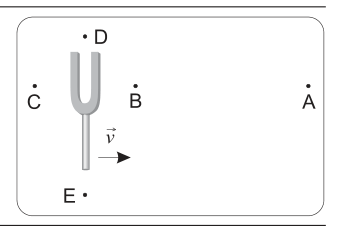 Moving tuning fork with observers
Topic: Oscillations & Waves Metodi: Wave Equation, Physical Modeling Competenze: Physical Reasoning, Diagrammatic Reasoning Objects: Tuning Fork Fonte: Testo (PDF) — p.5 Risposta: C · Soluzioni
In the side view a diapason is oscillating and emitting a constant frequency sound while moving to the right at a constant speed . The observers are located in the points shown in the figure.
What observer, at the moment the figure is being referred to, hears the lowest frequency sound?
Moving tuning fork with observers
Topic: Oscillations & Waves Metodi: Wave Equation, Physical Modeling Competenze: Physical Reasoning, Diagrammatic Reasoning Objects: Tuning Fork Fonte: Testo (PDF) — p.5 Risposta: C · Soluzioni
Una macchina lancia una pallina da tennis in una direzione che forma un angolo di con l’orizzontale. La pallina ha una velocità iniziale con una componente verticale pari a . La pallina raggiunge la sua altezza massima dopo il suo lancio e atterra alla stessa altezza da cui è stata lanciata. Si supponga trascurabile l’attrito con l’aria.
La distanza totale percorsa in orizzontale dalla pallina durante il suo tempo di volo vale
- A.
- B.
- C.
- D.
- E. Topic: Newtonian Mechanics Metodi: Kinematic Equations, Vector Decomposition Competenze: Mathematical Modeling, Physical Reasoning Objects: Ball, Projectile Fonte: Testo (PDF) — p.5 Risposta: E · Soluzioni
A machine throws a tennis ball in a direction that forms an angle of with the horizontal. The ball has an initial speed with a vertical component equal to . The ball reaches its maximum height after its launch and lands at the same height from which it was launched. Let’s assume that friction with the air is negligible.
The total distance travelled horizontally from the ball during its flight time is valid
- A.
- B.
- C.
- D.
- E. Topic: Newtonian Mechanics Metodi: Kinematic Equations, Vector Decomposition Competenze: Mathematical Modeling, Physical Reasoning Objects: Ball, Projectile Fonte: Testo (PDF) — p.5 Risposta: E · Soluzioni
Un cuoco lascia cadere inavvertitamente due uova dalla stessa altezza. Il primo cade sul pavimento e si rompe. Il secondo cade su un tappetino di gommapiuma e si arresta senza rimbalzare né rompersi.
Rispetto all’impulso subito dal primo uovo nell’impatto col terreno, quello subito dal secondo è…
- A. …minore, ma non nullo.
- B. …uguale.
- C. …maggiore.
- D. …nullo.
- E. Non ci sono dati sufficienti per rispondere. Topic: Newtonian Mechanics, Conservation of Momentum Metodi: Impulse-Momentum Theorem, Conservation of Momentum Competenze: Physical Reasoning, Mathematical Modeling Objects: — Fonte: Testo (PDF) — p.5 Risposta: B · Soluzioni
A cook inadvertently droppes two eggs from the same height. The first one falls on the floor and breaks. The second falls on a rubber rug and stops without bouncing or breaking.
Compared to the impulse of the first egg in the impact with the ground, the impulse of the second is…
- **A ** …minor but not zero.
- **B ** … is equal.
- **C ** … major.
- D. …nullo.
- E. There are not enough data to answer. Topic: Newtonian Mechanics, Conservation of Momentum Metodi: Impulse-Momentum Theorem, Conservation of Momentum Competenze: Physical Reasoning, Mathematical Modeling Objects: — Fonte: Testo (PDF) — p.5 Risposta: B · Soluzioni
In una pista di atletica la distanza tra lo starter di una corsa di e il cronometrista è di . Il cronometrista fa erroneamente partire il cronometro quando sente il colpo di pistola e non quando vede la fiammata dello sparo. Egli ferma il cronometro all’arrivo del vincitore e legge .
Quale tempo deve attribuire al vincitore per correggere il suo errore?
- A.
- B.
- C.
- D.
- E. Topic: Oscillations & Waves, Newtonian Mechanics Metodi: Kinematic Equations, Order-of-Magnitude Estimation Competenze: Physical Reasoning, Mathematical Modeling Objects: — Fonte: Testo (PDF) — p.5 Risposta: D · Soluzioni
In an athletics track the distance between the starter of a race of and the timer is . The timer is mistakenly started when it hears the gunshot and not when it sees the flame of the gunshot. He stops the timer when the winner arrives and reads .
How much time must the winner give to correct his mistake?
- A.
- B.
- C.
- D.
- E. Topic: Oscillations & Waves, Newtonian Mechanics Metodi: Kinematic Equations, Order-of-Magnitude Estimation Competenze: Physical Reasoning, Mathematical Modeling Objects: — Fonte: Testo (PDF) — p.5 Risposta: D · Soluzioni
Uno studente spinge un carretto per verso est e poi per verso nord. La forza che lo studente applica al carretto compie un lavoro di nel primo tratto e di nel secondo.
Il lavoro complessivo compiuto dalla forza è
- A.
- B.
- C.
- D.
- E. Topic: Newtonian Mechanics, Conservation of Energy Metodi: Energy Conservation Method, Vector Decomposition Competenze: Physical Reasoning, Mathematical Modeling Objects: Cart Fonte: Testo (PDF) — p.5 Risposta: C · Soluzioni
A student pushes a cart for to the east and then for to the north. The force applied to the cart by the student shall be in the first stroke and in the second stroke.
The overall work done by force is
- A.
- B.
- C.
- D.
- E. Topic: Newtonian Mechanics, Conservation of Energy Metodi: Energy Conservation Method, Vector Decomposition Competenze: Physical Reasoning, Mathematical Modeling Objects: Cart Fonte: Testo (PDF) — p.5 Risposta: C · Soluzioni
Una tazzina isolante mantiene caldo il caffè a lungo. Se però vi immergiamo un cucchiaino metallico molto freddo, questo si scalda mentre il caffè si raffredda un po’ fino a che entrambi raggiungono la stessa temperatura. Si considerino cinque cucchiaini fatti di metalli diversi, di uguale volume e temperatura iniziale. Nella tabella seguente sono indicati, per ciascun cucchiaino, il calore specifico del metallo e la massa.
Per quale cucchiaino si avrà la temperatura di equilibrio più bassa?
| metallo | ||
|---|---|---|
| (A) Acciaio inox | 0.45 | 15.8 |
| (B) Alluminio | 0.89 | 5.4 |
| (C) Argento | 0.24 | 21.0 |
| (D) Oro | 0.13 | 39.0 |
| (E) Rame | 0.38 | 17.9 |
Topic: Thermodynamics Metodi: First Law of Thermodynamics, Physical Modeling Competenze: Physical Reasoning, Mathematical Modeling Objects: — Fonte: Testo (PDF) — p.5 Risposta: A · Soluzioni
An insulating cup keeps the coffee warm for a long time. But if we dip a very cold metal spoon in it, it heats up while the coffee cools down a little until both reach the same temperature. Consider five spoons made of different metals, of the same volume and initial temperature. The following table shows the specific heat and mass of the metal for each spoon.
Which spoon will have the lowest equilibrium temperature?
| metallo | ||
|---|---|---|
| This is the first time I’ve ever seen a single person in a movie. | ||
| This is the first time I’ve ever seen this. | ||
| This is the first time I’ve ever seen a black diamond. | ||
| This is the first time I’ve ever seen a gold medal. | ||
| This is a very good idea. |
Topic: Thermodynamics Metodi: First Law of Thermodynamics, Physical Modeling Competenze: Physical Reasoning, Mathematical Modeling Objects: — Fonte: Testo (PDF) — p.5 Risposta: A · Soluzioni
Si usa un trasformatore elettrico per far funzionare un trenino giocattolo. Il circuito primario è alimentato alla tensione di rete (). Sul circuito secondario viene indotta una tensione di e si genera una corrente di . Il trasformatore ha un’efficienza .
Quanta corrente fluisce nel circuito primario?
- A.
- B.
- C.
- D.
- E. Topic: Electromagnetic Induction, Circuits Metodi: Faraday’s Law of Induction, Kirchhoff’s Laws Competenze: Mathematical Modeling, Physical Reasoning Objects: Coil, Wire Fonte: Testo (PDF) — p.6 Risposta: B · Soluzioni
An electrical transformer is used to power a toy train. The primary circuit is powered by a network voltage (). The secondary circuit is induced with a voltage of and a current of is generated. The transformer has an efficiency of .
How much current is flowing in the primary circuit?
- A.
- B.
- C.
- D.
- E. Topic: Electromagnetic Induction, Circuits Metodi: Faraday’s Law of Induction, Kirchhoff’s Laws Competenze: Mathematical Modeling, Physical Reasoning Objects: Coil, Wire Fonte: Testo (PDF) — p.6 Risposta: B · Soluzioni
Se si raddoppia il modulo della velocità di un oggetto, quale altra quantità raddoppia?
- A. Il modulo della sua quantità di moto.
- B. La sua energia cinetica.
- C. Il modulo della sua accelerazione.
- D. La sua energia potenziale gravitazionale.
- E. Il modulo della risultante delle forze che agiscono su di esso. Topic: Newtonian Mechanics, Conservation of Energy Metodi: Kinematic Equations, Conservation of Energy Competenze: Physical Reasoning, Mathematical Modeling Objects: — Fonte: Testo (PDF) — p.6 Risposta: A · Soluzioni
If you double the speed of an object, what other quantity doubles?
- A. The form of its motor quantity.
- B. La sua energia cinetica.
- C. The model of its acceleration.
- D. La sua energia potenziale gravitazionale.
- E. The form of the resultant of the forces acting on it. Topic: Newtonian Mechanics, Conservation of Energy Metodi: Kinematic Equations, Conservation of Energy Competenze: Physical Reasoning, Mathematical Modeling Objects: — Fonte: Testo (PDF) — p.6 Risposta: A · Soluzioni
Un proiettile A viene sparato orizzontalmente alla velocità di dalla sommità di una collina e cade a terra più tardi. Un altro proiettile B viene sparato orizzontalmente dallo stesso punto da cui è stato sparato A, ma alla velocità di .
Il tempo impiegato dal proiettile B a toccare terra è
- A.
- B.
- C.
- D.
- E. Topic: Newtonian Mechanics Metodi: Kinematic Equations, Free-Body Diagram Competenze: Physical Reasoning, Mathematical Modeling Objects: Projectile Fonte: Testo (PDF) — p.6 Risposta: C · Soluzioni
A bullet A is fired horizontally at from the top of a hill and falls to the ground later. Another B bullet is fired horizontally from the same point from which A was fired, but at a speed of .
The time it takes the B bullet to touch the ground is
- A.
- B.
- C.
- D.
- E. Topic: Newtonian Mechanics Metodi: Kinematic Equations, Free-Body Diagram Competenze: Physical Reasoning, Mathematical Modeling Objects: Projectile Fonte: Testo (PDF) — p.6 Risposta: C · Soluzioni
Un carrello A di massa si sta muovendo a quando colpisce un altro carrello B che si sta muovendo a nella stessa direzione di A. Dopo l’urto A viaggia a e B a . Prima e dopo l’urto, i due carrelli si muovono nello stesso verso. Si trascuri l’attrito.
Qual è la massa del carrello B?
- A.
- B.
- C.
- D.
- E. Topic: Conservation of Momentum, Newtonian Mechanics Metodi: Conservation of Momentum, Impulse-Momentum Theorem Competenze: Mathematical Modeling, Physical Reasoning Objects: Cart Fonte: Testo (PDF) — p.6 Risposta: C · Soluzioni
A cart A of mass is moving at when it hits another cart B moving at in the same direction as A. After impact A travels to and B to . Before and after the impact, the two cars move in the same direction. You’re neglecting the friction.
What is the mass of cart B?
- A.
- B.
- C.
- D.
- E. Topic: Conservation of Momentum, Newtonian Mechanics Metodi: Conservation of Momentum, Impulse-Momentum Theorem Competenze: Mathematical Modeling, Physical Reasoning Objects: Cart Fonte: Testo (PDF) — p.6 Risposta: C · Soluzioni
In un parco di divertimenti si trova talvolta la giostra schematizzata in figura, formata da un cilindro cavo che può ruotare intorno al suo asse. Alcune persone salgono sulla giostra mentre il cilindro è fermo e si appoggiano alla parete laterale. La giostra inizia poi a ruotare. Quando raggiunge un’opportuna velocità , il pavimento, che è mobile, si abbassa ma i passeggeri rimangono “attaccati” alla parete laterale, sospesi a una certa altezza dal pavimento.
Se la grandezza della forza di attrito fra un adulto di e la parete del cilindro vale , quanto vale la forza di attrito fra un bambino di e la parete?
- A.
- B.
- C.
- D.
- E.
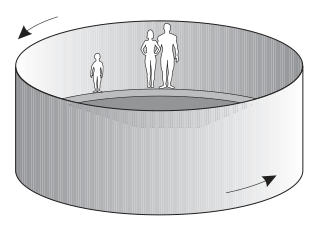 Rotating cylinder amusement ride
Topic: Newtonian Mechanics, Rotational Dynamics Metodi: Free-Body Diagram, Physical Modeling Competenze: Physical Reasoning, Mathematical Modeling Objects: Cylinder Fonte: Testo (PDF) — p.6 Risposta: B · Soluzioni
In an amusement park, the figure-shaped ride is sometimes found, formed by a cable cylinder that can rotate around its axis. Some people climb the wheel while the cylinder is still and lean against the side wall. The wheel then starts to spin. When it reaches a suitable speed , the floor, which is mobile, drops but passengers remain “attached” to the side wall, suspended at a certain height from the floor.
If the force of friction between an adult of and the cylinder wall is , what is the force of friction between a child of and the wall?
- A.
- B.
- C.
- D.
- E.
Rotating cylinder amusement ride
Topic: Newtonian Mechanics, Rotational Dynamics Metodi: Free-Body Diagram, Physical Modeling Competenze: Physical Reasoning, Mathematical Modeling Objects: Cylinder Fonte: Testo (PDF) — p.6 Risposta: B · Soluzioni
Una candela è posta oltre il centro C di uno specchio sferico concavo avente il fuoco nel punto F, come mostrato in figura.
Dove si forma l’immagine della candela?
- A. Dietro lo specchio.
- B. Sullo specchio.
- C. Fra lo specchio ed F.
- D. Fra F e C.
- E. Fra C e la posizione della candela.
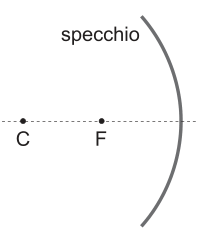 Concave mirror with candle beyond C
Topic: Geometric Optics Metodi: Thin Lens & Mirror Equation, Ray Tracing Competenze: Physical Reasoning, Diagrammatic Reasoning Objects: Mirror Fonte: Testo (PDF) — p.7 Risposta: D · Soluzioni
A candle is placed above the center C of a concave spherical mirror with fire at the point F, as shown in the figure.
Where does the image of the candle form?
- A. Dietro lo specchio.
- B. Sullo specchio.
- C. Between the mirror and F.
- ** D.** Between F and C.
- E. Between C and the position of the candle.
Concave mirror with candle beyond C
Topic: Geometric Optics Metodi: Thin Lens & Mirror Equation, Ray Tracing Competenze: Physical Reasoning, Diagrammatic Reasoning Objects: Mirror Fonte: Testo (PDF) — p.7 Risposta: D · Soluzioni
Tra tutte le macchine termiche che scambiano calore con due sorgenti a temperature fissate e , il rendimento di quelle che sfruttano il ciclo di Carnot…
- A. …è uguale a 1 (ossia al 100%).
- B. …è il maggiore.
- C. …è uguale a quello di qualunque altro motore termico.
- D. …è il minore.
- E. …dipende dal progetto del motore. Topic: Thermodynamics Metodi: Thermodynamic Cycle Analysis, Physical Modeling Competenze: Physical Reasoning, Mathematical Modeling Objects: Heat Engine Fonte: Testo (PDF) — p.7 Risposta: B · Soluzioni
Between all heat exchanging machines with two fixed temperature sources and , the performance of those using the Carnot cycle…
- A. … is equal to 1 (i.e. 100%).
- **B ** …is the largest.
- C. …is the same as that of any other heat engine.
- **D ** …is the minor.
- E. …depends on the engine design. Topic: Thermodynamics Metodi: Thermodynamic Cycle Analysis, Physical Modeling Competenze: Physical Reasoning, Mathematical Modeling Objects: Heat Engine Fonte: Testo (PDF) — p.7 Risposta: B · Soluzioni
Un condensatore piano è costituito da due armature metalliche piane e parallele, tenute a una distanza fissa.
Quale grafico rappresenta meglio la relazione tra l’intensità del campo tra le armature e la differenza di potenziale tra le stesse?
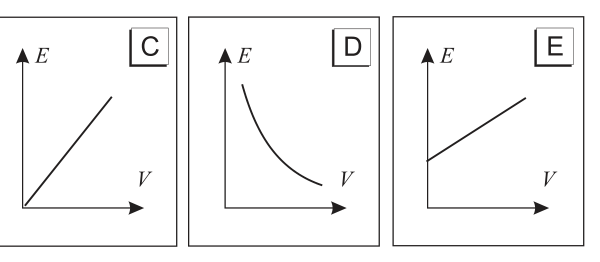 Five graphs of electric field E vs voltage V
Topic: Electrostatics Metodi: Electric Potential Method, Physical Modeling Competenze: Physical Reasoning, Diagrammatic Reasoning Objects: Capacitor Fonte: Testo (PDF) — p.7 Risposta: C · Soluzioni
A flat capacitor consists of two flat, parallel metal frames, held at a fixed distance.
Which graph best represents the relationship between the field intensity between the frames and the potential difference between them?
Five graphs of electric field E vs voltage V
Topic: Electrostatics Metodi: Electric Potential Method, Physical Modeling Competenze: Physical Reasoning, Diagrammatic Reasoning Objects: Capacitor Fonte: Testo (PDF) — p.7 Risposta: C · Soluzioni
In un ciclotrone l’intensità del campo magnetico è .
Quanto deve valere, al minimo, il raggio della macchina se si vuole che possano circolare protoni con un’energia cinetica massima di ?
- A.
- B.
- C.
- D.
- E. Topic: Magnetism, Modern-Quantum Physics Metodi: Lorentz Force Analysis, Relativistic Energy-Momentum Competenze: Mathematical Modeling, Physical Reasoning Objects: Point Charge Fonte: Testo (PDF) — p.7 Risposta: B · Soluzioni
In a cyclotron the magnetic field intensity is .
What is the minimum value of the radius of the machine if protons with a maximum kinetic energy of are to be able to circulate?
- A.
- B.
- C.
- D.
- E. Topic: Magnetism, Modern-Quantum Physics Metodi: Lorentz Force Analysis, Relativistic Energy-Momentum Competenze: Mathematical Modeling, Physical Reasoning Objects: Point Charge Fonte: Testo (PDF) — p.7 Risposta: B · Soluzioni
La figura rappresenta un blocco del peso di che scivola a velocità costante su un piano inclinato di rispetto all’orizzontale.
Il modulo della forza d’attrito tra blocco e piano è circa
- A.
- B.
- C.
- D.
- E.
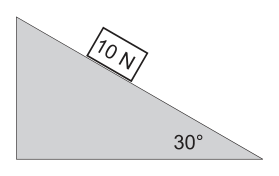 Block sliding on inclined plane at 30°
Topic: Newtonian Mechanics Metodi: Free-Body Diagram, Vector Decomposition Competenze: Physical Reasoning, Mathematical Modeling Objects: Block, Inclined Plane Fonte: Testo (PDF) — p.7 Risposta: B · Soluzioni
The figure represents a block of weight that slides at a constant speed on a plane inclined by to the horizontal.
The modulus of friction between the block and the plane is approximately
- A.
- B.
- C.
- D.
- E.
Block sliding on inclined plane at 30°
Topic: Newtonian Mechanics Metodi: Free-Body Diagram, Vector Decomposition Competenze: Physical Reasoning, Mathematical Modeling Objects: Block, Inclined Plane Fonte: Testo (PDF) — p.7 Risposta: B · Soluzioni
Un dinamometro segna quando viene adoperato per trascinare un blocco di lungo una tavola.
Qual è la forza esercitata dal blocco sul dinamometro?
- A.
- B.
- C.
- D.
- E. Topic: Newtonian Mechanics Metodi: Free-Body Diagram, Physical Modeling Competenze: Physical Reasoning, Mathematical Modeling Objects: Block Fonte: Testo (PDF) — p.8 Risposta: D · Soluzioni
A dynamometer marks when used to drag a block of along a table.
What is the force exerted by the block on the dynamometer?
- A.
- B.
- C.
- D.
- E. Topic: Newtonian Mechanics Metodi: Free-Body Diagram, Physical Modeling Competenze: Physical Reasoning, Mathematical Modeling Objects: Block Fonte: Testo (PDF) — p.8 Risposta: D · Soluzioni
Una forza che agisce su un oggetto di massa produce un’accelerazione .
Quanto vale la massa di un secondo oggetto che accelera con accelerazione quando viene applicata una forza ?
- A.
- B.
- C.
- D.
- E. Topic: Newtonian Mechanics Metodi: Kinematic Equations, Dimensional Analysis Competenze: Mathematical Modeling, Physical Reasoning Objects: — Fonte: Testo (PDF) — p.8 Risposta: A · Soluzioni
A force acting on an object of mass produces an acceleration .
What is the mass of a second object accelerating with acceleration when a force is applied?
- A.
- B.
- C.
- D.
- E. Topic: Newtonian Mechanics Metodi: Kinematic Equations, Dimensional Analysis Competenze: Mathematical Modeling, Physical Reasoning Objects: — Fonte: Testo (PDF) — p.8 Risposta: A · Soluzioni
Un fascio di luce non polarizzata passa attraverso un primo filtro polarizzatore e successivamente attraverso un secondo filtro polarizzatore (si trattino i filtri come ideali).
Se l’intensità del fascio di luce che esce dal secondo polarizzatore è pari al di quella del fascio che colpisce il primo polarizzatore, qual è l’angolo formato dagli assi dei due filtri polarizzatori?
- A.
- B.
- C.
- D.
- E. Topic: Wave Optics, Electromagnetism Metodi: Superposition Principle, Physical Modeling Competenze: Mathematical Modeling, Physical Reasoning Objects: — Fonte: Testo (PDF) — p.8 Risposta: D · Soluzioni
An unpolarized beam of light passes through a first polarizing filter and then through a second polarizing filter (filters are treated as ideal).
If the intensity of the beam of light coming out of the second polarizer is of that of the beam hitting the first polarizer, what is the angle formed by the axes of the two polarizing filters?
- A.
- B.
- C.
- D.
- E. Topic: Wave Optics, Electromagnetism Metodi: Superposition Principle, Physical Modeling Competenze: Mathematical Modeling, Physical Reasoning Objects: — Fonte: Testo (PDF) — p.8 Risposta: D · Soluzioni
Uno studente scrive le seguenti affermazioni circa i campi elettrici.
1 – In un campo elettrico viene esercitata una forza su una carica. 2 – Quando un campo elettrico è applicato ad un conduttore le cariche libere nel conduttore si muovono. 3 – Quando una carica si muove in un campo elettrico viene compiuto lavoro sulla carica.
Quali delle precedenti affermazioni sono sempre corrette?
- A. Solo la 1.
- B. Solo la 2.
- C. Solo la 1 e la 2.
- D. Solo la 1 e la 3.
- E. Tutte e tre. Topic: Electrostatics Metodi: Electric Potential Method, Coulomb’s Law Competenze: Physical Reasoning, Mathematical Modeling Objects: — Fonte: Testo (PDF) — p.8 Risposta: C · Soluzioni
One student writes the following statements about electric fields.
1 In an electric field, a force is applied to a charge. 2 When an electric field is applied to a conductor, the free charges in the conductor move. 3 When a charge moves in an electric field, work is done on the charge.
Which of the above statements is always correct?
- **A ** Only the 1.
- **B ** Only the 2.
- C. Only the 1 and 2.
- D. Only the 1 and 3.
- E. Tutte e tre. Topic: Electrostatics Metodi: Electric Potential Method, Coulomb’s Law Competenze: Physical Reasoning, Mathematical Modeling Objects: — Fonte: Testo (PDF) — p.8 Risposta: C · Soluzioni
Il calore può fluire da una regione a temperatura più bassa verso una regione a temperatura più alta se…
- A. …il calore specifico della regione più fredda è maggiore di quello della regione più calda.
- B. …la temperatura della regione più fredda è vicina allo zero assoluto.
- C. …si fa del lavoro per generare il flusso di calore.
- D. …la regione più fredda è allo stato liquido, la regione più calda è allo stato solido.
- E. …la sorgente più fredda viene collocata al di sotto di quella più calda. Topic: Thermodynamics Metodi: Thermodynamic Cycle Analysis, Physical Modeling Competenze: Physical Reasoning, Mathematical Modeling Objects: — Fonte: Testo (PDF) — p.8 Risposta: C · Soluzioni
Heat can flow from a lower-temperature region to a higher-temperature region if…
- A. …the specific heat of the coldest region is higher than that of the warmer region.
- B. …the temperature of the coldest region is close to absolute zero.
- **C ** …work is being done to generate the heat flow.
- D. …the coldest region is liquid, the warmest region is solid.
- E. …the coldest source is placed below the hot one. Topic: Thermodynamics Metodi: Thermodynamic Cycle Analysis, Physical Modeling Competenze: Physical Reasoning, Mathematical Modeling Objects: — Fonte: Testo (PDF) — p.8 Risposta: C · Soluzioni
Una provetta viene zavorrata in modo che galleggi verticale nell’acqua. Se si aggiunge un pesetto di la provetta scende di . La provetta viene ora messa a galleggiare in un liquido diverso la cui densità relativa all’acqua è .
Quale massa dovrà avere il pesetto che si aggiunge ora alla provetta per fare in modo che questa scenda di nel nuovo liquido?
- A.
- B.
- C.
- D.
- E. Topic: Fluid Mechanics Metodi: Hydrostatic Equilibrium, Physical Modeling Competenze: Physical Reasoning, Mathematical Modeling Objects: Tube Fonte: Testo (PDF) — p.8 Risposta: B · Soluzioni
A test tube is fertilized so that it floats vertically in the water. If a weight of is added, the test shall be reduced to . The test is now floated in a different liquid with a density of relative to water.
What mass will the peset have to have now to be added to the test to make it go down into the new liquid?
- A.
- B.
- C.
- D.
- E. Topic: Fluid Mechanics Metodi: Hydrostatic Equilibrium, Physical Modeling Competenze: Physical Reasoning, Mathematical Modeling Objects: Tube Fonte: Testo (PDF) — p.8 Risposta: B · Soluzioni
Il grafico mostra l’andamento nel tempo della velocità di 5 automobili A, B, C, D ed E, che percorrono una strada dritta in pianura.
Per quale di queste l’accelerazione media nell’intervallo di è maggiore?
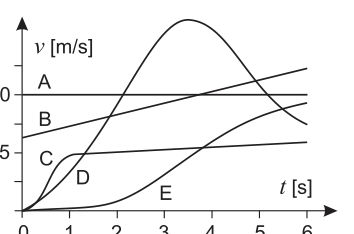 Velocity-time graph for 5 cars A–E
Topic: Newtonian Mechanics Metodi: Kinematic Equations, Experimental Data Analysis Competenze: Diagrammatic Reasoning, Physical Reasoning Objects: — Fonte: Testo (PDF) — p.9 Risposta: E · Soluzioni
The graph shows the time trend of the speed of five cars A, B, C, D and E, which run along a straight road in the plain.
For which of these is the mean acceleration in the range greater?
Velocity-time graph for 5 cars A–E
Topic: Newtonian Mechanics Metodi: Kinematic Equations, Experimental Data Analysis Competenze: Diagrammatic Reasoning, Physical Reasoning Objects: — Fonte: Testo (PDF) — p.9 Risposta: E · Soluzioni
Un isotopo radioattivo ha un tempo di dimezzamento di .
Se, dopo , rimangono , qual era la quantità iniziale di quell’isotopo?
- A.
- B.
- C.
- D.
- E. Topic: Nuclear & Particle Physics Metodi: Radioactive Decay Law, Physical Modeling Competenze: Mathematical Modeling, Physical Reasoning Objects: Nucleus Fonte: Testo (PDF) — p.9 Risposta: E · Soluzioni
A radioactive isotope has a half-life of .
If, after , remains, what was the initial amount of that isotope?
- A.
- B.
- C.
- D.
- E. Topic: Nuclear & Particle Physics Metodi: Radioactive Decay Law, Physical Modeling Competenze: Mathematical Modeling, Physical Reasoning Objects: Nucleus Fonte: Testo (PDF) — p.9 Risposta: E · Soluzioni
Uno studente, nella sua relazione su un esperimento di ottica, inserisce la figura mostrata a fianco. In essa si vede un fascio di luce bianca che incide su un prisma avente gli angoli di . L’angolo limite del vetro di cui è fatto il prisma è .
La figura fatta dallo studente è sbagliata perché…
- A. …le estremità rossa e violetta dello spettro sono state scambiate.
- B. …sulla prima superficie il fascio deve essere deviato.
- C. …sulla prima superficie il fascio si allarga a ventaglio, scomponendosi nei vari colori.
- D. …il fascio subisce una riflessione totale nel prisma.
- E. …il fascio emerge dal prisma senza alcuna deviazione.
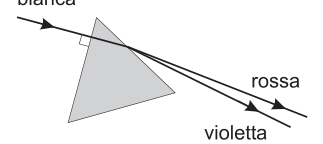 White light incident on 60° glass prism
Topic: Geometric Optics, Wave Optics Metodi: Snell’s Law, Ray Tracing Competenze: Physical Reasoning, Diagrammatic Reasoning Objects: Prism Fonte: Testo (PDF) — p.9 Risposta: D · Soluzioni
A student, in his report on an optical experiment, inserts the figure shown next to it. In it, a white beam of light is seen that hits a prism with angles . The limit angle of the glass from which the prism is made is .
The student’s figure is wrong because…
- **A ** …the red and purple ends of the spectrum have been exchanged.
- B. … on the first surface the beam shall be deflected.
- C. … on the first surface the beam widens fan-like, breaking down into various colours.
- D. …the beam is fully reflected in the prism.
- **E ** …the beam emerges from the prism without any deviation.
White light incident on 60° glass prism
Topic: Geometric Optics, Wave Optics Metodi: Snell’s Law, Ray Tracing Competenze: Physical Reasoning, Diagrammatic Reasoning Objects: Prism Fonte: Testo (PDF) — p.9 Risposta: D · Soluzioni
Un congelatore utilizza l’evaporazione dell’ammoniaca (NH) nelle serpentine per raffreddare l’ambiente interno.
Quanta ammoniaca deve evaporare per sottrarre dal sistema una quantità di calore pari a ?
- A.
- B.
- C.
- D.
- E. Topic: Thermodynamics Metodi: First Law of Thermodynamics, Physical Modeling Competenze: Mathematical Modeling, Physical Reasoning Objects: Tube Fonte: Testo (PDF) — p.9 Risposta: C · Soluzioni
A freezer uses the evaporation of ammonia (NH) in the syringes to cool the interior.
How much ammonia must be evaporated to remove heat from the system?
- A.
- B.
- C.
- D.
- E. Topic: Thermodynamics Metodi: First Law of Thermodynamics, Physical Modeling Competenze: Mathematical Modeling, Physical Reasoning Objects: Tube Fonte: Testo (PDF) — p.9 Risposta: C · Soluzioni
Il diagramma mostra l’energia potenziale di un sistema costituito da due molecole in funzione della distanza, , tra di esse.
Quali delle seguenti affermazioni sono vere?
1 – L’energia potenziale è nulla per . 2 – L’energia potenziale diminuisce costantemente all’aumentare di . 3 – La forza tra le molecole è attrattiva per e repulsiva per .
- A. Solo la 1.
- B. Solo la 3.
- C. La 1 e la 2.
- D. La 1 e la 3.
- E. La 2 e la 3.
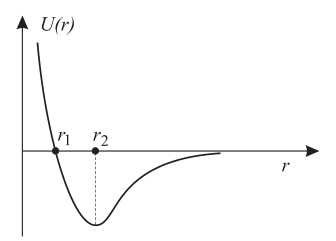 Potential energy vs intermolecular distance r
Topic: Newtonian Mechanics, Modern-Quantum Physics Metodi: Physical Modeling, Conservation of Energy Competenze: Physical Reasoning, Diagrammatic Reasoning Objects: — Fonte: Testo (PDF) — p.9 Risposta: D · Soluzioni
The diagram shows the potential energy of a system consisting of two molecules based on the distance, , between them.
Which of the following statements is true?
1 The potential energy is zero for . 2 The potential energy decreases constantly as it increases by . 3 The force between molecules is attractive for and repulsive for .
- **A ** Only the 1.
- B. Only the 3.
- C. La 1 e la 2.
- D. La 1 e la 3.
- E. La 2 e la 3.
Potential energy vs intermolecular distance r
Topic: Newtonian Mechanics, Modern-Quantum Physics Metodi: Physical Modeling, Conservation of Energy Competenze: Physical Reasoning, Diagrammatic Reasoning Objects: — Fonte: Testo (PDF) — p.9 Risposta: D · Soluzioni
In quale dei seguenti circuiti il generatore eroga meno corrente?
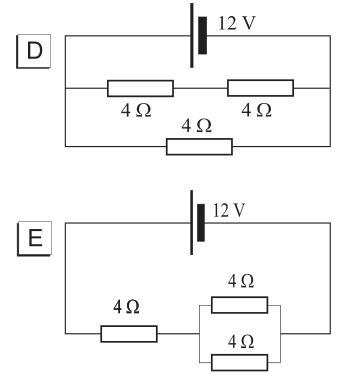 Five resistor circuit diagrams A–E
 Five planetary orbits around a star
Topic: Circuits Metodi: Equivalent Circuit Reduction, Kirchhoff’s Laws Competenze: Diagrammatic Reasoning, Physical Reasoning Objects: Resistor, Battery Fonte: Testo (PDF) — p.10 Risposta: B · Soluzioni
In which of the following circuits does the generator deliver less current?
Five resistor circuit diagrams A–E
Five planetary orbits around a star
Topic: Circuits Metodi: Equivalent Circuit Reduction, Kirchhoff’s Laws Competenze: Diagrammatic Reasoning, Physical Reasoning Objects: Resistor, Battery Fonte: Testo (PDF) — p.10 Risposta: B · Soluzioni
Pierino si chiede quanto pesa approssimativamente una pagina strappata da un libro di scuola, ma senza rovinare il libro, fa due conti a mente e trova
- A.
- B.
- C.
- D.
- E. Topic: Order-of-Magnitude Estimation, Newtonian Mechanics Metodi: Order-of-Magnitude Estimation, Physical Modeling Competenze: Estimation & Approximation, Physical Reasoning Objects: — Fonte: Testo (PDF) — p.10 Risposta: A · Soluzioni
Pierino wonders how much a page torn from a school book weighs, but without ruining the book, he makes two calculations in his mind and finds
- A.
- B.
- C.
- D.
- E. Topic: Order-of-Magnitude Estimation, Newtonian Mechanics Metodi: Order-of-Magnitude Estimation, Physical Modeling Competenze: Estimation & Approximation, Physical Reasoning Objects: — Fonte: Testo (PDF) — p.10 Risposta: A · Soluzioni
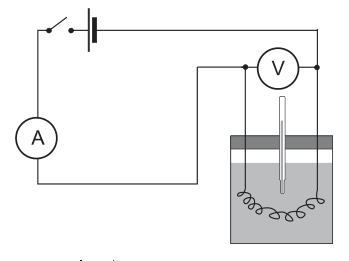
Un liquido viene riscaldato usando l’apparecchiatura il cui schema è mostrato in figura. La corrente nel liquido passa per , mentre l’amperometro A segna e il voltmetro . Si osserva che la temperatura del liquido sale di e che il calore disperso è una frazione trascurabile di quello scambiato nell’apparecchio.
La capacità termica del sistema (calorimetro+liquido) è approssimativamente
- A.
- B.
- C.
- D.
- E.
 Electrical heating calorimeter setup
Topic: Thermodynamics, Circuits Metodi: First Law of Thermodynamics, Kirchhoff’s Laws Competenze: Mathematical Modeling, Physical Reasoning Objects: Calorimeter, Battery Fonte: Testo (PDF) — p.10 Risposta: D · Soluzioni
A liquid is heated using the equipment whose pattern is shown in the figure. The current in the liquid passes through , while the amperometer A marks and the voltmeter . It is noted that the temperature of the liquid rises to and that the heat dissipated is a negligible fraction of that exchanged in the apparatus.
The thermal capacity of the system (calorometer+liquid) is approximately
- A.
- B.
- C.
- D.
- E.
Electrical heating calorimeter setup
Topic: Thermodynamics, Circuits Metodi: First Law of Thermodynamics, Kirchhoff’s Laws Competenze: Mathematical Modeling, Physical Reasoning Objects: Calorimeter, Battery Fonte: Testo (PDF) — p.10 Risposta: D · Soluzioni
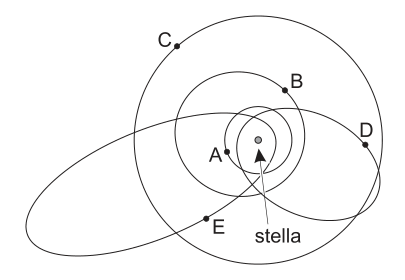
Un sistema planetario è formato da una stella e cinque pianeti, le cui orbite sono mostrate in figura.
Quale pianeta ha il maggiore periodo di rivoluzione?
Topic: Astrophysics, Gravitation Metodi: Kepler’s Laws, Physical Modeling Competenze: Physical Reasoning, Diagrammatic Reasoning Objects: Star, Planet Fonte: Testo (PDF) — p.10 Risposta: E · Soluzioni
A planetary system consists of one star and five planets, whose orbits are shown in the figure.
Which planet has the longest period of revolution?
Topic: Astrophysics, Gravitation Metodi: Kepler’s Laws, Physical Modeling Competenze: Physical Reasoning, Diagrammatic Reasoning Objects: Star, Planet Fonte: Testo (PDF) — p.10 Risposta: E · Soluzioni