Q1. Si scelga quale, tra le seguenti coppie, comprende una grandezza vettoriale e una grandezza scalare. A) Spostamento e accelerazione; B) Forza ed energia cinetica; C) Potenza e massa; D) Lavoro ed energia potenziale; E) Velocità e quantità di moto.
Topic: Newtonian Mechanics Metodi: — Competenze: Physical Reasoning Objects: — Fonte: Testo (PDF) — p.3 Risposta: B · Soluzioni (PDF)
Q1. Choose which of the following pairs includes a vector quantity and a scalar quantity. A) Displacement and acceleration; B) Force and kinetic energy; C) Power and mass; D) Work and potential energy; E) Velocity and momentum.
Answer: B · Soluzioni (PDF)
Q2. Il diagramma mostra una corda elastica tesa fra due punti fissi P e Q. Sulla corda è presente un’onda stazionaria. Quale o quali delle seguenti affermazioni, riguardo ai due punti indicati X e Y della corda, sono corrette? 1 — I due punti oscillano con una differenza di fase uguale a ; 2 — I due punti hanno lo stesso periodo di oscillazione; 3 — La distanza fra i due punti è uguale a una lunghezza d’onda. A) Tutte e tre; B) Solo 1 e 2; C) Solo la 2 e la 3; D) Solo la 1; E) Solo la 3.
Onda stazionaria sulla corda fra P e Q, con i punti X e Y su ventri adiacenti.
Topic: Oscillations & Waves Metodi: Wave Equation, Superposition Principle Competenze: Physical Reasoning, Diagrammatic Reasoning Objects: String Fonte: Testo (PDF) — p.3 Risposta: B · Soluzioni (PDF)
Q2. The diagram shows an elastic string stretched between two fixed points P and Q. A standing wave is present on the string. Which of the following statements, regarding the two indicated points X and Y on the string, are correct? 1 — The two points oscillate with a phase difference equal to ; 2 — The two points have the same oscillation period; 3 — The distance between the two points is equal to one wavelength. A) All three; B) Only 1 and 2; C) Only 2 and 3; D) Only 1; E) Only 3.
Standing wave on the string between P and Q, with points X and Y on adjacent antinodes.
Answer: B · Soluzioni (PDF)
Q3. Per riscaldare l’acqua del tè si riscaldano d’acqua portandoli da a . Per riscaldare l’acqua del tè occorre una energia di circa… A) ; B) ; C) ; D) ; E) .
Topic: Thermodynamics Metodi: Order-of-Magnitude Estimation Competenze: Estimation & Approximation Objects: — Fonte: Testo (PDF) — p.3 Risposta: B · Soluzioni (PDF)
Q3. To heat the tea water, of water are heated, bringing them from to . To heat the tea water, an energy of about… A) ; B) ; C) ; D) ; E) .
Answer: B · Soluzioni (PDF)
Q4. Una pentola a pressione ha la valvola di sicurezza regolata per aprirsi quando all’interno la pressione raggiunge il valore di [pressione relativa ]. Poiché sopra è chiusa in condizioni di pressione atmosferica normale, alla temperatura di , la pentola viene dimenticata vuota sul fornello acceso. Si indichi, fra i valori seguenti, quello che si avvicina di più alla temperatura alla quale si aprirà la valvola. A) ; B) ; C) ; D) ; E) .
Topic: Thermodynamics Metodi: Ideal Gas Law Competenze: Physical Reasoning Objects: Container, Gas Fonte: Testo (PDF) — p.3 Risposta: C · Soluzioni (PDF)
Q4. A pressure cooker has its safety valve set to open when the pressure inside reaches the value of [gauge pressure ]. Since it is closed on top under normal atmospheric pressure conditions, at the temperature of , the empty pot is forgotten on the lit stove. Among the following values, indicate the one closest to the temperature at which the valve will open. A) ; B) ; C) ; D) ; E) .
Answer: C · Soluzioni (PDF)
Q5. Una macchina viaggia lungo una strada rettilinea. Il grafico mostra come varia nel tempo la sua accelerazione dal momento in cui parte, per un certo tempo. Quale punto del grafico si riferisce al momento in cui la macchina raggiunge la massima velocità?
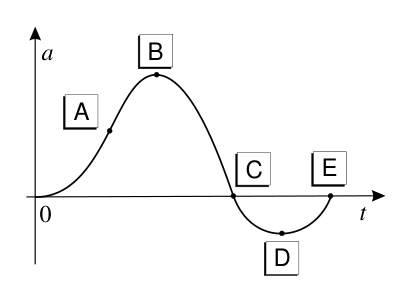 Grafico – con i punti A, B, C, D, E.
Topic: Newtonian Mechanics Metodi: Kinematic Equations Competenze: Diagrammatic Reasoning Objects: — Fonte: Testo (PDF) — p.4 Risposta: C · Soluzioni (PDF)
A car travels along a straight road. The graph shows how its acceleration varies over time from the moment it starts, for a certain period of time. What point on the graph refers to the time when the machine reaches maximum speed?
Graph – with points A, B, C, D, E.
Topic: Newtonian Mechanics Metodi: Kinematic Equations Competenze: Diagrammatic Reasoning Objects: — Fonte: Testo (PDF) — p.4 Answer: C · Soluzioni (PDF)
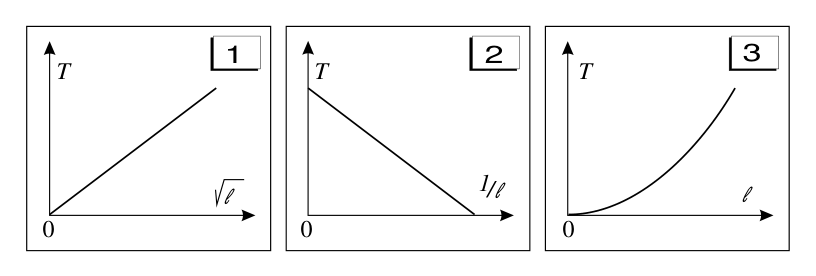
Q6. Il periodo di un pendolo semplice è dato da , dove è il periodo del pendolo, è la lunghezza del pendolo e è l’accelerazione di gravità. Si vuol sapere quale o quali fra i grafici seguenti potrebbero essere corretti: grafico 1 ( vs , retta per l’origine); grafico 2 ( vs ); grafico 3 ( vs ). A) Tutti e tre; B) Solo 1 e 2; C) Solo 2 e 3; D) Solo 1; E) Solo 3.
Grafici 1 ( vs ), 2 ( vs ) e 3 ( vs ).
Topic: Oscillations & Waves Metodi: Graph Linearization Competenze: Graph Linearization, Mathematical Modeling Objects: Pendulum Fonte: Testo (PDF) — p.4 Risposta: D · Soluzioni (PDF)
Q6. The period of a simple pendulum is given by , where is the period of the pendulum, is the length of the pendulum and is the acceleration of gravity. It is necessary to know which of the following graphs could be corrected: graph 1 ( vs , straightforward for origin); graph 2 ( vs ); graph 3 ( vs ). (a) All three; (b) Only 1 and 2; (c) Only 2 and 3; (d) Only 1; (e) Only 3.
Grafici 1 ( vs ), 2 ( vs ) e 3 ( vs ).
Topic: Oscillations & Waves Metodi: Graph Linearization Competenze: Graph Linearization, Mathematical Modeling Objects: Pendulum Fonte: Testo (PDF) — p.4 Risposta: D · Soluzioni (PDF)
Q7. Un micrometro, il cui errore di lettura è di , dà i seguenti risultati quando viene usato per misurare il diametro di un filo a sezione costante: , , , , . Togliendo il filo e chiudendo le ganasce del micrometro, sulla scala dello strumento si legge . Quale dei seguenti valori esprime, con la precisione appropriata, la misura di in millimetri? A) 1.0; B) 1.00; C) 1.02; D) 1.038; E) 1.04.
Topic: Order-of-Magnitude Estimation Metodi: Experimental Data Analysis Competenze: Measurement & Instrumentation, Significant Figures Objects: Wire Fonte: Testo (PDF) — p.3 Risposta: E · Soluzioni (PDF)
Q7. A micrometer, whose reading error is , gives the following results when used to measure the diameter of a wire of constant cross-section: , , , , . Removing the wire and closing the jaws of the micrometer, the instrument scale reads . Which of the following values expresses, with the appropriate precision, the measurement of in millimeters? A) 1.0; B) 1.00; C) 1.02; D) 1.038; E) 1.04.
Answer: E · Soluzioni (PDF)
Q8. Due lastre conduttrici, di uguale forma, sono disposte parallelamente tra loro a distanza piccola rispetto alle loro dimensioni, e sono separate da un mezzo dielettrico. La d.d.p. tra le lastre è nota. Quale o quali ulteriori informazioni sono necessarie per determinare l’intensità del campo elettrico presente tra le lastre? A) La distanza tra le lastre; B) La distanza e l’area delle lastre; C) La permeabilità dielettrica del mezzo e la distanza tra le lastre; D) La permeabilità dielettrica del mezzo e l’area delle lastre; E) La permeabilità dielettrica del mezzo, la distanza e l’area delle lastre.
Topic: Electrostatics Metodi: Gauss’s Law Competenze: Physical Reasoning Objects: Capacitor Fonte: Testo (PDF) — p.5 Risposta: A · Soluzioni (PDF)
Q8. Two conducting plates, of the same shape, are arranged parallel to each other at a distance small compared to their dimensions, and are separated by a dielectric medium. The potential difference between the plates is known. Which additional information, or pieces of information, is necessary to determine the intensity of the electric field present between the plates? A) The distance between the plates; B) The distance and the area of the plates; C) The dielectric permittivity of the medium and the distance between the plates; D) The dielectric permittivity of the medium and the area of the plates; E) The dielectric permittivity of the medium, the distance and the area of the plates.
Answer: A · Soluzioni (PDF)
Q9. Quattro resistori sono connessi come in figura ( tra P e Q; tra P e S; tra Q e R; tra S e R). Fra quale coppia di punti la resistenza è massima? A) e ; B) e ; C) e ; D) e ; E) ed .
Maglia P-Q-R-S: tra P e Q, tra Q e R, tra S e R, tra P e S.
Topic: Circuits Metodi: Equivalent Circuit Reduction, Kirchhoff’s Laws Competenze: Physical Reasoning Objects: Resistor Fonte: Testo (PDF) — p.5 Risposta: B · Soluzioni (PDF)
Q9. Four resistors are connected as in the figure ( between P and Q; between P and S; between Q and R; between S and R). Between which pair of points is the resistance maximum? A) and ; B) and ; C) and ; D) and ; E) and .
Mesh P-Q-R-S: between P and Q, between Q and R, between S and R, between P and S.
Answer: B · Soluzioni (PDF)
Q10. Un ingegnere afferma di aver inventato un motore termico che funziona fra le temperature di e con un rendimento di . Si può dire che… A) l’ingegnere non ha niente di cui vantarsi; B) è proprio un rendimento medio; C) il rendimento è buono, ma nient’altro di più; D) il rendimento ottenuto è eccellente; E) un tale motore non può esistere.
Topic: Thermodynamics Metodi: Thermodynamic Cycle Analysis Competenze: Physical Reasoning Objects: Heat Engine Fonte: Testo (PDF) — p.3 Risposta: E · Soluzioni (PDF)
Q10. An engineer claims to have invented a heat engine that operates between the temperatures and with an efficiency of . Can one say that… A) the engineer has nothing to boast about; B) it is just an average efficiency; C) the efficiency is good, but nothing more than that; D) the efficiency obtained is excellent; E) such an engine cannot exist.
Answer: E · Soluzioni (PDF)
Q11. Il disegno mostra un lungo filo rettilineo percorso da una corrente elettrica stazionaria. Il punto P è posto alla distanza dal filo. Quale o quali delle seguenti affermazioni sono corrette? 1 — Il campo magnetico in P è inversamente proporzionale a ; 2 — Il campo magnetico in P è proporzionale alla corrente elettrica; 3 — Il campo magnetico in P è parallelo al filo. A) Tutte e tre; B) Solo la 1 e la 2; C) Solo la 2 e la 3; D) Solo la 1; E) Solo la 3.
Filo rettilineo percorso da corrente; il punto P dista dal filo.
Topic: Magnetism Metodi: Ampère’s Law Competenze: Physical Reasoning Objects: Wire Fonte: Testo (PDF) — p.5 Risposta: B · Soluzioni (PDF)
Q11. The drawing shows a long straight wire carrying a steady electric current. Point P is located at distance from the wire. Which or how many of the following statements are correct? 1 — The magnetic field at P is inversely proportional to ; 2 — The magnetic field at P is proportional to the electric current; 3 — The magnetic field at P is parallel to the wire. A) All three; B) Only 1 and 2; C) Only 2 and 3; D) Only 1; E) Only 3.
Straight wire carrying current; point P is at distance from the wire.
Answer: B · Soluzioni (PDF)
Q12. Due blocchi di legno, collegati da una fune, sono sollecitati da una forza di , come in figura. I blocchi sono appoggiati su una superficie liscia (massa tirata, fune, massa ). Qual è l’intensità della forza applicata dalla fune al blocco di ? A) ; B) ; C) ; D) ; E) .
Blocchi di e collegati da una fune e tirati con una forza di .
Topic: Newtonian Mechanics Metodi: Free-Body Diagram, Kinematic Equations Competenze: Physical Reasoning Objects: Block, String Fonte: Testo (PDF) — p.4 Risposta: B · Soluzioni (PDF)
Q12. Two wooden blocks, connected by a rope, are acted upon by a force of , as in the figure. The blocks rest on a smooth surface (mass pulled, rope, mass ). What is the magnitude of the force applied by the rope to the block of ? A) ; B) ; C) ; D) ; E) .
Blocks of and connected by a rope and pulled with a force of .
Answer: B · Soluzioni (PDF)
Q13. In figura la linea PQR rappresenta un sottile fascio di luce monocromatica che passa dal mezzo (1) al mezzo (2). In tale fenomeno si può dire che… A) la frequenza della luce aumenta; B) la frequenza della luce diminuisce; C) la lunghezza d’onda della luce rimane invariata; D) la lunghezza d’onda della luce aumenta; E) la lunghezza d’onda della luce diminuisce.
Fascio PQR che passa dal mezzo (1) al mezzo (2) attraverso l’interfaccia.
Topic: Geometric Optics Metodi: Snell’s Law Competenze: Physical Reasoning Objects: — Fonte: Testo (PDF) — p.3 Risposta: D · Soluzioni (PDF)
Q13. In the figure, the line PQR represents a thin beam of monochromatic light passing from medium (1) to medium (2). In this phenomenon it can be said that… A) the frequency of the light increases; B) the frequency of the light decreases; C) the wavelength of the light remains unchanged; D) the wavelength of the light increases; E) the wavelength of the light decreases.
Beam PQR passing from medium (1) to medium (2) through the interface.
Answer: D · Soluzioni (PDF)
Q14. Un elettrone si sposta in un campo elettrico da un punto P a un punto Q. Nella tabella seguente si danno i valori, nei punti P e Q, dell’intensità del campo elettrico e del potenziale ad esso associato: P → , ; Q → , . La carica dell’elettrone è . Usando soltanto i dati precedenti, quale delle seguenti grandezze è possibile determinare quando l’elettrone si trova in P? A) La forza agente sull’elettrone; B) La velocità dell’elettrone; C) La quantità di moto dell’elettrone; D) L’energia cinetica dell’elettrone; E) L’energia totale dell’elettrone.
Topic: Electrostatics Metodi: Electric Potential Method Competenze: Physical Reasoning Objects: Electron Fonte: Testo (PDF) — p.5 Risposta: A · Soluzioni (PDF)
Q14. An electron moves in an electric field from a point P to a point Q. The following table gives the values, at points P and Q, of the electric field strength and of the potential associated with it: P → , ; Q → , . The charge of the electron is . Using only the preceding data, which of the following quantities is it possible to determine when the electron is at P? A) The force acting on the electron; B) The speed of the electron; C) The momentum of the electron; D) The kinetic energy of the electron; E) The total energy of the electron.
Answer: A · Soluzioni (PDF)
Q15. Con riferimento al testo del quesito precedente, quale dei valori seguenti si avvicina di più all’energia necessaria all’elettrone per spostarsi da P a Q? A) 0; B) ; C) ; D) ; E) .
Topic: Electrostatics Metodi: Electric Potential Method, Energy Conservation Method Competenze: Physical Reasoning Objects: Electron Fonte: Testo (PDF) — p.5 Risposta: C · Soluzioni (PDF)
Q15. With reference to the text of the previous question, which of the following values is closest to the energy required by the electron to move from P to Q? A) 0; B) ; C) ; D) ; E) .
Answer: C · Soluzioni (PDF)
Q16. Un aereo vola orizzontalmente alla velocità di , a di altezza dal suolo; quando si trova sulla verticale di un punto a distanza dal proiettile T, sgancia un contenitore. Assumendo che l’accelerazione di gravità valga e che la resistenza dell’aria sia trascurabile, il contenitore cadrà esattamente nel punto T se è… A) ; B) ; C) ; D) ; E) .
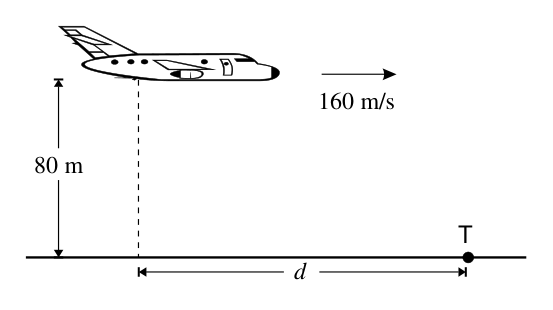 Aereo a di quota e ; il contenitore deve cadere nel punto T a distanza .
Topic: Newtonian Mechanics Metodi: Kinematic Equations Competenze: Mathematical Modeling Objects: Projectile Fonte: Testo (PDF) — p.4 Risposta: D · Soluzioni (PDF)
Q16. An airplane flies horizontally at a speed of , at a height of from the ground; when it is on the vertical of a point at a distance from the target T, it releases a container. Assuming that the acceleration of gravity is and that air resistance is negligible, the container will fall exactly on point T if is… A) ; B) ; C) ; D) ; E) .
Airplane at an altitude of and ; the container must fall on point T at a distance of .
Answer: D · Soluzioni (PDF)
Q17. Un tubo a U, chiuso ad entrambe le estremità, contiene azoto da una parte ed elio dall’altra parte; i due gas sono separati da mercurio, la cui densità è . Detta l’accelerazione di gravità, il dislivello in alto, il dislivello in basso, e la pressione dell’elio (parte alta), qual è la pressione dell’azoto? A) ; B) ; C) ; D) ; E) .
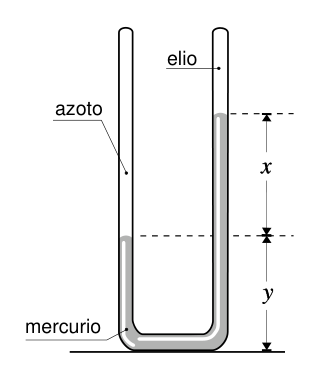 Tubo a U: elio in alto a destra (dislivello ) e azoto a sinistra (dislivello ), separati dal mercurio.
Topic: Fluid Mechanics Metodi: Hydrostatic Equilibrium Competenze: Physical Reasoning Objects: Tube, Gas, Manometer Fonte: Testo (PDF) — p.3 Risposta: D · Soluzioni (PDF)
Q17. A U-tube, closed at both ends, contains nitrogen on one side and helium on the other side; the two gases are separated by mercury, whose density is . Letting be the acceleration due to gravity, the upper height difference, the lower height difference, and the pressure of the helium (upper part), what is the pressure of the nitrogen? A) ; B) ; C) ; D) ; E) .
U-tube: helium at the upper right (height difference ) and nitrogen on the left (height difference ), separated by mercury.
Answer: D · Soluzioni (PDF)
Q18. Quale delle seguenti grandezze non necessariamente ha lo stesso valore per tutti i satelliti che sono in orbita geostazionaria intorno alla Terra? A) La velocità angolare; B) L’accelerazione centripeta; C) L’energia cinetica; D) Il periodo orbitale; E) La distanza dal centro della Terra.
Topic: Gravitation Metodi: Kepler’s Laws, Newton’s Law of Gravitation Competenze: Physical Reasoning Objects: Satellite, Planet Fonte: Testo (PDF) — p.4 Risposta: C · Soluzioni (PDF)
Q18. Which of the following quantities does not necessarily have the same value for all satellites that are in geostationary orbit around the Earth? A) The angular velocity; B) The centripetal acceleration; C) The kinetic energy; D) The orbital period; E) The distance from the center of the Earth.
Answer: C · Soluzioni (PDF)
Q19. Una palla, lasciata cadere da ferma a una certa altezza dal pavimento, rimbalza diverse volte. Il grafico mostra come varia nel tempo una grandezza relativa al moto della palla. Che cosa rappresenta la grandezza ? A) L’accelerazione; B) Lo spostamento; C) L’energia cinetica; D) La velocità; E) L’energia meccanica totale.
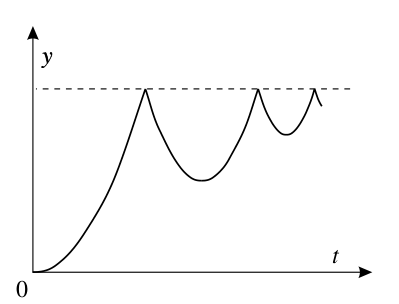 Grafico della grandezza in funzione del tempo per la palla che rimbalza.
Topic: Newtonian Mechanics Metodi: Energy Conservation Method Competenze: Diagrammatic Reasoning Objects: Ball Fonte: Testo (PDF) — p.4 Risposta: C · Soluzioni (PDF)
Q19. A ball, dropped from rest at a certain height above the floor, bounces several times. The graph shows how a quantity related to the motion of the ball varies over time. What does the quantity represent? A) The acceleration; B) The displacement; C) The kinetic energy; D) The velocity; E) The total mechanical energy.
Graph of the quantity as a function of time for the bouncing ball.
Answer: C · Soluzioni (PDF)
Q20. Due satelliti si urtano, nello spazio, anelasticamente. Cosa accade all’energia cinetica totale e alla quantità di moto totali dei due satelliti? (opzioni con coppie Energia cinetica totale / Quantità di moto totale: A si conserva / si conserva; B si conserva / aumenta; C si riduce / si conserva; D si riduce / aumenta; E si riduce / si riduce).
Topic: Conservation of Momentum Metodi: Conservation of Momentum, Conservation of Energy Competenze: Physical Reasoning Objects: Satellite Fonte: Testo (PDF) — p.4 Risposta: C · Soluzioni (PDF)
Q20. Two satellites collide inelastically in space. What happens to the total kinetic energy and the total momentum of the two satellites? (options with pairs Total kinetic energy / Total momentum: A conserved / conserved; B conserved / increases; C decreases / conserved; D decreases / increases; E decreases / decreases).
Answer: C · Soluzioni (PDF)
Q21. Quale o quali delle seguenti affermazioni, riguardo all’effetto fotoelettrico, sono corrette? 1 — Quando avviene l’emissione, il numero di elettroni emessi al secondo è proporzionale all’intensità della radiazione usata; 2 — Gli elettroni vengono emessi solo se la radiazione elettromagnetica incidente ha una lunghezza d’onda maggiore di un certo valore, detto di soglia; 3 — Gli elettroni vengono emessi solo se la radiazione elettromagnetica incidente ha un’intensità maggiore di un certo valore, detto di soglia. A) Tutte e tre; B) Solo la 1 e la 2; C) Solo la 2 e la 3; D) Solo la 1; E) Solo la 3.
Topic: Modern-Quantum Physics Metodi: Photon Energy Relation Competenze: Physical Reasoning Objects: Photon, Electron Fonte: Testo (PDF) — p.3 Risposta: D · Soluzioni (PDF)
Q21. Which of the following statements, regarding the photoelectric effect, are correct? 1 — When emission occurs, the number of electrons emitted per second is proportional to the intensity of the radiation used; 2 — Electrons are emitted only if the incident electromagnetic radiation has a wavelength greater than a certain value, called the threshold; 3 — Electrons are emitted only if the incident electromagnetic radiation has an intensity greater than a certain value, called the threshold. A) All three; B) Only 1 and 2; C) Only 2 and 3; D) Only 1; E) Only 3.
Answer: D · Soluzioni (PDF)
Q22. Un raggio di luce passa dall’aria al vetro come mostrato in figura (incidenza in aria, rifrazione nel vetro). Qual è la migliore stima della velocità della luce nel vetro? A) ; B) ; C) ; D) ; E) .
Raggio dall’aria al vetro: incidenza e rifrazione .
Topic: Geometric Optics Metodi: Snell’s Law Competenze: Mathematical Modeling Objects: — Fonte: Testo (PDF) — p.3 Risposta: B · Soluzioni (PDF)
Q22. A light ray passes from air to glass as shown in the figure (incidence in air, refraction in glass). What is the best estimate of the speed of light in glass? A) ; B) ; C) ; D) ; E) .
Ray from air to glass: incidence and refraction .
Answer: B · Soluzioni (PDF)
Q23. In un oscilloscopio si formano sull’acqua onde piane che si propagano a velocità costante. Nei disegni seguenti, in cui le linee rappresentano i vertici dei massimi delle onde, si mostrano delle onde (in vista dall’alto) che si propagano dalla parte alta del disegno a quella bassa. A un certo punto incontrano una barriera col centro vi è un’ampia interruzione. Quale, fra i seguenti schemi, rappresenta correttamente la situazione al di là della barriera?
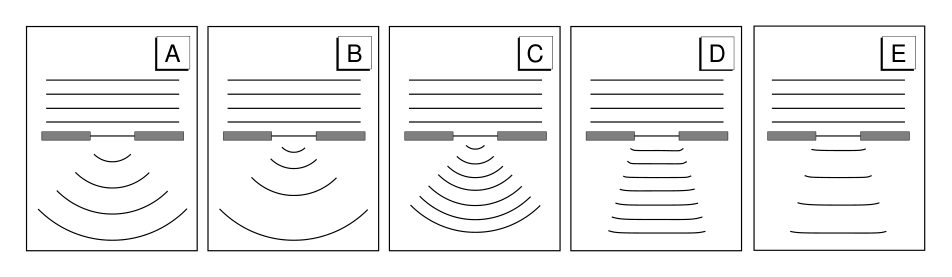 Cinque schemi A–E della diffrazione delle onde attraverso l’interruzione nella barriera.
Topic: Wave Optics Metodi: Interference & Diffraction Analysis Competenze: Diagrammatic Reasoning Objects: Slit Fonte: Testo (PDF) — p.3 Risposta: D · Soluzioni (PDF)
Q23. In a ripple tank, plane waves are formed on the water that propagate at constant speed. In the following drawings, in which the lines represent the crests of the wave maxima, waves are shown (in top view) that propagate from the upper part of the drawing to the lower part. At a certain point they encounter a barrier with a wide gap in the center. Which of the following diagrams correctly represents the situation beyond the barrier?
Five diagrams A–E of wave diffraction through the gap in the barrier.
Answer: D · Soluzioni (PDF)
Q24. Una pallina da golf viene fatta cadere da ferma sopra un pavimento rigido. Essa rimbalza fino ad un’altezza più bassa rispetto al punto di caduta poiché perde energia durante l’urto con il pavimento. Si chiede come varia, durante la caduta ed il rimbalzo, una certa grandezza fisica, , in funzione del tempo. Trascurando gli effetti della resistenza dell’aria: quale di questi grafici rappresenta meglio come varia la quantità di moto della pallina, in funzione del tempo, durante la caduta e il rimbalzo?
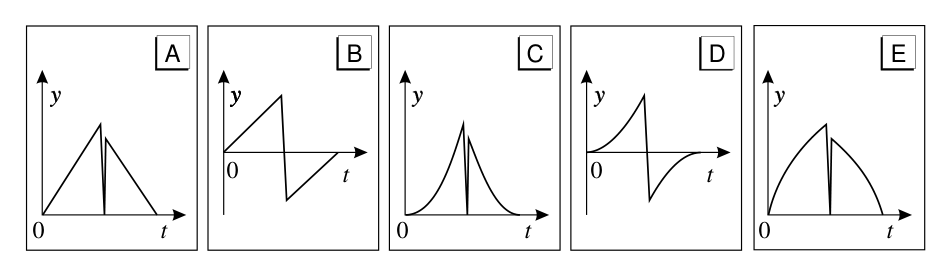 Cinque grafici – (A–E) per la pallina che cade e rimbalza.
Topic: Conservation of Momentum Metodi: Impulse-Momentum Theorem Competenze: Diagrammatic Reasoning Objects: Ball Fonte: Testo (PDF) — p.4 Risposta: E · Soluzioni (PDF)
A golf ball is dropped from a stand on a rigid floor. It bounces to a lower height than the point of fall because it loses energy during impact with the floor. It is asked how a certain physical size, , varies during fall and bounce, depending on the time. Disregarding the effects of air resistance, which of these graphs best illustrates how the amount of ball motion varies, depending on the time, during the fall and bounce?
Five graphs – (AE) for the ball that falls and bounces.
Topic: Conservation of Momentum Metodi: Impulse-Momentum Theorem Competenze: Diagrammatic Reasoning Objects: Ball Fonte: Testo (PDF) — p.4 Answer: E · Soluzioni (PDF)
Q25. Con riferimento alla situazione descritta nel quesito precedente e ai relativi grafici, quale di quelli descrive meglio come varia nel tempo l’energia cinetica della pallina durante la caduta e il rimbalzo? (Si vedano gli stessi cinque grafici – A–E del quesito precedente.)
Topic: Conservation of Energy Metodi: Energy Conservation Method Competenze: Diagrammatic Reasoning Objects: Ball Fonte: Testo (PDF) — p.4 Risposta: C · Soluzioni (PDF)
Q25. In relation to the situation described in the previous question and the related graphs, which one of them best describes how the kinetic energy of the ball changes over time during the fall and bounce? (You can see the same five graphs – AE of quesito precedente.)
Topic: Conservation of Energy Metodi: Energy Conservation Method Competenze: Diagrammatic Reasoning Objects: Ball Fonte: Testo (PDF) — p.4 Answer: C · Soluzioni (PDF)
Q26. Una gru sostiene un carico di massa . La tensione del cavo ha il valore di e il carico sta accelerando verso il basso. Ammettendo che sia , quale dei seguenti valori esprime meglio, in , l’accelerazione del carico? A) 0; B) 0.71; C) 4.0; D) 9.1; E) 9.8.
Topic: Newtonian Mechanics Metodi: Free-Body Diagram, Kinematic Equations Competenze: Physical Reasoning Objects: String, Block Fonte: Testo (PDF) — p.4 Risposta: B · Soluzioni (PDF)
Q26. A crane supports a load of mass . The tension in the cable has the value and the load is accelerating downward. Assuming that , which of the following values best expresses, in , the acceleration of the load? A) 0; B) 0.71; C) 4.0; D) 9.1; E) 9.8.
Answer: B · Soluzioni (PDF)
Q28. Un forno solare usato per scaldare acqua è costituito da uno specchio concavo di area . La potenza radiante per unità di superficie, che arriva dal Sole sullo specchio, è . Il minimo tempo necessario per riscaldare nel forno di acqua da a è… A) ; B) ; C) ; D) ; E) .
Topic: Thermodynamics Metodi: Order-of-Magnitude Estimation Competenze: Estimation & Approximation Objects: Mirror Fonte: Testo (PDF) — p.3 Risposta: B · Soluzioni (PDF)
Q28. A solar oven used to heat water consists of a concave mirror of area . The radiant power per unit area that arrives from the Sun on the mirror is . The minimum time necessary to heat in the oven of water from to is… A) ; B) ; C) ; D) ; E) .
Answer: B · Soluzioni (PDF)
Q29. La Luna ha un diametro di e la sua distanza media dalla Terra è di . Qual è il diametro dell’immagine reale della Luna formata da un telescopio il cui specchio sferico ha un raggio di curvatura di ? A) ; B) ; C) ; D) ; E) .
Topic: Geometric Optics Metodi: Thin Lens & Mirror Equation Competenze: Mathematical Modeling Objects: Mirror, Satellite Fonte: Testo (PDF) — p.3 Risposta: A · Soluzioni (PDF)
Q29. The Moon has a diameter of and its average distance from the Earth is . What is the diameter of the real image of the Moon formed by a telescope whose spherical mirror has a radius of curvature of ? A) ; B) ; C) ; D) ; E) .
Answer: A · Soluzioni (PDF)
Q30. Un satellite con la massa di è in un’orbita circolare di raggio . All’altezza dell’orbita il potenziale gravitazionale della Terra è pari a . Il satellite viene poi spostato su un’altra orbita il cui raggio è . Quale fra i valori indicati di seguito rappresenta il guadagno di energia potenziale del satellite, espresso in joule, quando avviene questo cambiamento di orbita? A) ; B) ; C) ; D) ; E) .
Topic: Gravitation Metodi: Newton’s Law of Gravitation, Energy Conservation Method Competenze: Physical Reasoning Objects: Satellite, Planet Fonte: Testo (PDF) — p.4 Risposta: D · Soluzioni (PDF)
Q30. A satellite with mass is in a circular orbit of radius . At the altitude of the orbit, the gravitational potential of the Earth is equal to . The satellite is then moved to another orbit whose radius is . Which of the following values represents the gain in potential energy of the satellite, expressed in joules, when this change of orbit occurs? A) ; B) ; C) ; D) ; E) .
Answer: D · Soluzioni (PDF)
Q31. Una molla, la cui lunghezza a riposo è , viene appesa al soffitto; all’altra estremità viene fissato un corpo che, dopo essere stato tirato e poi abbandonato, comincia ad oscillare secondo un moto armonico di periodo . Il grafico indica come varia nel tempo la sua distanza dal soffitto (asse in cm, da a , in funzione del tempo, con e marcati). Dal grafico si può ricavare che… A) l’ampiezza del moto armonico è ; B) l’energia cinetica ha un massimo in ; C) il modulo della forza di richiamo sul corpo aumenta fra e ; D) il modulo della velocità ha un massimo in ; E) il valore di è .
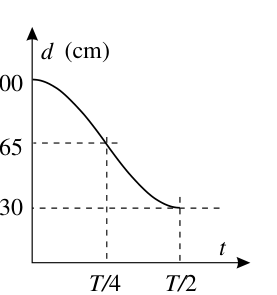 Distanza dal soffitto (in cm) in funzione del tempo, con e indicati.
Topic: Oscillations & Waves Metodi: Simple Harmonic Motion Analysis Competenze: Diagrammatic Reasoning Objects: Spring Fonte: Testo (PDF) — p.4 Risposta: D · Soluzioni (PDF)
Q31. A spring, whose rest length is , is hung from the ceiling; to the other end a body is attached which, after being pulled and then released, begins to oscillate with simple harmonic motion of period . The graph shows how its distance from the ceiling varies over time (axis in cm, from to , as a function of time, with and marked). From the graph one can deduce that… A) the amplitude of the simple harmonic motion is ; B) the kinetic energy has a maximum at ; C) the magnitude of the restoring force on the body increases between and ; D) the magnitude of the velocity has a maximum at ; E) the value of is .
Distance from the ceiling (in cm) as a function of time, with and indicated.
Answer: D · Soluzioni (PDF)
Q32. L’intensità del campo gravitazionale in un punto P della superficie terrestre è uguale… A) all’accelerazione di caduta libera nel punto P; B) alla variazione dell’energia in uno spostamento unitario dal punto P; C) alla forza che agisce su un corpo posto in P; D) al lavoro fatto per portare una massa unitaria dall’infinito nel punto P; E) al lavoro fatto per portare una massa unitaria dal centro della Terra nel punto P.
Topic: Gravitation Metodi: Newton’s Law of Gravitation Competenze: Physical Reasoning Objects: Planet Fonte: Testo (PDF) — p.4 Risposta: A · Soluzioni (PDF)
Q32. The intensity of the gravitational field at a point P on the Earth’s surface is equal to… A) the free-fall acceleration at point P; B) the change in energy over a unit displacement from point P; C) the force acting on a body placed at P; D) the work done to bring a unit mass from infinity to point P; E) the work done to bring a unit mass from the center of the Earth to point P.
Answer: A · Soluzioni (PDF)
Q33. Una sfera conduttrice isolata, P, possiede la distribuzione di carica elettrica mostrata in figura. Una sfera Q, simile alla prima e collegata a terra con un lungo filo, viene portata in prossimità della sfera P. Quale dei seguenti disegni rappresenta meglio la distribuzione finale della carica sulle due sfere?
Distribuzione iniziale di carica sulla sfera conduttrice isolata P.
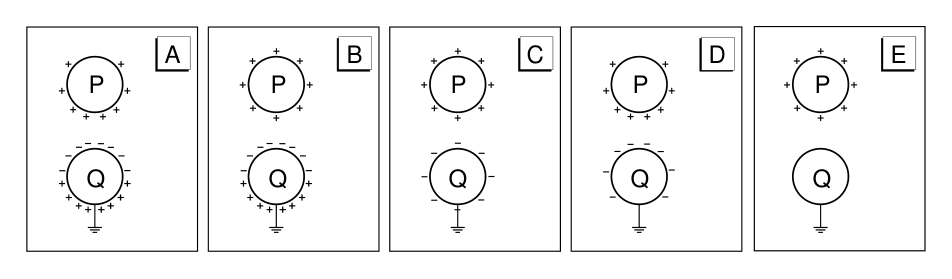 Cinque disegni A–E della distribuzione finale di carica sulle sfere P e Q.
Topic: Electrostatics Metodi: Gauss’s Law, Symmetry Argument Competenze: Physical Reasoning, Diagrammatic Reasoning Objects: Conducting Sphere, Wire Fonte: Testo (PDF) — p.5 Risposta: D · Soluzioni (PDF)
Q33. An isolated conducting sphere, P, has the distribution of electric charge shown in the figure. A sphere Q, similar to the first and connected to ground with a long wire, is brought near sphere P. Which of the following drawings best represents the final distribution of charge on the two spheres?
Initial charge distribution on the isolated conducting sphere P.
Five drawings A–E of the final charge distribution on spheres P and Q.
Answer: D · Soluzioni (PDF)
Q34. L’energia interna di una quantità fissata (cioè a massa costante) di un dato gas perfetto dipende… A) dalla pressione, ma non dal volume o dalla temperatura; B) dalla temperatura, ma non dalla pressione o dal volume; C) dal volume, ma non dalla pressione o dalla temperatura; D) dalla pressione e dalla temperatura, ma non dal volume; E) dal volume e dalla temperatura, ma non dalla pressione.
Topic: Thermodynamics Metodi: Ideal Gas Law, Kinetic Theory of Gases Competenze: Physical Reasoning Objects: Gas Fonte: Testo (PDF) — p.3 Risposta: E · Soluzioni (PDF)
Q34. The internal energy of a fixed quantity (that is, at constant mass) of a given perfect gas depends… A) on the pressure, but not on the volume or the temperature; B) on the temperature, but not on the pressure or the volume; C) on the volume, but not on the pressure or the temperature; D) on the pressure and the temperature, but not on the volume; E) on the volume and the temperature, but not on the pressure.
Answer: E · Soluzioni (PDF)
Q35. Se è la quantità di moto di un corpo di massa , l’espressione ha le dimensioni fisiche di… A) un’accelerazione; B) un’energia; C) una forza; D) una potenza; E) una velocità.
Topic: Newtonian Mechanics Metodi: Dimensional Analysis Competenze: Physical Reasoning Objects: — Fonte: Testo (PDF) — p.3 Risposta: B · Soluzioni (PDF)
Q35. If is the momentum of a body of mass , the expression has the physical dimensions of… A) an acceleration; B) an energy; C) a force; D) a power; E) a velocity.
Answer: B · Soluzioni (PDF)
Q36. Il diagramma mostra il braccio di una gru. Sul braccio agiscono solo tre forze: la tensione esercitata dal cavo di sostegno, il peso del braccio e la forza (non mostrata) agente nel punto X. Il braccio della gru è in equilibrio. Qual è, tra i seguenti, il triangolo delle forze corretto?
Braccio della gru con la tensione , il peso e il punto X.
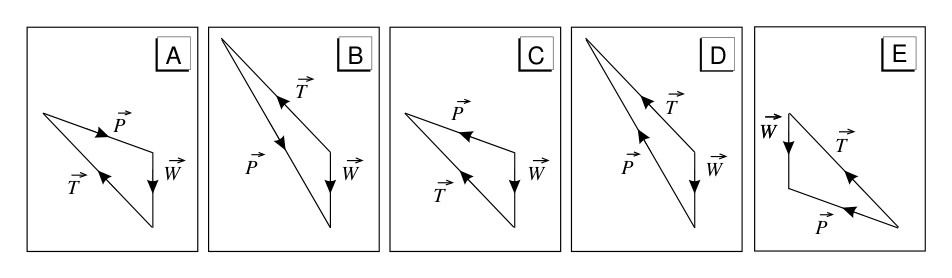 Cinque triangoli delle forze A–E con , e .
Topic: Rigid Body Statics Metodi: Free-Body Diagram, Torque & Angular Momentum Analysis Competenze: Diagrammatic Reasoning Objects: Beam, String Fonte: Testo (PDF) — p.4 Risposta: A · Soluzioni (PDF)
Q36. The diagram shows the arm of a crane. Only three forces act on the arm: the tension exerted by the supporting cable, the weight of the arm and the force (not shown) acting at point X. The crane arm is in equilibrium. Which of the following is the correct force triangle?
Crane arm with the tension , the weight and point X.
Five force triangles A–E with , and .
Answer: A · Soluzioni (PDF)
Q37. Il disegno rappresenta due recipienti di vetro collegati insieme. Il volume del recipiente X è doppio rispetto a quello del recipiente Y. Il sistema è riempito con un gas perfetto e mantenuto in uno stato stazionario con i recipienti rispettivamente a e . Nel recipiente X ci sono moli di gas. Quante moli di gas ci sono nel recipiente Y? A) ; B) ; C) ; D) ; E) .
Due recipienti collegati: X a (volume doppio) e Y a .
Topic: Thermodynamics Metodi: Ideal Gas Law Competenze: Physical Reasoning Objects: Container, Gas Fonte: Testo (PDF) — p.3 Risposta: A · Soluzioni (PDF)
Q37. The drawing shows two glass containers connected together. The volume of container X is twice that of container Y. The system is filled with a perfect gas and maintained in a steady state with the containers at and respectively. In container X there are moles of gas. How many moles of gas are there in container Y? A) ; B) ; C) ; D) ; E) .
Two connected containers: X at (double volume) and Y at .
Answer: A · Soluzioni (PDF)
Q38. Un cannone di massa , montato su ruote, spara orizzontalmente un proiettile di massa con una velocità di . La velocità di rinculo del cannone, subito dopo lo sparo, è… A) 0; B) verso est; C) verso ovest; D) verso est; E) verso ovest. (il proiettile è sparato verso est).
Topic: Conservation of Momentum Metodi: Conservation of Momentum Competenze: Physical Reasoning Objects: Projectile, Wheel Fonte: Testo (PDF) — p.4 Risposta: C · Soluzioni (PDF)
Q38. A cannon of mass , mounted on wheels, fires horizontally a projectile of mass with a speed of . The recoil speed of the cannon, immediately after firing, is… A) 0; B) toward the east; C) toward the west; D) toward the east; E) toward the west. (the projectile is fired toward the east).
Answer: C · Soluzioni (PDF)
Q39. Microonde di lunghezza d’onda passano attraverso due strette fessure e di una barriera di alluminio. Il punto P, molto lontano dalla barriera, dista in più da una fessura rispetto all’altra (differenza di cammino ). Quale o quali delle seguenti affermazioni sulla radiazione che arriva in P da sono corrette? 1 — Arriva in fase con la radiazione proveniente da ; 2 — Si combina costruttivamente con la radiazione proveniente da ; 3 — Ha percorso un cammino di lunghezze di sei lunghezze d’onda in più rispetto alla radiazione proveniente da . A) Tutte e tre; B) Solo la 1 e la 2; C) Solo la 2 e la 3; D) Solo la 1; E) Solo la 3.
Barriera con le fessure e ; differenza di cammino verso il punto P.
Topic: Wave Optics Metodi: Interference & Diffraction Analysis Competenze: Physical Reasoning Objects: Slit Fonte: Testo (PDF) — p.3 Risposta: A · Soluzioni (PDF)
Q39. Microwaves of wavelength pass through two narrow slits and in an aluminum barrier. Point P, very far from the barrier, is farther from one slit than from the other (path difference ). Which or which of the following statements about the radiation arriving at P from are correct? 1 — It arrives in phase with the radiation coming from ; 2 — It combines constructively with the radiation coming from ; 3 — It has traveled a path six wavelengths longer than the radiation coming from . A) All three; B) Only 1 and 2; C) Only 2 and 3; D) Only 1; E) Only 3.
Barrier with slits and ; path difference toward point P.
Answer: A · Soluzioni (PDF)
Q40. Ioni di isotopi diversi, carichi in modo diverso, vengono tutti accelerati dallo stesso campo elettrico uniforme. Quale, tra gli ioni indicati qui sotto, subisce l’accelerazione maggiore? A) ; B) ; C) ; D) ; E) .
Topic: Electrostatics Metodi: Lorentz Force Analysis, Dimensional Analysis Competenze: Physical Reasoning Objects: Nucleus Fonte: Testo (PDF) — p.3 Risposta: C · Soluzioni (PDF)
Q40. Ions of different isotopes, charged differently, are all accelerated by the same uniform electric field. Which, among the ions listed below, undergoes the greatest acceleration? A) ; B) ; C) ; D) ; E) .
Answer: C · Soluzioni (PDF)