- Determinare le dimensioni della sorgente di luce, b e c, e l’altezza h dello schermo.
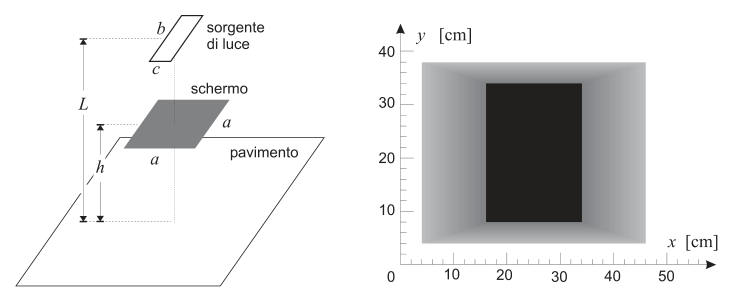 sorgente rettangolare e ombra sul pavimento
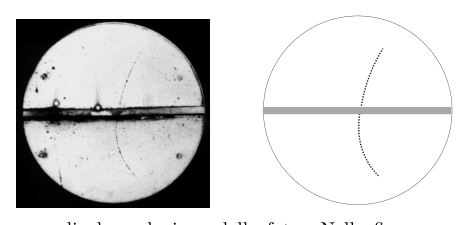
p.4 — traccia positrone in camera a nebbia
Topic: Geometric Optics Metodi: Ray Tracing, Physical Modeling Competenze: Diagrammatic Reasoning, Physical Reasoning Objects: Screen Fonte: Testo (PDF) — p.6 Soluzione: Soluzioni
- Determine the dimensions of the light source, b and c, and the screen height h.
rectangular source and shade on the floor
The following table shows the results of the test:
Topic: Geometric Optics Metodi: Ray Tracing, Physical Modeling Competenze: Diagrammatic Reasoning, Physical Reasoning Objects: Screen Fonte: Testo (PDF) — p.6 Soluzione: Soluzioni
- Specificare l’orientazione della lampada chiarendo se il suo lato lungo (b) è parallelo all’asse x o a quello y della figura a destra. 2 – Riscaldatore elettrico [Punti 10] Un riscaldatore elettrico di acqua è formato da due cilindri coassiali metallici di lunghezza L. Il raggio del cilindro interno vale r e s è la distanza tra i due cilindri, con . I due cilindri sono collegati ad un generatore che fornisce una bassa tensione . L’acqua scorre tra i due cilindri parallelamente al loro asse con velocità v e viene riscaldata dalla corrente elettrica che la attraversa.
- Specificare, motivando, se la corrente elettrica scorre: (a) parallelamente all’asse dei cilindri; (b) attorno al cilindro interno, descrivendo circonferenze perpendicolari all’asse; (c) perpendicolarmente all’asse dei cilindri, in direzione radiale. Si indichi con la densità dell’acqua, con la sua resistività e con c il suo calore specifico. Si trascurino la capacità termica dei due cilindri e il trasferimento di calore all’ambiente. Si consideri un sottile tratto d’acqua di larghezza . In funzione dei parametri forniti, si calcoli:
- La sua resistenza elettrica.
Topic: Circuits, Electrostatics Metodi: Physical Modeling, Dimensional Analysis, Free-Body Diagram Competenze: Physical Reasoning, Mathematical Modeling Objects: Cylinder, Battery Fonte: Testo (PDF) — p.6 Soluzione: Soluzioni
- Specify the orientation of the lamp by clarifying whether its long side (b) is parallel to the x-axis or to the y-axis The figure on the right. 2 Electric heater The Commission shall adopt implementing acts in accordance with Article 21 of this Regulation. An electric water heater is made up of two metal co-axial cylinders of length L. The radius of the The internal cylinder value r and s is the distance between the two cylinders, with . The two cylinders are connected to a a generator providing a low voltage . Water flows between the two cylinders parallel to their axis with V and is heated by the electric current passing through it.
- Specify, by reasoning, whether the electric current flows: (a) parallel to the axis of the cylinders; (b) around the internal cylinder, describing perpendicular circumferences to the axis; (c) perpendicular to the axis of the cylinders, In the radial direction. Indicate the density of the water with , its resistivity with and its specific heat with c. They should ignore the The thermal capacity of the two cylinders and the transfer of heat to the environment. It is considered a thin stretch of water of width. The following shall be calculated according to the parameters provided:
- Its electrical resistance.
Topic: Circuits, Electrostatics Metodi: Physical Modeling, Dimensional Analysis, Free-Body Diagram Competenze: Physical Reasoning, Mathematical Modeling Objects: Cylinder, Battery Fonte: Testo (PDF) — p.6 Soluzione: Soluzioni
- La quantità di calore che assorbe nel passaggio attraverso l’intercapedine tra i cilindri.
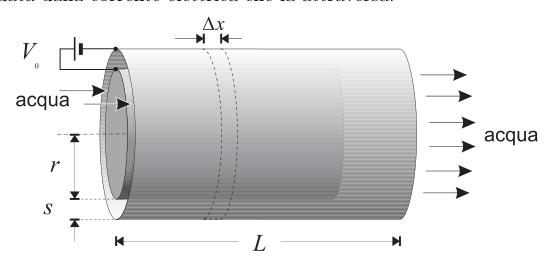 cilindri coassiali riscaldatore elettrico
Topic: Circuits, Thermodynamics Metodi: First Law of Thermodynamics, Kirchhoff’s Laws Competenze: Mathematical Modeling, Physical Reasoning Objects: Cylinder Fonte: Testo (PDF) — p.6 Soluzione: Soluzioni
- The amount of heat absorbed in the passage through the intercaepedine between the cylinders.
The following table shows the manufacturer’s technical specifications for the manufacturer’s products:
Topic: Circuits, Thermodynamics Metodi: First Law of Thermodynamics, Kirchhoff’s Laws Competenze: Mathematical Modeling, Physical Reasoning Objects: Cylinder Fonte: Testo (PDF) — p.6 Soluzione: Soluzioni
- La variazione di temperatura che subisce. 3 – Tappeto elastico [Punti 20] Valeria è una ragazzina che sta saltando sul tappeto elastico al parco giochi. Fa inizialmente alcuni semplici rimbalzi in verticale aumentando ad ogni rimbalzo l’altezza massima raggiunta. Per studiarne il moto consideriamo il suo centro di massa (CdM) C. Fissiamo un sistema di riferimento con l’origine nel punto in cui si trova C all’istante del distacco dal tappeto elastico e l’asse y verticale e orientato verso l’alto.
Topic: Thermodynamics, Circuits Metodi: First Law of Thermodynamics, Kirchhoff’s Laws Competenze: Mathematical Modeling, Physical Reasoning Objects: Membrane Fonte: Testo (PDF) — p.6 Soluzione: Soluzioni
- The temperature change that you experience. 3 Rubber rug The Commission shall adopt implementing acts in accordance with Article 21 of Regulation (EC) No 1272/2009. Valeria is a little girl jumping on the rubber rug at the playground. It starts with a few simple things. vertical bounces increasing the maximum height at each bounce. To study its motion, consider its center of mass (CdM) C. We should set up a reference system with the origin at the point where C is located, distant from the detachment from the rubber carpet and the vertical and oriented axis Up the hill.
Topic: Thermodynamics, Circuits Metodi: First Law of Thermodynamics, Kirchhoff’s Laws Competenze: Mathematical Modeling, Physical Reasoning Objects: Membrane Fonte: Testo (PDF) — p.6 Soluzione: Soluzioni
- Esprimere il tempo di volo (tra un rimbalzo e l’altro) e la velocità al momento del distacco dal tappeto in funzione dell’altezza h raggiunta, ovvero la variazione di quota del CdM. Calcolare i valori numerici di e per . Nei suoi salti, Valeria si mantiene dritta verticalmente, e tiene le braccia tese verso l’alto. Molto grossolanamente, possiamo assimilarla ad un’asta rigida e uniforme di lunghezza e massa m, come mostrato in figura (a). A un certo punto, quando giudica di aver raggiunto un’altezza massima sufficiente, Valeria vorrebbe fare una capriola (salto mortale) in aria, ma si rende conto che se resta rigida ciò non è possibile.
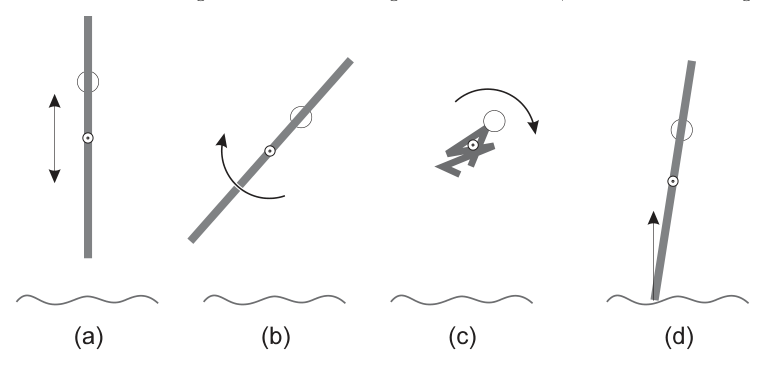 ragazzina su tappeto elastico con angolo
Topic: Newtonian Mechanics Metodi: Kinematic Equations, Free-Body Diagram Competenze: Mathematical Modeling, Physical Reasoning Objects: Rod, Membrane Fonte: Testo (PDF) — p.7 Soluzione: Soluzioni
- Express the flight time (between one bounce and the other) and the speed at the time of detachment from the carpet The maximum height of the MQC is h. Calculate the numerical values of and for . In her jumps, Valeria stands upright vertically, holding her arms outstretched upwards. Very coarsenely, We can assimilate it to a rigid and uniform strip of length and mass m, as shown in Figure (a). At some point, when she thinks she has reached a sufficient maximum height, Valeria would like to make a Capriola (death leap) in the air, but he realizes that if he stays rigid that’s not possible.
*girl on rubber rug with corner *
Topic: Newtonian Mechanics Metodi: Kinematic Equations, Free-Body Diagram Competenze: Mathematical Modeling, Physical Reasoning Objects: Rod, Membrane Fonte: Testo (PDF) — p.7 Soluzione: Soluzioni
- Perché? Valeria allora fa in modo di ruotare (più avanti vedremo come), subito dopo un rimbalzo, attorno ad un asse orizzontale passante per il suo CdM, come mostrato in figura (b). Sia la sua velocità angolare. Valeria si rende però presto conto che sta ruotando troppo lentamente e non riuscirà a completare la capriola. Allora si rannicchia di scatto, come mostrato in figura (c) e in questo modo riesce a ridurre il proprio momento d’inerzia I di un fattore 4. La sua velocità angolare diventa .
Topic: Rotational Dynamics Metodi: Torque & Angular Momentum Analysis, Physical Modeling Competenze: Physical Reasoning, Diagrammatic Reasoning Objects: Rod Fonte: Testo (PDF) — p.7 Soluzione: Soluzioni
- Why? Why? Valeria then makes sure to rotate (later we’ll see how), right after a bounce, around an axis horizontal passing through its CdM, as shown in Figure (b). Let be its angular velocity. Valeria soon realizes, however, that she is spinning too slowly and will not be able to complete the capriola. Then it snaps, as shown in Figure (c) and thus manages to reduce its momentum The value of the input data is the value of the input data. Its angular velocity becomes .
Topic: Rotational Dynamics Metodi: Torque & Angular Momentum Analysis, Physical Modeling Competenze: Physical Reasoning, Diagrammatic Reasoning Objects: Rod Fonte: Testo (PDF) — p.7 Soluzione: Soluzioni
- Trovare la relazione tra e . Dopo aver compiuto buona parte della rotazione, Valeria si distende di nuovo. È davvero brava, perché riesce a farlo nel momento esatto che le consente di completare la rotazione e atterrare sul tappeto in posizione verticale. Durante il suo salto, ha trascorso metà tempo in posizione rannicchiata.
Topic: Rotational Dynamics Metodi: Torque & Angular Momentum Analysis, Conservation Laws Competenze: Mathematical Modeling, Physical Reasoning Objects: Rod Fonte: Testo (PDF) — p.7 Soluzione: Soluzioni
- Find the relationship between and . After completing much of the rotation, Valeria rests again. She’s really good, because she can Do it at the exact moment that allows you to complete the rotation and land on the carpet in a vertical position. During his jump, he spent half the time in a rancid position.
Topic: Rotational Dynamics Metodi: Torque & Angular Momentum Analysis, Conservation Laws Competenze: Mathematical Modeling, Physical Reasoning Objects: Rod Fonte: Testo (PDF) — p.7 Soluzione: Soluzioni
- Ricordando che il tempo di volo è , trovare la velocità angolare in funzione dell’altezza massima h e calcolare il valore numerico di per . Come abbiamo detto sopra, per fare la capriola Valeria fa in modo di avere una velocità angolare già all’inizio del suo salto. Per ottenere questo, alla fine del salto precedente arriva sul tappeto con un piccolo angolo rispetto alla verticale, perché in questo modo la spinta verticale che riceve dal tappeto le imprime un momento angolare rispetto al CdM, come mostrato in figura (d). Si supponga che il modulo della velocità con cui Valeria arriva sul tappeto, e con cui ne riparte, sia in entrambi i casi , e che prima dell’urto sia . Si tratti l’urto col tappeto come istantaneo. Si ricordi che il momento d’inerzia I di un’asta rigida e uniforme rispetto ad un asse perpendicolare all’asta e passante per il suo centro vale .
Topic: Rotational Dynamics, Conservation of Momentum Metodi: Torque & Angular Momentum Analysis, Conservation Laws, Impulse-Momentum Theorem Competenze: Mathematical Modeling, Physical Reasoning Objects: Rod, Membrane Fonte: Testo (PDF) — p.7 Soluzione: Soluzioni
- If the flight time is , find the angular velocity according to the maximum height h and calculate the numerical value of for . As we said above, to make the capriola Valeria makes sure to have an angular velocity already at the beginning of his jump. To get this, at the end of the previous jump you get on the carpet with a small angle And the vertical push that you get from the carpet is going to be a momentary impression. angular to the CdM, as shown in Figure (d). Suppose that the speed at which Valeria arrives on the carpet and leaves is in both cases , and that before impact it is . Treat the carpet as an instantaneous. Remember that The moment of inertia I of a rigid and uniform axis relative to a perpendicular axis of the axis and passing through the axis its centre is .
Topic: Rotational Dynamics, Conservation of Momentum Metodi: Torque & Angular Momentum Analysis, Conservation Laws, Impulse-Momentum Theorem Competenze: Mathematical Modeling, Physical Reasoning Objects: Rod, Membrane Fonte: Testo (PDF) — p.7 Soluzione: Soluzioni
- Ricavare in funzione di e di h. Si trascuri la piccola inclinazione che la ragazzina ha in partenza e si consideri ancora una rotazione di ; posto che sia ancora e che sia , calcolare il valore numerico di . 4 – Radiazione termica [Punti 20] Il termine radiazione termica viene usato per quelle onde elettromagnetiche il cui spettro è continuo e dipende soprattutto dalla temperatura del corpo che le emette, a differenza di quel che avviene per altri tipi di onde elettromagnetiche, come le onde radio o quelle del telefono cellulare, che sono caratterizzate da frequenze discrete e ben definite, riconducibili alle caratteristiche dei dispositivi che le emettono. Una grandezza utile per caratterizzare la radiazione termica emessa da un corpo è l’intensità della radiazione(∗). Detta la quantità di energia emessa da una piccola porzione della superficie del corpo di area , in un piccolo intervallo di tempo , l’intensità I è il rapporto . La sua unità di misura nel SI è quindi quella di una potenza per unità di superficie: . Per caratterizzare in dettaglio i fenomeni di emissione della radiazione la grandezza più utile è l’intensità spettrale, , intesa come il rapporto tra l’intensità della radiazione compresa in un piccolo intervallo di lunghezza d’onda (centrato su un particolare valore di ) e l’ampiezza dell’intervallo stesso: ; ovviamente, è funzione della lunghezza d’onda. In generale, l’intensità spettrale della radiazione termica emessa da un corpo dipende dalle proprietà del corpo, oltre che dalla sua temperatura, tuttavia in certi casi essa ha un andamento prossimo a quello di una funzione universale, che si calcola teoricamente sulla base della sola temperatura del corpo ed è appunto indipendente dalle sue proprietà: tale funzione è chiamata spettro di corpo nero. ATTENZIONE: In un foglio a parte vengono forniti i grafici dell’intensità spettrale di corpo nero a due diverse temperature e .
Topic: Rotational Dynamics, Conservation of Momentum Metodi: Torque & Angular Momentum Analysis, Impulse-Momentum Theorem, Conservation Laws Competenze: Mathematical Modeling, Physical Reasoning, Diagrammatic Reasoning Objects: Rod Fonte: Testo (PDF) — p.7 Soluzione: Soluzioni
- Find by and h. Si trascuri la piccola inclinazione che la ragazzina ha in partenza e si Consider a spin of again; where is still , calculate the value The number of . 4 Thermal radiation The Commission shall adopt implementing acts in accordance with Article 21 of Regulation (EC) No 1272/2009. The term thermal radiation is used for those electromagnetic waves whose spectrum is continuous and depends on The body temperature that emits them, unlike other types of waves. Electromagnetic waves, such as radio waves or cell phone waves, which are characterized by discrete frequencies and well defined, due to the characteristics of the devices that emit them. A useful quantity for characterizing the thermal radiation emitted by a body is the radiation intensity (). This is the amount of energy emitted by a small portion of the surface of the body of area , In a small time interval , the intensity I is the ratio . Its SI unit of measurement is The following is the power per unit area: . For the detailed characterization of radiation emission phenomena the most useful size is the intensity The spectral range is defined as the ratio of the radiation intensity within a small range of wavelength (centered on a particular value of ) and range width: ; Of course, is a function of the wavelength. In general, the spectral intensity of thermal radiation emitted by a body depends on the properties of the body, In addition to its temperature, however, in some cases it has a tendency close to that of a function The universe is theoretically calculated on the basis of body temperature alone and is independent of the This function is called the black body spectrum. ATTENTION: In a separate sheet, black body spectral intensity graphs are provided for two different temperature e .
Topic: Rotational Dynamics, Conservation of Momentum Metodi: Torque & Angular Momentum Analysis, Impulse-Momentum Theorem, Conservation Laws Competenze: Mathematical Modeling, Physical Reasoning, Diagrammatic Reasoning Objects: Rod Fonte: Testo (PDF) — p.7 Soluzione: Soluzioni
- Utilizzando questi due grafici determinare il rapporto tra le intensità spettrali delle radiazioni emesse, alla lunghezza d’onda di , da due corpi alle temperature e . Una legge importante legata allo spettro di corpo nero fu derivata nel 1893 da Wilhelm Wien: egli dimostrò che, per un corpo nero, la lunghezza d’onda alla quale corrisponde il massimo dell’intensità spettrale è legata alla temperatura T dalla relazione , dove n è un numero intero e b è una costante universale, chiamata appunto costante di Wien.
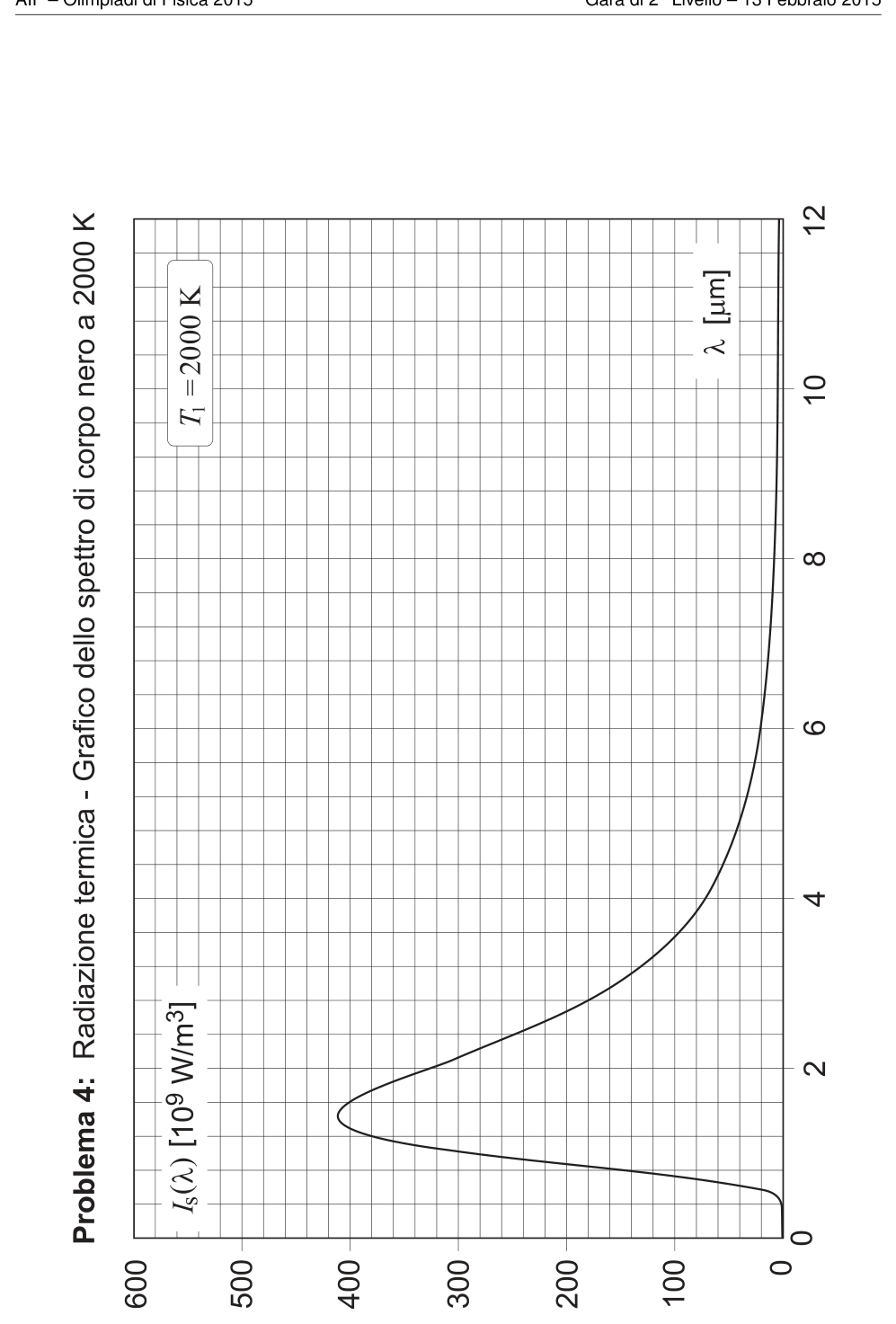 spettro corpo nero T1=2000 K
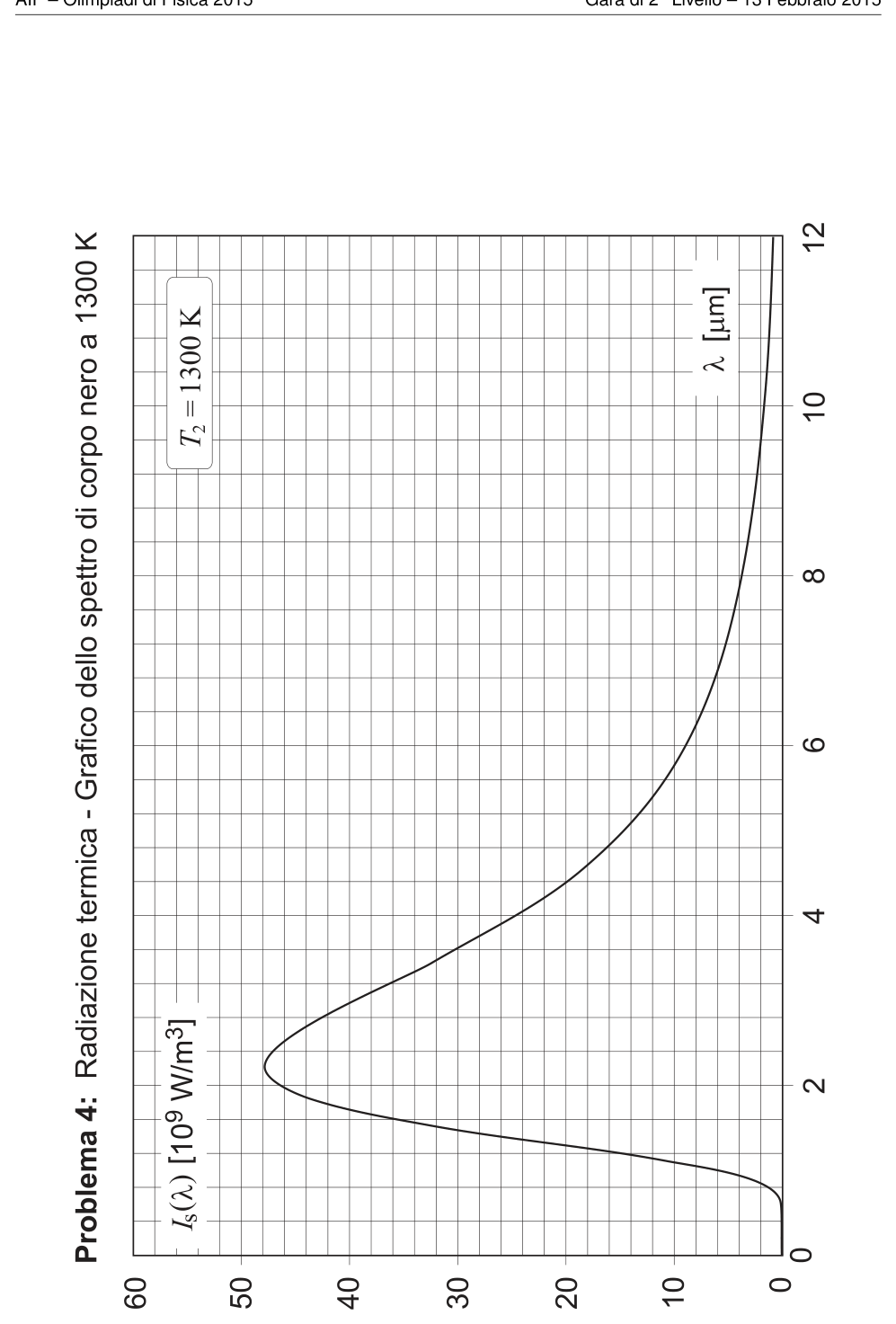 spettro corpo nero T2=1300 K
Topic: Thermodynamics, Modern-Quantum Physics Metodi: Experimental Data Analysis, Physical Modeling Competenze: Experimental Data Analysis, Graph Linearization, Physical Reasoning Objects: — Fonte: Testo (PDF) — p.8 Soluzione: Soluzioni
- Using these two graphs to determine the ratio of the spectral intensities of the radiation emitted, Wavelength of , from two bodies at temperatures and . An important law related to the black-body spectrum was derived in 1893 by Wilhelm Wien: he proved that, For a black body, the wavelength to which the maximum spectral intensity corresponds is bound to the temperature T from the ratio, where n is an integer and b is a universal constant, called The same as the constant of Wien.
The black body spectrum T1=2000 K*
The black body spectrum T2=1300 K
Topic: Thermodynamics, Modern-Quantum Physics Metodi: Experimental Data Analysis, Physical Modeling Competenze: Experimental Data Analysis, Graph Linearization, Physical Reasoning Objects: — Fonte: Testo (PDF) — p.8 Soluzione: Soluzioni
- Determinare i valori di b ed n utilizzando esclusivamente i due grafici forniti. Un’altra legge importante venne derivata, circa nello stesso periodo, da Joseph Stefan e, indipendentemente, da Ludwig Boltzmann: la legge afferma che l’intensità della radiazione emessa da un corpo nero, cioè l’intensità spettrale integrata su tutte le lunghezze d’onda (sommando i contributi di radiazione delle varie lunghezze d’onda), è legata alla temperatura dalla relazione , dove m è un numero intero e è una costante universale, chiamata appunto costante di Stefan-Boltzmann.
Topic: Thermodynamics, Modern-Quantum Physics Metodi: Experimental Data Analysis, Graph Linearization, Approximation & Series Expansion Competenze: Graph Linearization, Experimental Data Analysis, Mathematical Modeling Objects: — Fonte: Testo (PDF) — p.8 Soluzione: Soluzioni
- Determine the values of b and n using only the two charts provided. Another important law was derived, about the same time, from Joseph Stefan and, independently, By Ludwig Boltzmann: the law states that the intensity of radiation emitted by a black body, i.e. the intensity of the radiation emitted by a black body, is the The total radiation input of the various wavelengths is added to the total radiation input of the various wavelengths. d wave), is bound to temperature by the ratio, where m is an integer and is a constant The first is the universal constant, called the Stefan-Boltzmann constant.
Topic: Thermodynamics, Modern-Quantum Physics Metodi: Experimental Data Analysis, Graph Linearization, Approximation & Series Expansion Competenze: Graph Linearization, Experimental Data Analysis, Mathematical Modeling Objects: — Fonte: Testo (PDF) — p.8 Soluzione: Soluzioni
- Determinare il valore di m e dare una stima di quello di attraverso i due grafici forniti, illustrando adeguatamente come si sono utilizzati: misure e calcoli eseguiti. L’intensità spettrale della radiazione emessa dal Sole è approssimabile alla radiazione di corpo nero con .
Topic: Thermodynamics, Modern-Quantum Physics Metodi: Experimental Data Analysis, Graph Linearization, Order-of-Magnitude Estimation Competenze: Experimental Data Analysis, Graph Linearization, Estimation & Approximation Objects: Star Fonte: Testo (PDF) — p.8 Soluzione: Soluzioni
- Determine the value of m and estimate that of using the two graphs provided, by the appropriate use: measurements and calculations carried out. The spectral intensity of radiation emitted by the Sun is approximate to black body radiation with .
Topic: Thermodynamics, Modern-Quantum Physics Metodi: Experimental Data Analysis, Graph Linearization, Order-of-Magnitude Estimation Competenze: Experimental Data Analysis, Graph Linearization, Estimation & Approximation Objects: Star Fonte: Testo (PDF) — p.8 Soluzione: Soluzioni
- Stimare il tempo necessario al Sole per perdere l’1 % della sua massa a causa della radiazione termica. La massa del Sole vale ed il suo raggio è . . (∗) In questo problema useremo il termine “Intensità” come riferito, in senso generico, al valore di una certa grandezza. La grandezza in questione si dovrebbe chiamare propriamente Emettenza radiante (unità nel SI: ), mentre si definisce Intensità radiante il flusso di energia per unità di tempo e di angolo solido in una certa direzione (unità di misura nel SI: W/sr). Analogamente per le grandezze riferite all’unità di lunghezza d’onda nella distribuzione spettrale: Emettenza spettrale radiante (che si misura quindi in ) ed Intensità spettrale radiante (unità: W/(m sr)).
Topic: Astrophysics, Thermodynamics Metodi: Order-of-Magnitude Estimation, Physical Modeling Competenze: Estimation & Approximation, Physical Reasoning, Mathematical Modeling Objects: Star Fonte: Testo (PDF) — p.8 Soluzione: Soluzioni
- Estimate the time it takes for the Sun to lose 1 percent of its mass due to thermal radiation. The mass of the Sun is and its radius is . . (∗) In this problem we will use the term Intensity as a general reference to the value of a certain magnitude. The size in question should be properly called radiant emittance (unit in SI: ), while it is defined as Radiant intensity the flow of energy per unit of time and solid angle in a certain direction (measurement unit in SI: W/sr). Similarly for the quantities per unit wavelength in the spectral distribution: Spectral emission Radiant (which is then measured in ) and Radiant Spectral Intensity (unit: W/(m sr)).
Topic: Astrophysics, Thermodynamics Metodi: Order-of-Magnitude Estimation, Physical Modeling Competenze: Estimation & Approximation, Physical Reasoning, Mathematical Modeling Objects: Star Fonte: Testo (PDF) — p.8 Soluzione: Soluzioni